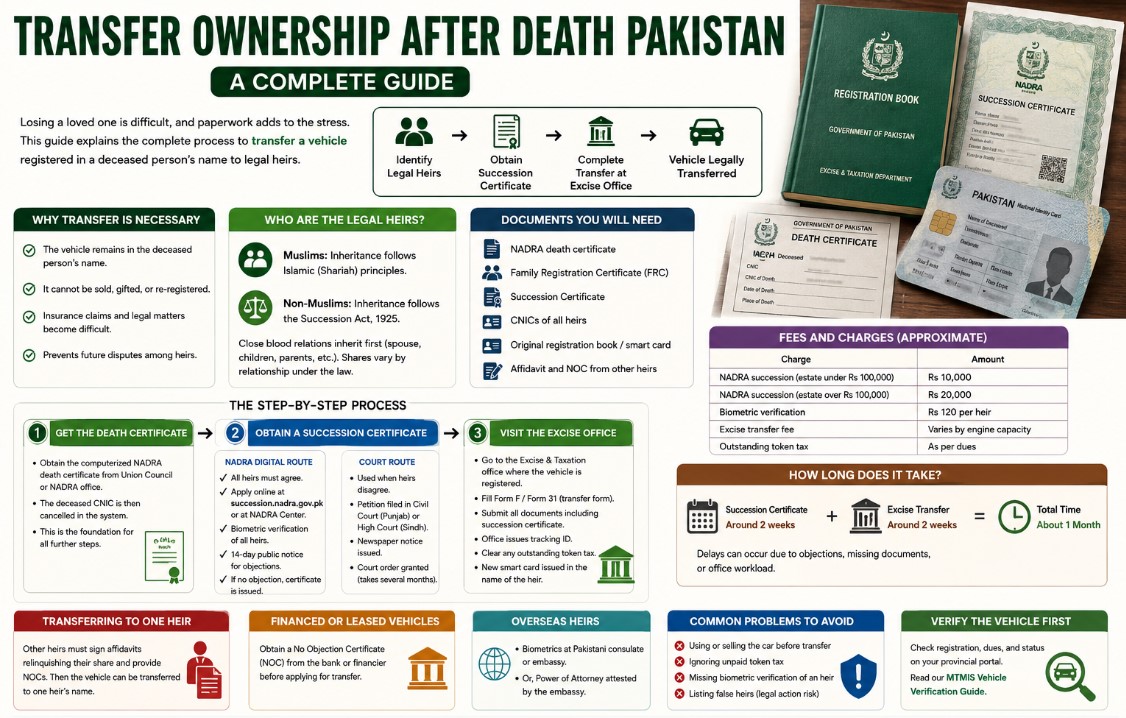
Knowing how to transfer ownership after death Pakistan rules require can ease a hard time. Moreover, the process became far simpler since NADRA started issuing digital succession certificates. In this post, you will learn each step in clear, simple language. Furthermore, this guide covers documents, fees, the Excise process, and the timeline in full detail.
Losing a loved one is painful, and paperwork only adds to the stress. However, transferring their vehicle is a necessary legal step. First, you identify the legal heirs. Next, you obtain a succession certificate. Finally, you complete the transfer at the Excise office. Therefore, this post explains the full journey so nothing feels confusing.
Why Transfer Is Necessary
A vehicle cannot simply pass to family without a legal transfer. Specifically, the registration still shows the deceased person’s name. As a result, the car cannot be legally sold, gifted, or re-registered. So, the transfer protects the rightful heirs and their ownership.
In practice, several problems arise if you delay this step. Firstly, no buyer will purchase a car still registered to a deceased owner. Secondly, insurance and legal claims become harder to settle. Thirdly, traffic or Excise checks may flag the mismatch. Therefore, completing the transfer ownership after death Pakistan process keeps everything clean and legal.
This step also prevents future family disputes. For example, a clear transfer records each heir’s share. Moreover, it stops outside parties from making false claims. Consequently, handling it early gives the whole family peace of mind. Indeed, a proper transfer is both a legal and a practical safeguard.
Who Are the Legal Heirs
Legal heirs are the people entitled to inherit under the law. For Muslims, inheritance follows Islamic (Shariah) principles. Meanwhile, non-Muslims follow the Succession Act, 1925. So, the rightful shares depend on each heir’s relationship to the deceased.
Generally, close blood relations inherit first. For instance, the spouse, children, and parents are common heirs. However, exact shares differ by relationship and family structure. Therefore, the law assigns fixed portions to each eligible heir. Above all, every legal heir must be named honestly in the documents.
To prove these relationships, NADRA issues a Family Registration Certificate (FRC). This certificate lists the deceased’s complete lineage. Moreover, it forms the base for the succession certificate. So, a fresh FRC is one of the first documents you should request.
Documents You Will Need
Correct documents are the heart of a smooth transfer. Missing papers, on the other hand, cause long delays. So, gather the full set before you begin. Below are the core documents required.
Document
Purpose
NADRA death certificate
Confirms the owner’s death
Family Registration Certificate (FRC)
Lists all legal heirs
Succession Certificate
Authorizes the heirs to claim assets
CNICs of all heirs
Verifies each heir’s identity
Original registration book/smart card
Proves vehicle ownership
Affidavit and NOC from other heirs
Allows transfer to one heir
Additionally, financed vehicles need extra papers. For example, a No Objection Certificate (NOC) from the bank is required. Therefore, check your exact case before visiting any office. In every case, keep originals plus one photocopy of each document.
Step 1: Get the Death Certificate
The death certificate is the first official document you need. Specifically, you must obtain a computerized NADRA death certificate. This is issued through your local Union Council or NADRA office. So, register the death there before anything else.
To apply, you provide the deceased’s CNIC and basic details. Moreover, the deceased person’s CNIC is then cancelled in the system. After processing, NADRA issues the official computerized certificate. Therefore, this document becomes the foundation for every later step. You can find guidance on the official portal at nadra.gov.pk.
Step 2: Obtain a Succession Certificate
A succession certificate legally confirms the heirs of the deceased. Importantly, it authorizes them to claim and transfer movable assets. A vehicle counts as movable property under this system. So, this certificate is central to the whole transfer.
There are two main routes to get it. Firstly, the fast NADRA digital route suits undisputed cases. Secondly, the court route handles disputes or special situations. Below, both are explained clearly.
NADRA Digital Succession Route
NADRA now issues digital succession certificates for movable property. This route is fast, secure, and far easier than court. To use it, all heirs must fully agree on the distribution. So, family consensus is the key requirement here.
The process moves through clear phases. First, one heir applies at a NADRA Succession Facilitation Center or online at succession.nadra.gov.pk. Next, all legal heirs complete biometric verification. Then, NADRA publishes a 14-day public notice for objections. After that, if no objection arrives, the certificate is cleared. Finally, NADRA prints a secure certificate with a QR code.
However, one rule is strict in this route. If any heir disputes the claim, NADRA stops the process. In that case, the family must approach a civil court instead. Therefore, full agreement among heirs keeps this route smooth and quick.
Court Route (If Disputed)
The court route applies when heirs disagree or complications exist. Specifically, a legal heir files a petition in the relevant court. In Punjab, this is usually a civil court. Meanwhile, in Sindh, the High Court often handles such cases.
This route involves more steps and time. To begin, a lawyer files the petition with affidavits. Moreover, the court issues a newspaper notice inviting objections. After hearing evidence, the court issues its order. However, this process can take several months. Therefore, the NADRA route is preferred whenever the family agrees.
Step 3: Visit the Excise Office
Once you hold the succession certificate, the Excise step begins. Specifically, you visit the Excise and Taxation office where the vehicle is registered. There, you start the formal transfer of ownership. So, this is the stage where the car finally changes hands.
The process at the office follows a clear order. First, fill out the transfer form, often Form F or Form 31. Next, submit it with the succession certificate and other documents. Then, the office issues a tracking ID for your request. Meanwhile, you can track progress online on the Excise website. Finally, the new owner receives a fresh smart card.
Importantly, all heirs’ consent must be on record at this stage. Moreover, any outstanding token tax must be cleared first. Therefore, settle all dues before submitting the file. Indeed, a clean tax record speeds up the transfer ownership after death Pakistan process.
Fees and Charges
Several charges apply across this process. Each one is modest, but they add up. So, budget for them from the start. Below is a clear breakdown.
Charge
Approximate Amount
NADRA succession (estate under Rs 100,000)
Rs 10,000
NADRA succession (estate over Rs 100,000)
Rs 20,000
Biometric verification
Rs 120 per heir
Excise transfer fee
Varies by engine capacity
Outstanding token tax
As per dues
As the table shows, the succession certificate is the largest single cost. However, it is far cheaper than years of court fees. Moreover, the Excise transfer fee depends on your vehicle’s engine size. Therefore, confirm the exact amount with your provincial Excise office.
How Long the Process Takes
Timing depends on agreement, documents, and office workload. Generally, the NADRA route is much faster than court. The succession certificate itself can take around two weeks. Meanwhile, the Excise transfer may take another two weeks.
So, the full process often completes within about one month. However, delays can occur in several ways. For example, a missing biometric verification halts the certificate. Likewise, any objection during the 14-day notice stops progress. Therefore, prepared and agreed heirs finish the fastest. Ultimately, good preparation saves both time and stress.
Transferring to One Heir
Sometimes the family wants the car in one heir’s name. In such cases, the other heirs must formally agree. Specifically, they sign affidavits relinquishing their share. Moreover, a No Objection Certificate from each heir is needed.
These documents must be clear and properly attested. For example, each affidavit confirms the heir’s consent. Additionally, the applicant submits all of them to the Excise office. Therefore, the transfer can then proceed to a single name. However, all heirs must still appear truthfully in the records. So, honesty among the family keeps the transfer valid and dispute-free.
Financed or Leased Vehicles
Financed vehicles need an extra step before transfer. Specifically, the bank or lender still holds an interest in the car. Therefore, you must obtain a No Objection Certificate from them. Without it, the Excise office will not process the change.
To get this NOC, contact the financing bank first. Moreover, settle or transfer any remaining loan as required. After clearance, the bank issues the NOC and endorses the forms. Consequently, the transfer can then move forward normally. So, always check the loan status before starting the process.
Overseas Heirs
Overseas heirs can still take part in the process. However, they cannot always travel back for biometrics. Therefore, two options exist for heirs living abroad. Firstly, they can complete biometrics at a Pakistani mission or consulate. Secondly, they can issue a Power of Attorney attested by the embassy.
This flexibility keeps the process moving despite distance. For example, a consulate handles biometric verification for the certificate. Moreover, the attested Power of Attorney lets a local heir act for them. So, overseas family members are never left out. Indeed, NADRA’s system was built to include heirs worldwide.
Common Problems to Avoid
Many families face avoidable setbacks during transfer. Firstly, some use or sell the car before the legal transfer. Secondly, others ignore unpaid token tax and face rejection. Thirdly, a few miss biometric verification for one heir.
To stay safe, plan every step in advance. Moreover, ensure all heirs agree before applying through NADRA. Likewise, clear all vehicle dues before visiting the Excise office. Additionally, never list false heirs, since this invites legal action. Therefore, honesty and preparation prevent most problems. In short, careful handling keeps the transfer smooth and final.
Verify the Vehicle First
Verifying the vehicle record is a smart first move. In fact, it confirms the registration, dues, and ownership status. Moreover, it reveals any pending token tax or block on the car. So, you avoid surprises during the transfer.
To check the record, use your provincial verification system. Our MTMIS vehicle verification guide explains this process simply. After verifying, you know exactly what needs clearing. Therefore, this quick step makes the whole transfer easier. Indeed, a verified record protects every heir involved.
Communities and Help
Support is widely available during this difficult task. For example, inheritance lawyers can guide complex or disputed cases. Similarly, NADRA Succession Facilitation Centers assist with the certificate directly. Moreover, helpdesks at Excise offices answer transfer questions.
Beyond official help, online communities share useful experiences. Specifically, forums like PakWheels discuss real transfer cases often. Likewise, Facebook groups for car owners offer step-by-step tips. So, you can learn from others who finished the same process. Indeed, shared advice can save you days of confusion.
These communities also track rule changes over time. For instance, members posted quickly about the NADRA digital system launch. Therefore, joining one or two groups keeps you informed. Ultimately, the right help turns a hard task into a manageable one.
After the Transfer
Completing the transfer is not always the final step. Once the car is in your name, a few duties follow. For instance, you should keep your registration record fully updated. Our car registration Pakistan guide explains these basics clearly.
Beyond registration, some vehicles need further checks. For commercial vehicles, a fitness certificate is also required. You can read the full steps in our vehicle fitness certificate Pakistan guide. Therefore, these linked tasks complete your legal ownership. So, finishing them keeps the vehicle fully road-ready.
Frequently Asked Questions
How do I start the transfer ownership after death Pakistan process?
First, obtain the deceased owner’s computerized NADRA death certificate. Next, get a Family Registration Certificate and a succession certificate. Then, visit the Excise office where the vehicle is registered. Finally, submit the transfer form with all documents.
Do I need a succession certificate to transfer the car?
Yes, a succession certificate is usually required. Specifically, it confirms the legal heirs and authorizes the transfer. Moreover, NADRA now issues digital succession certificates quickly for undisputed cases. For disputes, a civil court issues the certificate instead.
How much does the succession certificate cost?
The NADRA fee depends on the estate’s total value. For estates under Rs 100,000, the fee is Rs 10,000. For estates above that, it is Rs 20,000. Additionally, biometric verification costs Rs 120 per heir.
How long does the whole transfer take?
The full process often completes within about one month. Generally, the succession certificate takes around two weeks. Meanwhile, the Excise transfer takes another two weeks. However, disputes or missing documents can cause longer delays.
Can the car be transferred to just one heir?
Yes, but the other heirs must formally agree. Specifically, they sign affidavits relinquishing their share. Moreover, each provides a No Objection Certificate. Then, the Excise office can transfer the car to one name.
What if an heir lives abroad?
Overseas heirs can still join the process easily. Firstly, they can complete biometrics at a Pakistani consulate. Secondly, they can issue an embassy-attested Power of Attorney. Therefore, distance does not block the transfer.