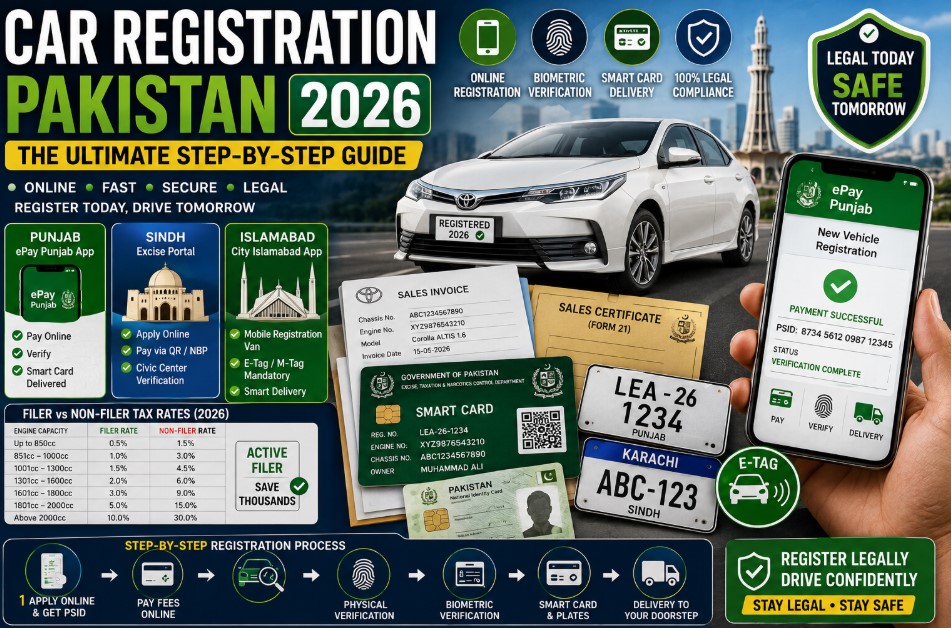
Car registration Pakistan is the mandatory legal process every vehicle owner must complete before driving on public roads in 2026. In May 2026, the Excise, Taxation, and Narcotics Control Departments have fully shifted to cloud-based automation. Consequently, traditional paper registrations are obsolete. This guide provides an extensive, detailed breakdown of how to register your new vehicle seamlessly.
In this post, we will explore the updated systems across Punjab, Sindh, and Islamabad Capital Territory. We will look at the exact fee structures, withholding tax tables, and mandatory biometric systems. Furthermore, this guide provides solutions for handled financing situations and dealership protocols. Whether you are dealing with a local hatchback or a premium vehicle, this car registration Pakistan guide ensures full legal compliance today.
The 2026 Vehicle Registration Landscape in Pakistan
The year 2026 marks a massive digital overhaul for the transport sector in Pakistan. The methods of visiting government offices and paying extra fees to illegal agents are entirely gone. Instead, the centralized network links directly to your identity data.
The Biometric Synchronization Shift
Every province now coordinates directly with the National Database and Registration Authority (NADRA). Consequently, a car cannot be allocated a license plate without biometric verification. This step has successfully minimized vehicle theft across major metropolitan hubs. Moreover, it creates an unalterable digital footprint for every asset.
The Blue Economy and Clean Air Mandates
During early 2026, new environmental parameters were integrated into the registration process. Specifically, vehicles must pass a brief digital emissions evaluation at designated verification points. As a result, the government aims to curb urban smog while building an accurate national data repository.
Punjab Province: Registering via the e-Pay Punjab App
Punjab possesses the most advanced automated system for processing new vehicle entries. The process is remarkably efficient if you use the designated digital platforms correctly.
Step 1: Digital Assessment via the e-Pay Punjab App
First, you must download the e-Pay Punjab app on your smartphone.
Select the “Excise & Taxation” tab from the home screen.
Choose the “New Vehicle Registration” option.
Input the manufacturing chassis number and your valid CNIC.
The system will automatically calculate your total payable dues based on your FBR filer status.
Consequently, a unique 17-digit Payment Slip ID (PSID) will be generated.
Step 2: Completing the Payment
You can pay this PSID through online banking, mobile wallets, or any local ATM. Once the payment is processed, you will receive a secure confirmation SMS. This digital receipt acts as temporary proof of payment while you complete the physical requirements.
Step 3: Physical Inspection at a Khidmat Markaz
Second, you must visit your nearest e-Khidmat Markaz or Excise office. Bring the vehicle along for a mandatory chassis physical tracing. An officer will inspect the engine bay and cross-reference the numbers with the digital database.
Step 4: Smart Card Delivery
Finally, your biometric verification will be recorded on-site. The department will print your secure Smart Card and standard aluminum number plates. These items are delivered straight to your registered residential address via Pakistan Post within seven working days.
Sindh Province: The Modernized Civic Center Process
Sindh has also made major strides toward full digital resource mobilization in 2026. The Excise and Taxation Department in Karachi handles thousands of applications daily through an updated system.
Step 1: Downloading Motor Vehicle Forms
You must access the official Sindh Excise portal. Navigate to the “Downloads” section and select the “Application for New Registration (Full)” document. Print this form and fill in the technical specifications exactly as they appear on your dealer invoice.
Step 2: Visiting the Civic Center or Regional Offices
Bring the completed form along with your vehicle to the designated Excise hub. In Karachi, the primary center is located at the Civic Center.
An inspector will physically check the vehicle’s roadworthiness.
The official will verify your tax filer status directly through the FBR portal.
Subsequently, a banking challan will be issued to you for the base registration fee.
Step 3: Paying at the National Bank
You must deposit the calculated fees at the designated National Bank of Pakistan (NBP) counter inside the office. In 2026, the department also allows direct mobile app payments via a specialized QR code on the challan. Therefore, you can avoid long bank lines by using your smartphone.
Step 4: Collecting the Smart Card
After payment, your biometrics are scanned at the NADRA kiosk inside the facility. Your details are immediately locked into the provincial ledger. The smart card and white alphanumeric number plates are usually prepared within two weeks for collection.
Islamabad Capital Territory (ICT): High-Tech Registration
Islamabad offers the cleanest and fastest vehicle tracking system in the country. The capital administration relies heavily on mobile applications to facilitate citizens.
The City Islamabad App Integration
If you reside in Islamabad, you can download the City Islamabad app. This app allows you to request a “Mobile Registration Van” to come directly to your home or office. A team of officials will arrive with mobile biometric scanners and document verification tools. Consequently, you can register your car without wasting a single hour in traffic.
The 2026 E-Tag and M-Tag Mandates
As of January 2026, a strict new security law has been implemented in the capital. No vehicle is allowed to enter Islamabad without a valid RFID E-Tag pasted on the windshield.
This tag is linked directly to the Safe City surveillance network.
The registration operator will attach the fragile sticker during your initial vehicle inspection.
The standard cost for this sticker is PKR 250.
Furthermore, you must load an initial balance of PKR 300 to 500 to keep the tag active for highway tolls.
💰 The Filer vs. Non-Filer Withholding Tax Matrix (2026)
The single largest cost factor in your car registration Pakistan journey is your tax status with the Federal Board of Revenue (FBR). The government implements heavy financial penalties on non-filers to encourage tax compliance.
Engine Capacity
WHT Rate for Active Filers
WHT Rate for Non-Filers
Legal Implication
Up to 850cc
0.5% of Vehicle Value
1.5% of Vehicle Value
3x Higher Cost
851cc to 1000cc
1.0% of Vehicle Value
3.0% of Vehicle Value
Heavy Penalty
1001cc to 1300cc
1.5% of Vehicle Value
4.5% of Vehicle Value
Major Budget Gap
1301cc to 1600cc
2.0% of Vehicle Value
6.0% of Vehicle Value
Strict Non-Filer Levy
1601cc to 1800cc
3.0% of Vehicle Value
9.0% of Vehicle Value
Luxury Tier Penalty
1801cc to 2000cc
5.0% of Vehicle Value
15.0% of Vehicle Value
High Financial Burden
Above 2000cc
10.0% of Vehicle Value
30.0% of Vehicle Value
Prohibitive for Non-Filers
Moreover, the total value is calculated based on the ex-factory invoice price provided by the auto manufacturer.
Step-by-Step Document Checklist
To ensure your application is processed without rejection, you must organize your paperwork perfectly. For an exhaustive breakdown of individual ownership papers, consult our master guide on car buying documents Pakistan.
For Locally Manufactured Cars
Original Sales Invoice: Issued by the manufacturer (e.g., Indus Motor Company or Pak Suzuki).
Sales Certificate (Form 21): The official birth document from the factory.
Form F Application: Properly signed by the applicant.
CNIC Copy: A valid, unexpired national identity card.
FBR Active Taxpayer Proof: A printout showing your active filer status.
For Imported (JDM) Vehicles
If you have skipped the physical verification steps for an imported vehicle, ensure you read our guide on performing a used car inspection Pakistan guide to protect your investment. The required import documents include:
Goods Declaration (GD) Copy: Proves custom clearance and duty payment.
Bill of Lading: Confirms the shipping manifest details.
Passport Copy of Importer: Necessary if imported under baggage or gift schemes.
Managing Registrations for Financed Cars
If you are not purchasing your vehicle with cash, your documentation will follow a specific bank protocol. You can explore our complete overview of financing systems in the car finance Pakistan complete guide.
The HPA (Hire Purchase Agreement) Clause
When a bank finances your car, they remain the primary financial stakeholder. Consequently, the car registration Pakistan smart card will carry a specific “HPA” stamp. This means the vehicle is legally hypothecated to the bank.
The original registration file will be kept by the bank in a secure vault.
You will only receive a photocopy of the file along with the original Smart Card.
Therefore, you cannot sell or transfer the car to another individual.
To remove this restriction, you must pay off the loan and obtain an official No Objection Certificate (NOC).
Common Registration Pitfalls and Late Penalties
Failing to follow the official timeline can lead to heavy fines and legal issues at police checkpoints.
The 30-Day Golden Rule
The law requires you to initiate your car registration Pakistan within 30 days of the invoice or customs clearance date. If you delay past this window, the system automatically applies a severe penalty.
31 to 60 Days Delay: A fixed penalty of PKR 10,000 is added to your challan.
Beyond 60 Days: The fine scales progressively, making it incredibly expensive.
Furthermore, traffic police have the legal authority to impound an unregistered vehicle driving on city streets.
Typographical Errors on Chassis Numbers
Always double-check the alphanumeric sequence typed by the excise operator. A single wrong character between a ‘0’ and an ‘O’ can ruin your legal record. Consequently, your smart card will not match the physical engine stamp. Correcting this mistake later requires a lengthy forensic evaluation by the police department.
Comparison: Vehicle Registration Process by Province
Feature
Punjab Province
Sindh Province
Islamabad Capital Territory
Primary App
e-Pay Punjab
Sindh Excise Web Portal
City Islamabad
Verification
Biometric via Khidmat Markaz
Biometric via Civic Center
Mobile Van / Registration Booth
Delivery
Post to home address
Manual Collection / Courier
Courier Delivery
Mandatory Tag
Standard Plates
Standard Plates
E-Tag / M-Tag RFID Sticker
Payment Mode
1Bill / ATM / Internet Banking
NBP Bank / QR Code
1-Link / JazzCash / Mobile App
The Environmental and Emissions Verification Step
In May 2026, the government has integrated environmental monitoring into the core tracking flow. This step ensures that every new vehicle meets minimum eco-friendly parameters.
How the Test is Conducted
During your physical asset verification, the inspector will connect a small probe to the exhaust pipe. Alternatively, for modern vehicles, they can scan the onboard diagnostics (OBD) port. The system ensures the catalytic converter is functioning perfectly. If your vehicle fails this test, the registration is paused until a certified mechanic fixes the emission issue. This measure has successfully reduced urban pollution levels across Lahore and Karachi.
✅ FAQ Section
What is the penalty for driving an unregistered car in Pakistan?
Driving an unregistered car can lead to a direct traffic fine of up to PKR 5,000. Moreover, the traffic police have the legal right to impound your vehicle until you show a paid excise challan.
Can a non-filer complete a car registration Pakistan process?
Yes, non-filers can legally register a car. However, they must pay a withholding tax that is three times higher than the rate for active tax filers.
How much time does it take to get the Smart Card?
With the automated systems of 2026, the smart card is typically printed and delivered to your home address within 7 to 14 working days after successful biometric verification.
Can I choose a custom number plate for my new car?
Yes, all provincial excise departments offer a “Premium/Choice Number” auction system. You can purchase specific categories like Titanium or Silicon numbers for an additional fee through their online apps.
Is a biometric scan mandatory for brand-new cars?
Yes, biometric verification is strictly mandatory for all new car registrations in 2026. This process completely eliminates the illegal use of open transfer letters.
Summary and Final Practical Tips
In conclusion, mastering car registration Pakistan in 2026 is simple if you utilize the official mobile applications. The entire ecosystem is designed to reward transparency and speed. Start by verifying your tax filer status to save thousands of rupees on withholding taxes. Similarly, ensure you collect every original invoice from your dealership without delay.
Always respect the 30-day legal timeline to protect your wallet from steep default penalties. By avoiding street agents and using portals like e-Pay Punjab or the City Islamabad app, you can complete the process safely. Your vehicle is a major investment, and proper documentation ensures its resale value stays secure. Stay safe on the road, follow the traffic regulations, and enjoy your legal ride today!