Every car and motorcycle owner hears the words “token tax” sooner or later. Yet many people still ask what is token tax in Pakistan, who takes it, and why it keeps going up. Therefore, this guide explains it in plain words. In addition, it covers the income tax part, lifetime options and penalties.
Note: Rates change almost every budget. For this reason, treat the figures below as a guide and confirm your exact amount with your provincial Excise office.
What Is Token Tax in Pakistan?
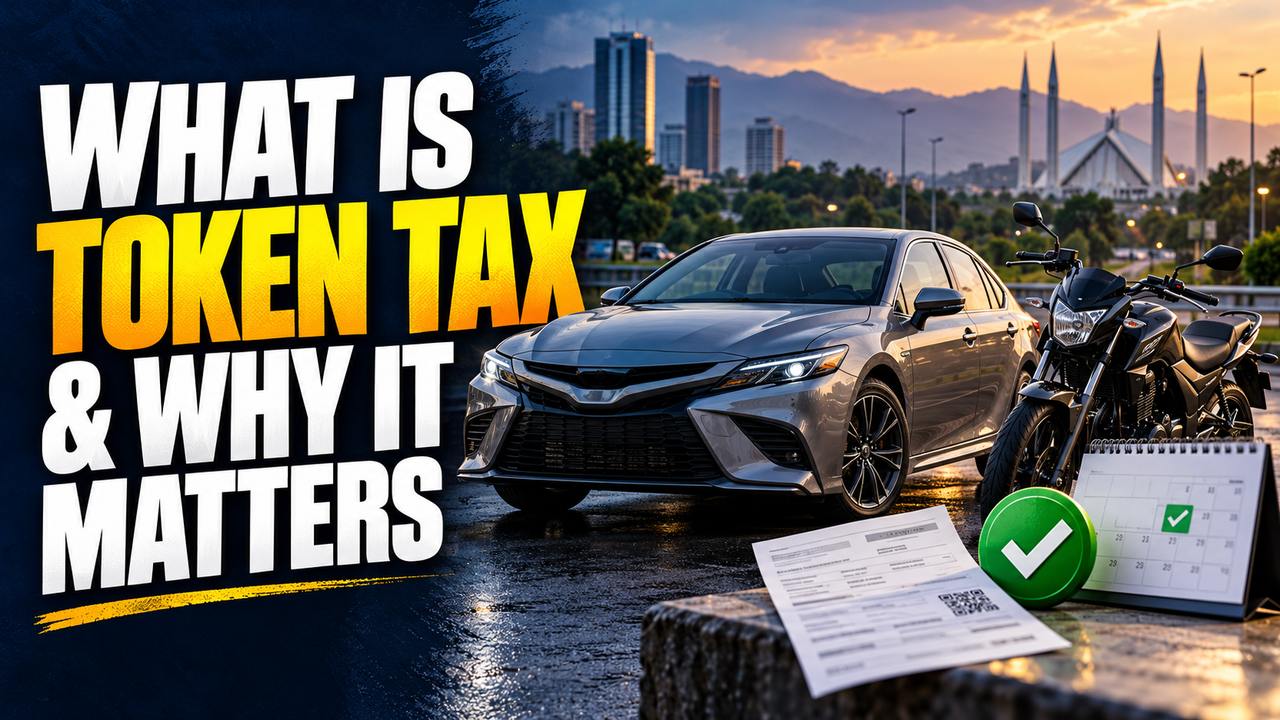
Token tax is an annual tax on owning a motor vehicle. In simple words, it is the yearly rent you pay the government for keeping a registered car, bike or truck on the road. In fact, the official name is motor vehicle tax.
Importantly, provinces charge it under their own motor vehicle tax laws. For example, Punjab still works under the Motor Vehicle Tax Act of 1958. As a result, rates and rules differ from Lahore to Karachi to Peshawar.
Token tax is separate from the one-time registration fee and the advance tax you pay when you first register a car. Instead, it repeats every year for as long as the vehicle stays in your name.
Why It Matters for Car Owners
Many owners ignore this tax until a problem appears. However, it affects your car in several real ways.
It is the law: every registered vehicle must pay it on time.
It funds the province: the money goes into the provincial budget, which pays for roads and other services.
It blocks transfers: you usually cannot sell or transfer a car with unpaid dues, because Excise checks the record first.
It invites checks: Excise teams can stop and impound defaulting vehicles.
It carries your income tax: filers pay a smaller advance income tax with it.
Buyers also check this record. For instance, a used-car buyer in Pakistan will often ask for the last token tax receipt before paying a single rupee. In short, a clean token record makes resale, transfer and daily driving much easier. For a wider view of all vehicle levies, see our guide to vehicle taxes in Pakistan.
Who Collects Token Tax in Pakistan?
Token tax is a provincial subject, since the provinces make the vehicle tax laws. Therefore, each province’s Excise and Taxation Department collects it for vehicles registered in that province. Islamabad has its own Excise office under the ICT Administration.
Region
Who collects it
Good to know
Punjab
Excise, Taxation and Narcotics Control Department
10% rebate if you pay the full year by 31 August
Sindh
Excise, Taxation and Narcotics Control Department, Sindh
Separate rate schedule from Punjab
Khyber Pakhtunkhwa
Excise, Taxation and Narcotics Control Department, KP
Own rates and payment channels
Balochistan
Provincial Excise and Taxation Department
Own rates and payment channels
Islamabad
Excise and Taxation Department, ICT Administration
Bigger cars pay a share of invoice value
So you always pay the province that registered your vehicle, not the one you live in. For example, a Lahore-registered car pays Punjab, even if its owner moves to Karachi.
Token tax in Punjab also comes with a yearly reward for early payers. If you pay the full year on or before 31 August, you get a 10% rebate. However, this rebate covers only the provincial token tax, not the income tax line.
How the Amount Is Calculated
Generally, for private cars, engine size has been the main factor. Small cars pay small amounts, while big engines pay much more.
However, Punjab and Islamabad have moved bigger cars to a value-based system. In Punjab, cars above 1000cc now pay a percentage of their invoice value. In fact, the Punjab budget for 2026-27 raised this from 0.2% to 0.3% for 1001cc to 2000cc. Similarly, cars above 2000cc went from 0.3% to 0.4%.
This shift means two cars with the same engine can pay different amounts. For instance, a top variant with a higher invoice price pays more than a base variant.
Islamabad followed a similar path in the Finance Act 2026. There, cars from 1001cc to 2000cc pay 0.25% of invoice value, while bigger cars pay 0.35%.
For example, suppose your 1300cc car had an invoice value of Rs 60 lakh in Punjab. At 0.3%, the token tax would come to about Rs 18,000 a year, before any rebate. On top of that, you also pay the income tax part, which we explain next.
Filer vs Non-Filer: The Income Tax Part
Your token tax challan usually shows two parts. The first is the provincial token tax. The second is advance income tax under Section 234 of the Income Tax Ordinance, which Excise collects for the FBR.
Importantly, this second part depends on engine size and on your tax status.
In other words, token tax for filer and non filer owners differs only in this income tax line. If your name is not on the Active Taxpayers List (ATL), you pay double. Unlike the provincial token tax, this income tax rule stays the same across Pakistan, because the FBR sets it.
Engine size
Filer (on ATL), per year
Non-filer, per year
Up to 1000cc
Rs 800
Rs 1,600
1001cc to 1199cc
Rs 1,500
Rs 3,000
1200cc to 1299cc
Rs 1,750
Rs 3,500
1300cc to 1499cc
Rs 2,500
Rs 5,000
1500cc to 1599cc
Rs 3,750
Rs 7,500
1600cc to 1999cc
Rs 4,500
Rs 9,000
2000cc and above
Rs 10,000
Rs 20,000
Source: FBR withholding tax rates card for Tax Year 2027.
Notably, filers can adjust this advance tax when they file their annual return. For example, a non-filer with a 1300cc car pays Rs 5,000 a year in this line, while a filer pays Rs 2,500. As a result, becoming a filer saves money twice. If you have not filed yet, our guide on filing income tax returns online shows the steps.
Annual vs Lifetime Payments
Most owners pay token tax every year. Generally, the tax year runs from 1 July to 30 June, in line with the budget.
Some provinces also offer a lifetime token tax for small vehicles. For instance, Punjab offers a one-time lifetime token of Rs 20,000 for cars up to 1000cc. Punjab also offers lifetime tokens for motorcycles. Meanwhile, bigger cars in Punjab have no lifetime option and must pay every year.
Besides, a car up to 1000cc may change hands within ten years of registration in Punjab. In that case, the new owner pays the lifetime token with a 10% rebate per year.
A lifetime token tax saves you yearly visits and rate hikes. On the other hand, you pay a large amount upfront. Therefore, it suits people who plan to keep the vehicle for many years.
Penalties for Not Paying Token Tax in Pakistan
Clearly, late payment costs much more than the tax itself. Excise departments can add a penalty surcharge, block transfers and seize vehicles.
For example, in June 2026, Punjab Excise warned defaulters of a 100% penalty surcharge. It also said teams would impound vehicles with unpaid tax on the spot. Similarly, Islamabad’s Excise office has warned owners that it can cancel registrations over long-pending dues.
Here is what usually happens, step by step, until you pay:
Arrears pile up for each missed year.
Excise adds a surcharge or fine on top.
Your vehicle shows up as a defaulter in the online record.
Checkpoints can stop and impound the car.
You cannot transfer ownership until you clear everything.
Also, an unpaid record can hold up other Excise work, such as a duplicate registration book.
In short, skipping token tax in Pakistan rarely saves money. Therefore, paying on time, especially before the rebate deadline in Punjab, is the cheapest choice.
Rules for Motorcycles and Commercial Vehicles
Motorcycles pay much smaller amounts than cars. Even so, the same vehicle token tax rules on ownership, arrears and transfers apply to bikes too. In Punjab, many riders choose the lifetime token instead of yearly payments. Our upcoming guide on motorcycle token tax covers bikes in detail.
However, commercial vehicles follow a different system. Here, laden weight matters more than engine size. In fact, Punjab tripled several bands for 2026-27. For example, loaders between 4,060kg and 8,120kg went from Rs 2,200 to Rs 6,600 a year. Meanwhile, the heaviest band above 16,000kg rose from Rs 8,000 to Rs 24,000.
Common Myths About Token Tax in Pakistan
Some wrong ideas cost owners real money, especially at transfer time. Here are the most common ones.
“A parked car does not need token tax.” Wrong, because the tax applies to ownership, not use.
“The new owner will pay the old dues.” Usually not, because Excise asks for clearance before the transfer.
“Non-filers pay the same.” No. They pay double on the income tax part.
“Token tax and registration are the same.” No. Registration happens once, while token tax repeats every year.
“A late payment only adds a small fine.” Not anymore, because surcharges can now match the tax itself.
How to Pay and Check Token Tax in Pakistan
Today, most provinces let you pay online. In Punjab, for instance, the ePay Punjab app shows your dues and applies the rebate on its own. Similarly, Sindh, KP and Islamabad offer their own online or bank payment channels.
Before you pay, keep your registration number, the owner’s CNIC and your last receipt ready. Also, double-check the vehicle number, since one wrong digit can send money to another car’s record.
No. Token tax is a provincial levy on owning a vehicle. However, the same challan also carries advance income tax for the FBR, which is why people mix them up.
Do I pay token tax in Pakistan if my car stays parked?
Yes. The tax follows ownership, so a parked car still owes token tax in Pakistan. In fact, only official exemptions or a cancelled registration stop it.
Can I pay in another province?
Generally, no. You pay the province that registered the vehicle. If you move for good, ask your Excise office about transferring the registration.
Do electric cars have to pay it?
They pay much less. For example, Punjab gives electric vehicles a large concession on motor vehicle tax. Check the current percentage with Excise before you pay.
What happens to unpaid dues when I sell my car?
The dues stay on the vehicle record. So Excise will usually ask you to clear them before it transfers the car to the buyer.
Final Word
So, what is token tax in Pakistan? Basically, it is the yearly price of keeping a registered vehicle legal. It depends on your province, engine size or car value, and your filer status.
Above all, pay it on time, keep the receipt, and become a filer to cut the income tax part. For the latest Punjab rates and rebates, visit the Punjab Excise motor vehicle tax page.