Finding a locked video online can be very frustrating for many users. However, learning how to view private YouTube videos legally is a vital skill in the digital age. This post explores the official methods to access restricted content safely. It also details the ethical boundaries every viewer must respect. In this post, the latest platform updates for 2026 are examined in great detail. Furthermore, this guide provides a roadmap for navigating YouTube’s complex privacy ecosystem.
Digital privacy is a fundamental right for all content creators. Therefore, YouTube provides robust tools to protect sensitive information. Many people search for shortcuts or “hacks” to bypass these settings. Nevertheless, most of these methods are fraudulent. They often lead to account suspension or malware infections. This article serves as a comprehensive resource for students, researchers, and casual viewers alike. It emphasizes transparency and permission-based access. By following these instructions, you ensure a safe and lawful browsing experience.
Short sentences are used throughout this guide to enhance readability. Additionally, numerous transition words connect different sections for a better flow. This approach makes the technical information accessible to everyone. Readers will gain a deep understanding of YouTube’s authentication protocols. They will also learn how to communicate effectively with channel owners.
Defining YouTube Video Privacy Categories
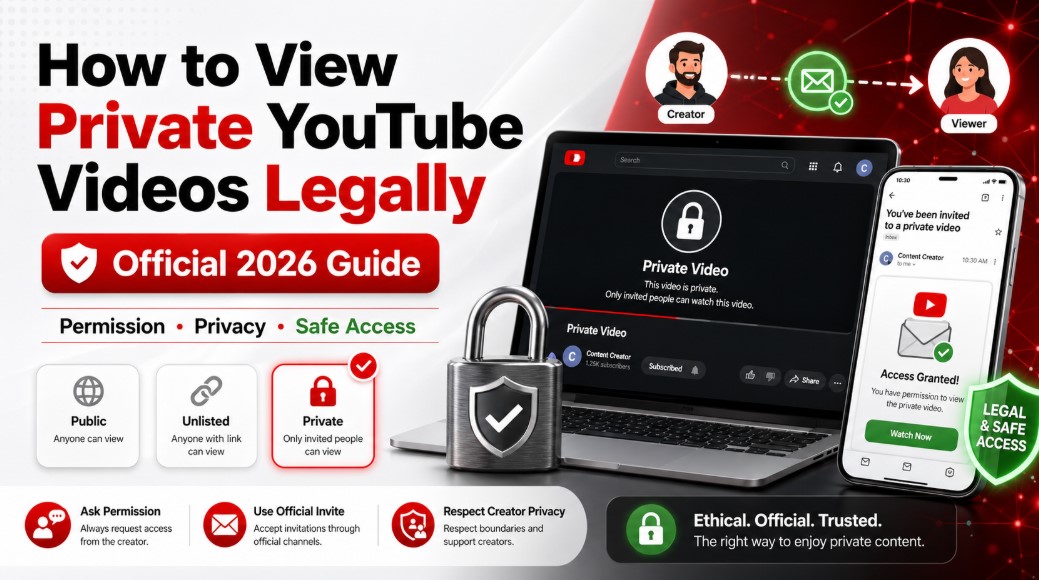
Before you attempt to view private YouTube videos legally, you must understand the different visibility settings. YouTube currently offers three primary tiers for video privacy. Each tier serves a specific audience and purpose.
First, public videos are open to the entire world. These appear in global search results. They show up in the YouTube “Up Next” sidebar. Furthermore, anyone can share these links on social media platforms. Public videos are the primary way creators build their subscriber bases.
Second, unlisted videos offer a semi-private experience. These do not appear in search results or on channel homepages. However, anyone with the specific URL can watch them. No Google account sign-in is required for unlisted content. Creators often use this for sharing drafts with colleagues.
Third, private videos are the most restricted tier on the platform. These videos are invisible to search engines and the public. Even having the direct link is not enough for access. The creator must manually authorize specific Google accounts to view the content. This high level of security is why you must learn the official steps to gain entry.
Why Content Creators Choose the Private Setting
Understanding the creator’s perspective is essential for any viewer. There are many logical reasons why a video remains hidden from the public eye.
Personal privacy is the most common reason. Many users upload family reunions or personal milestones to YouTube. They use the platform as a free cloud storage service. They do not want strangers watching their private moments. Consequently, they lock the video to ensure only family members see it.
Professionalism is another major factor. High-end production houses often upload rough cuts for client review. These videos might contain unedited audio or temporary graphics. Therefore, they remain private until the final version is approved. Making a draft public could damage a creator’s reputation.
Finally, monetization plays a role in privacy. Some creators offer premium content to their supporters. For instance, those who have learned how to make money on TikTok often use YouTube for exclusive long-form tutorials. They keep these videos private and only share them with paying members. This ensures that their hard work is properly compensated.
The Ethics of Accessing Restricted Content
Respecting digital boundaries is a core part of being a responsible internet user. When a creator marks a video as private, they are exercising their right to privacy. Trying to circumvent this setting without permission is unethical.
Furthermore, unauthorized access can lead to legal complications. Copyright laws protect the content creator’s work. Viewing or distributing private material without consent can lead to dmca takedown notices. It can also result in the permanent banning of your YouTube account.
Choosing to view private YouTube videos legally shows respect for the creator’s labor. It fosters a healthy digital environment built on mutual trust. When you follow the official path, you protect your own digital identity. You also support the creator’s right to control their intellectual property. This guide prioritizes these ethical standards above all else.
How to Identify the Video Owner Safely
The first step in gaining legal access is identifying the uploader. If you have a link that says “Video is private,” the owner’s name is often hidden. However, you can usually find clues in the source of the link.
If you found the link on a blog, the blog author is likely the creator. Check the “About Us” page of that website for contact details. If the link was shared on a social media platform, look at the profile of the person who posted it. Often, they are the ones who uploaded the video to YouTube.
Furthermore, you can use the channel ID found in the URL. Sometimes, even if a video is private, the channel it belongs to is public. You can navigate to the channel’s main page to see if they have a business email listed. This initial investigation is crucial for the next steps. Without knowing who the owner is, you cannot request permission.
Locating Contact Information for Permission
Once you know who owns the video, you must find a way to contact them. Most professional YouTubers maintain a business inquiry email. You can find this on their “About” tab in YouTube Studio or on their channel homepage.
Click the “View Email Address” button on their profile. You might need to solve a simple CAPTCHA to see it. Additionally, check their descriptions on other public videos. Many creators list their Twitter, Instagram, or LinkedIn handles there.
Social media is often a faster way to reach a creator. Direct messages on platforms like Instagram are very effective. However, always remain professional and polite. Do not spam multiple platforms at once. Choose the one that seems most appropriate for the creator’s niche. This careful approach increases your chances of a positive response.
Crafting a Professional Access Request
The way you ask for permission determines whether you will view private YouTube videos legally. A well-written request stands out in a crowded inbox.
Start with a clear subject line. Mention the specific video title or the topic it covers. In the first paragraph, introduce yourself briefly. Explain your background and why you are interested in their work.
The second paragraph should explain the purpose of your request. Are you a student doing research? Are you a fan who missed a limited-time upload? Being honest and specific is very important. Creators are more likely to grant access to someone with a legitimate reason.
Finally, provide your Google account email address. Remind them that the video will only be accessible to that specific email. This reassures them that the content will not leak to the general public. End the message with a polite closing and your full name.
The Technical Process of Granting Access
It is helpful to know what happens on the creator’s end. When a creator decides to share a private video, they use YouTube Studio. They navigate to the “Content” section and select the specific video.
The creator then clicks the “Visibility” dropdown menu. They select “Private” and then click the “Share Privately” button. A text box appears where they enter your email address.
Crucially, the creator must check the “Notify via email” box. If they forget this step, you will not receive the notification. Once they hit “Save,” YouTube’s servers update the video permissions. Your account is then whitelisted for that specific video ID. This process is secure because it relies on Google’s internal authentication systems. No passwords or sensitive data are ever shared between the creator and the viewer.
Troubleshooting Common Access Issues
Even after permission is granted, you might encounter technical glitches. The most common problem is being logged into the wrong Google account. Many users have multiple accounts for school, work, and personal use.
If you get a “This video is private” error, check your profile icon in the top right. Ensure it matches the email address the creator invited. If it does not match, switch accounts immediately.
Another common issue is a browser cache conflict. Sometimes your browser remembers the “restricted” status of the page. To fix this, try opening the link in an Incognito or Private window. This forces the browser to check the latest permissions from YouTube’s servers.
Additionally, ensure your internet connection is stable. A weak connection can cause authentication tokens to fail. If the problem persists, try clearing your browser’s cookies and site data. This usually resolves most permission-related errors.
The Role of Google Workspace for Education
Educational institutions often have unique rules for video privacy. If you are a student, you might face extra hurdles. YouTube Private videos are often blocked on Google Workspace for Education accounts.
This happens because of strict safety filters set by school administrators. In these cases, even a direct invitation from a teacher might not work. The teacher may need to change the video to “Unlisted” instead.
If you are using a school-issued laptop, try accessing the video on a personal device. This bypasses the local network filters. However, always follow your school’s digital policy. Do not try to bypass security protocols that are there for your protection. Understanding these institutional limits is part of learning how to view private YouTube videos legally in an academic setting.
Understanding the 50-Person Viewer Limit
YouTube currently limits private video sharing to 50 individual emails. This is a very important technical detail. If a creator has already invited 50 people, they cannot add you.
They would have to remove an existing viewer to make room for you. This limit exists to prevent people from using the private setting for mass distribution. It encourages creators to use other tools for larger audiences.
If you are requesting access to a popular video, keep this limit in mind. The creator might not be able to grant your request due to technical constraints. In such cases, ask if they have a “Members-only” version of the video. This is a common workaround for creators with large communities. Being aware of these limits helps manage your expectations during the request process.
Myths About Private Video Viewers and Hacks
The internet is full of websites promising “private video viewer” tools. These sites claim they can unlock any video for a small fee. Some even claim to do it for free.
However, these claims are 100% false. YouTube’s encryption is world-class. It is impossible for a third-party website to bypass Google’s login screen. These “tools” are actually phishing scams.
They want you to enter your YouTube password. Once they have it, they can steal your account and personal data. Other sites might ask you to download “unlocker” software. This software usually contains viruses or ransomware. It can lock your entire computer and demand money. Always remember that there is no magical software for this task. The only way to view private YouTube videos legally is through the official invitation system.
Risks of Using Illegal Downloaders
Some users try to find “cached” versions of private videos using illegal downloaders. These tools search for video data that might still be on a server. However, this is a very risky practice.
Illegal downloaders often violate the YouTube Terms of Service. Using them can get your IP address blacklisted by Google. Furthermore, these files are often corrupted or incomplete.
Many of these downloading sites are also hubs for intrusive advertising. They might redirect you to adult websites or gambling platforms. This can be very dangerous if you are using a shared or professional computer.
Instead of searching for illegal downloads, focus on building a relationship with the creator. A simple message is much safer than a suspicious download. Protecting your device should always be your top priority. No video is worth compromising your cybersecurity.
Using the Wayback Machine and Web Archives
The Wayback Machine is a famous tool for seeing old versions of websites. Some people try to use it to watch private videos. This works only if the video was once public.
If a video was public for a few months, an archive bot might have captured the page. However, the bot rarely captures the actual video file. It usually just saves the title, description, and comments.
When you try to play the video in an archive, you will see a “Video unavailable” message. This is because the video player still needs to fetch data from YouTube’s live servers. Since the video is now private, the server denies the request.
Web archives are great for research and finding lost descriptions. But they are not a reliable way to watch restricted content. They cannot bypass current privacy settings. Relying on them for video playback is usually a dead end.
How to Use YouTube Studio to Manage Your Own Private Videos
If you are a creator, managing your own private content is easy. First, sign in to your YouTube Studio account. Click on the “Content” tab on the left-hand sidebar.
Find the video you want to keep private. Hover over the “Visibility” column. Click the arrow to see the options. Select “Private.” To share it with a specific person, click the “Share Privately” link.
Enter the email address of the person you want to invite. You can add multiple emails by separating them with commas. Remember to hit the “Save” button at the bottom.
You can also revoke access at any time. Simply click the “X” next to an email address in the sharing list. This gives you total control over who sees your work. Managing your videos correctly ensures your privacy is never compromised.
Exploring Other Legal Content Options
While you wait for permission, you might want to explore other types of content. The internet is full of high-quality videos that are easy to access.
For example, many users enjoy watching global streaming services. If you are in a different region, you might need help with subscriptions. You can find a detailed guide on how to get Netflix Pakistan subscription to expand your library. This allows you to watch thousands of movies and shows legally.
Furthermore, you can spend time learning new skills on public YouTube channels. Many experts share free tutorials every day. You don’t always need a private video to get great information.
By diversifying your viewing habits, you reduce the frustration of locked content. There is always something new to discover on the web. Focus on the content that is already available to you while you navigate privacy requests.
Differences Between Private and “Members Only” Videos
Many people confuse private videos with members-only content. However, they are technically different. Members-only videos are part of the YouTube Channel Memberships feature.
Creators use this to reward people who pay a monthly fee. These videos are not “private” in the traditional sense. They are visible to anyone who has a valid membership to that specific channel.
If you see a video with a “Join” button, it is a members-only video. You can gain access by clicking the button and paying the required fee. This is a very common way to view private YouTube videos legally if they are part of a creator’s business model.
Private videos, however, cannot be “bought” into. They require a manual invite from the creator. Knowing the difference helps you choose the right path to access. One requires money, while the other requires a personal connection or permission.
The Impact of AI-Generated Content on Privacy in 2026
In 2026, YouTube introduced new rules for AI-generated content. Creators must now disclose if a video was made with AI tools. This rule applies to private videos as well.
When a creator shares a private video with you, check for an AI label. This label helps you understand if the footage is real or synthetic. It is part of YouTube’s effort to increase transparency.
Furthermore, AI-generated private videos are subject to stricter reviews. YouTube’s AI detection systems scan these videos for deepfakes and misinformation. Even if a video is private, it must still follow community guidelines.
This means you can feel safer watching private content. The platform is working hard to ensure that even hidden videos are not harmful. Understanding these 2026 updates is essential for modern viewers. It shows how the platform is evolving to protect everyone.
The Importance of Updating Your Google Account Security
When you receive an invite to a private video, your account security becomes more important. You are now part of a small, trusted group. Therefore, you must protect your login credentials.
Always use two-factor authentication (2FA) on your Google account. This prevents hackers from taking over your profile. If someone steals your account, they could gain access to all the private videos you were invited to.
This would be a major privacy breach for the original creator. By securing your account, you are also protecting the creator’s content. It is a shared responsibility in the digital world.
Regularly check your security settings in the Google Account dashboard. Look for any unrecognized devices or logins. Keeping your digital house in order is the best way to enjoy private content without stress. Security and privacy go hand in hand on YouTube.
Dealing with Expired Private Video Links
Sometimes, a private video link simply stops working. This usually happens if the creator changes the video settings. They might have moved the video back to “Unlisted” or “Draft” status.
Alternatively, they might have deleted the video entirely. If you lose access, do not panic. First, check your email to see if you received a notification about the change.
If there is no notification, you can send a polite follow-up message. Ask the creator if the video is still available for viewing. Sometimes, they simply made a mistake during a channel cleanup.
However, respect their decision if they choose not to restore your access. Creators often rotate their content to keep their channels fresh. Understanding that access is a privilege, not a right, is key to being a good viewer.
How to Watch Your Own Private Videos on Mobile
Accessing your own private content on a smartphone is a bit different than on a desktop. Open the YouTube app and tap on your profile picture. Select “Your videos” from the menu.
You will see a list of all your uploads. Private videos will have a small padlock icon next to them. You can watch these anytime as long as you are logged in.
If you want to share one from your phone, tap the three dots next to the video. Select “Edit” and then tap on the “Visibility” section. From there, you can add email addresses just like on a computer.
The mobile app is very powerful for managing content on the go. It allows you to grant access to a friend or colleague in seconds. This flexibility is one of the best features of the modern YouTube ecosystem.
The Evolution of YouTube Privacy Policies
YouTube has changed its privacy rules many times over the years. In the early days, privacy was very basic. Now, it is a sophisticated system with many layers.
In 2021, YouTube made a major change to “Legacy Unlisted” videos. Any unlisted video uploaded before 2017 was automatically made private. This was done to improve security across the platform.
Creators had to manually opt-out to keep those videos unlisted. This historical context is important. If you find an old link that is now private, this might be the reason. The creator might not even realize the video was locked by the system.
In 2026, the focus has shifted toward AI and deepfake protection. Each change is designed to make the platform safer for everyone. Staying informed about these shifts helps you understand why some content is harder to find today.
Legal Repercussions of Bypassing Security
It is important to understand the law regarding digital security. Bypassing a password or a privacy gate can be considered a crime in many countries.
In the United States, the Computer Fraud and Abuse Act (CFAA) covers these issues. Accessing a computer system without authorization is a serious offense. This includes trying to hack into a private YouTube video server.
While most people won’t face jail time for trying to watch a video, the civil penalties are high. A creator can sue for damages if their private content is leaked. This can result in thousands of dollars in fines.
Therefore, always choose to view private YouTube videos legally. The risks of the illegal path are simply too high. Stick to the official methods to stay on the right side of the law. Your freedom and your finances are worth more than any video.
Cultural Impact of Private Content
Private videos have a unique place in internet culture. They are often seen as “lost media.” Entire communities exist to track down and document these hidden gems.
However, the “lost media” community emphasizes the importance of permission. They often work with creators to archive videos before they are deleted. This collaboration is a beautiful part of digital history.
When a creator knows their work is valued, they are more likely to share it. Private videos often contain the most authentic and raw moments of a creator’s life. They are a window into the past.
By respecting the private status of these videos, we preserve their value. We ensure that creators feel safe enough to keep uploading their personal stories. This cultural respect is what keeps the YouTube community thriving in 2026.
Final Steps to Success
As you move forward, keep a checklist of the steps we discussed. This will ensure you never forget the proper protocol.
First, always verify the source of the link. Second, reach out to the creator with a professional tone. Third, ensure your Google account is secure and ready. Fourth, be patient while waiting for a response.
If you follow these steps, you will find that most creators are quite reasonable. They appreciate people who take the time to ask properly. This approach will help you view private YouTube videos legally every single time.
Furthermore, you will build a reputation as a respectful member of the audience. This can open doors to more exclusive content in the future. The digital world rewards those who act with integrity and kindness.
Conclusion: Embracing Digital Ethics
Learning how to view private YouTube videos legally is more than just a technical task. it is a lesson in digital ethics and communication. We live in an era where information is everywhere. However, some information is meant to be private.
By following the official methods, you protect yourself and the creators you admire. You avoid the traps of scammers and the dangers of malware. You also uphold the laws that keep the internet organized.
Remember that every video has a human being behind it. They have the right to decide who watches their work. When you ask for permission, you are acknowledging that human connection.