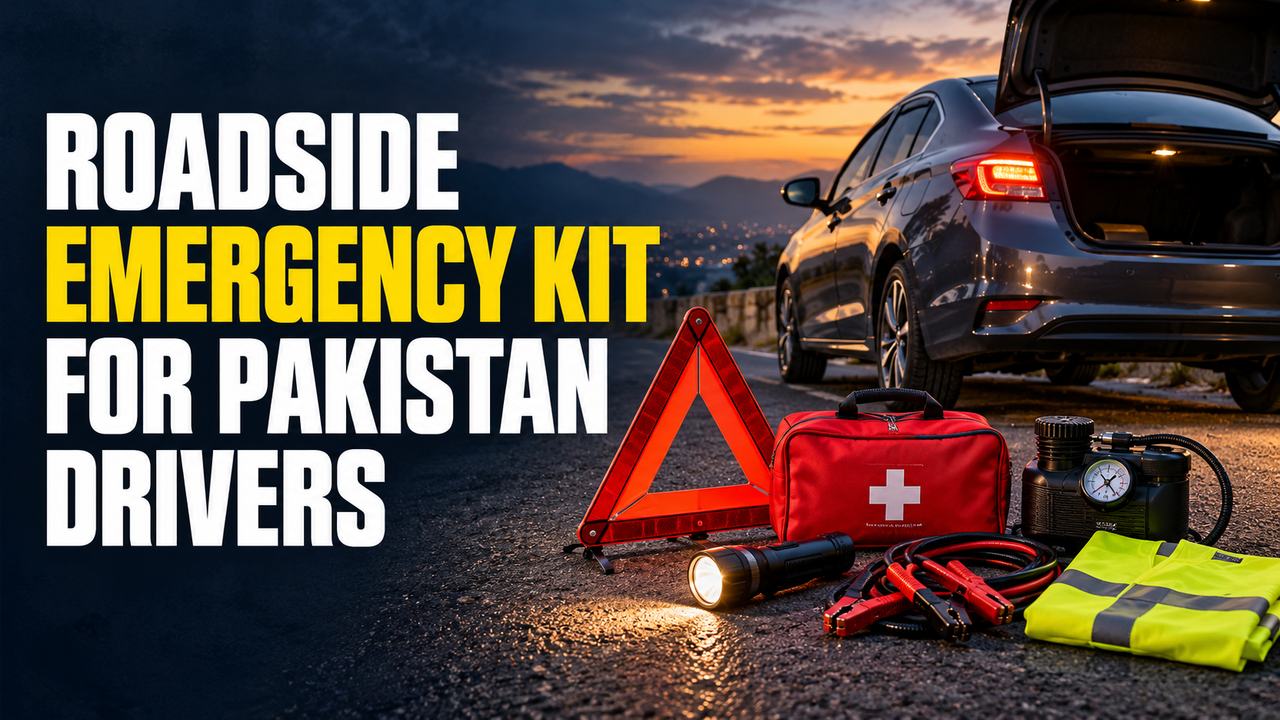
A flat tyre at night on the N-5, a dead battery in a Lahore parking lot or a long jam in Karachi rain can happen to anyone. When that happens, the right tools save hours and keep your family safe. So this guide shows what a complete roadside kit in Pakistan should hold, with rough prices and a printable checklist.
Safety note: Your safety comes before your car. On a busy road, get everyone behind the barrier first, and call for help instead of attempting risky repairs.
Why Every Driver Needs a Roadside Kit in Pakistan
Help does not always arrive fast. For example, a breakdown on a remote stretch of the N-25 or the Coastal Highway can leave you far from the nearest town. Similarly, city traffic can slow down even a nearby mechanic.
Our conditions also add risk. Summer heat drains batteries and stresses tyres, while monsoon floods stall engines. Meanwhile, winter fog closes motorway sections and leaves cars waiting for hours. Therefore, a basic roadside kit in Pakistan is not a luxury. Instead, it is as important as a spare tyre.
Of course, on motorways and national highways, you can call the motorway police 130 helpline for emergencies or assistance. Even so, help may take time to reach you, especially at night. As a result, your own kit covers the gap until help arrives.
The Complete Roadside Kit Checklist for Pakistan
Here is the main checklist. Prices come from PakWheels listings seen during 2026. However, prices change often, so treat them as rough guides. When we could not confirm a price, the table says so.
Item
Why You Need It
Approx Cost
Spare tyre, jack and wheel spanner
Fix a flat on the spot
Usually comes with the car
Tyre pressure gauge
Check pressure before long trips
Around Rs 1,000 to 1,250
Portable tyre inflator
Top up a slow leak
Around Rs 3,850 to 8,000
Jump cables
Start a dead battery with help
Around Rs 3,500
Portable jump starter
Start without another car
Around Rs 9,000 to 14,000
Tow rope or strap
Get towed to a workshop
Around Rs 1,000 to 2,800
Small fire extinguisher or fire-stop spray
Tackle a small fire early
Around Rs 1,000 to 2,600
Basic tool kit
Loose clamps, terminals, screws
Around Rs 1,150 to 1,800
Warning triangle
Warn traffic behind you
Check local price
Torch with spare batteries
Night repairs and signalling
Check local price
First aid box
Cuts, burns, headaches
Check local price
Water, snacks, power bank
Long waits in heat or cold
Everyday items
You do not need everything on day one. Instead, start with the safety basics and add tools over time. Ready-made car emergency kit sets are also sold online. However, check the contents carefully, because some sets include only cheap tools and skip the important items.
Tyre Tools: Spare, Jack, Inflator and Gauge
Flat tyres are the most common roadside problem. So first, check that your spare holds air and that the jack and wheel spanner are in the boot. Many drivers only discover a flat spare when they need it.
A small 12V inflator is very useful, because it runs from the car’s socket. For instance, it can top up a slow puncture enough to reach a tyre shop. In addition, a simple gauge helps you keep the right pressure. Our tyre pressure guide explains the correct numbers.
Since most modern cars use tubeless tyres, a tubeless puncture plug kit can seal a small hole for a while. However, if you have never used one, a shop repair is safer, so rely on the spare instead.
Battery Help: Jump Cables or Jump Starter
Batteries often fail during peak summer and on cold winter mornings. Jump cables are cheap, but they need a second car. On the other hand, a portable jump starter works alone, and many double as a power bank.
Option
Approx Price
Pros
Cons
Jump cables
Around Rs 3,500
Cheap, no charging needed
Needs another car
Portable jump starter
Around Rs 9,000 to 14,000
Works alone, charges phones
Must stay charged; avoid leaving it in heat
If you use cables, follow a safe order. First, connect red to the dead battery’s positive terminal, then red to the good battery’s positive. After that, connect black to the good battery’s negative. Finally, clip the last black clamp to bare metal on the dead car, away from the battery. When you finish, remove them in reverse order.
Since jump starters use lithium batteries, do not leave them in a baking car all summer. If the car still refuses to start, read our guide on why a car won’t start.
Safety Gear: Triangle, Torch and Fire Extinguisher
Visibility saves lives at the roadside. Therefore, place a warning triangle well behind the car, especially on motorways and at night. A torch helps you work, and it also lets you signal to passing traffic.
A small fire extinguisher is also worth carrying. Fit it where you can reach it quickly rather than under heavy bags. Also, check its gauge or expiry date every few months.
In addition, a cheap reflective vest makes you visible while you change a tyre at night. Similarly, keep the hazard lights on, although you should watch the battery during very long stops.
First Aid and Personal Items
Minor injuries happen during roadside repairs. For example, a jack can pinch fingers, and hot engine parts can burn. So keep a compact first aid box in the cabin, not buried in the boot.
Plasters, gauze, tape and antiseptic, because small cuts are common.
Pain relief and ORS sachets, particularly for summer trips.
Any personal medicines your family needs, especially for elders.
Gloves and a cloth, since engine parts get hot and dirty.
For a full list, see our guide on first aid box essentials. Also, check expiry dates twice a year, because heat spoils many medicines.
Seasonal Add-Ons for Your Roadside Kit in Pakistan
Your needs also change with the weather. So update your roadside kit in Pakistan at the start of each season.
Summer: extra drinking water, a sunshade and a cap.
Monsoon: an umbrella, a towel and a spare pair of wiper blades.
Winter: blankets, gloves and, for hill trips, snow chains.
Northern trips: a small shovel, warm clothes and dry food.
Besides saving these numbers in your phone, write them on a card in the glove box. That way, you still have them if your phone dies. In addition, the Motorway Police share updates on FM 95 radio, which helps during fog or rain.
Number
Service
Use It For
1122
Rescue service
Accidents, injuries, rescue
130
National Highways and Motorway Police
Breakdowns and accidents on motorways and national highways
15
Police emergency
Crime, accidents and traffic emergencies in cities
115
Edhi ambulance
Ambulance help
16
Fire brigade
Vehicle fires
What to Do When You Break Down
Pull as far off the road as you safely can, ideally on a straight stretch.
Turn on hazard lights, and at night also keep the parking lights on.
Move passengers behind the barrier, because standing near the car is risky.
Place the warning triangle well behind the car, so that drivers slow down in time.
Call 130 on motorways and national highways, or a mechanic in the city.
Fix the problem only if it is safe, for example a simple tyre change.
After the call, stay with your group and keep your phone charged. Meanwhile, be careful with strangers who offer help at night. Instead, wait for the Motorway Police, Rescue 1122 or a mechanic you trust.
How to Store and Check Your Kit
A kit only helps when it works. So keep the items in one strong bag, and strap it so that it does not slide around. Also, check the kit once a month:
Charge the jump starter and test the torch, since both lose charge over time.
Check spare tyre pressure as well.
Replace used or expired first aid items.
Refill drinking water, especially in summer.
Moreover, the boot gets very hot in June. For this reason, keep water and medicines in the cabin and replace them often. Similarly, keep the jump starter out of direct sun, since heat shortens battery life.
Bike riders need a kit too, although a smaller one. For example, a puncture kit, a small pump, a torch and a basic first aid pouch fit under most seats. In addition, save the same emergency numbers.
Building a Roadside Kit in Pakistan on a Budget
You can build a solid roadside kit in Pakistan step by step. For instance, start with the cheapest safety items, then add bigger tools later.
Level
Items
Approx Cost of Priced Items
Basic
Gauge, tow rope, tool kit, fire-stop spray, plus triangle, torch and first aid
Around Rs 4,000 to 8,500
Standard
Basic kit plus jump cables and a tyre inflator
Around Rs 11,500 to 20,000
Complete
Standard kit plus a portable jump starter
Around Rs 20,500 to 34,000
These totals, however, do not include the warning triangle, torch and first aid box. So check their prices at a local shop, and add them to your budget.
Also, compare quality, not just price. For example, a tow rope should list its load rating, and a jump cable should be thick and long enough. In short, a cheaper item that fails on the road costs more in the end. Above all, a modest roadside kit in Pakistan that you actually carry beats an expensive one left at home.
FAQs
What should a basic roadside kit in Pakistan include?
At minimum, carry a working spare, jack, warning triangle, torch, first aid box, tow rope and water. Then add jump cables and an inflator when you can.
Which number should I call on the motorway?
Call 130 for the National Highways and Motorway Police. For injuries, also call Rescue 1122. But on city roads, dial 15 for the police instead.
Is a jump starter better than jump cables?
A jump starter works without another car, so it suits people who often drive alone. However, it costs more and needs charging. Cables, on the other hand, last for years with no upkeep.
How much does a roadside kit in Pakistan cost?
A basic set of priced items costs around Rs 4,000 to 8,500. Meanwhile, a complete kit with a jump starter can cost around Rs 20,500 to 34,000.
Where should I keep the kit?
Keep tools in the boot, strapped down. However, keep the first aid box, torch and water in the cabin, within easy reach. That way, you can grab them quickly when it is dark.
Final Word
In the end, a good roadside kit in Pakistan turns a scary breakdown into a manageable delay. Start with the safety basics, then add tyre and battery tools, and update the kit each season. Before long trips, also run through our road trip car checklist. For motorway help and updates, visit the National Highways and Motorway Police website.