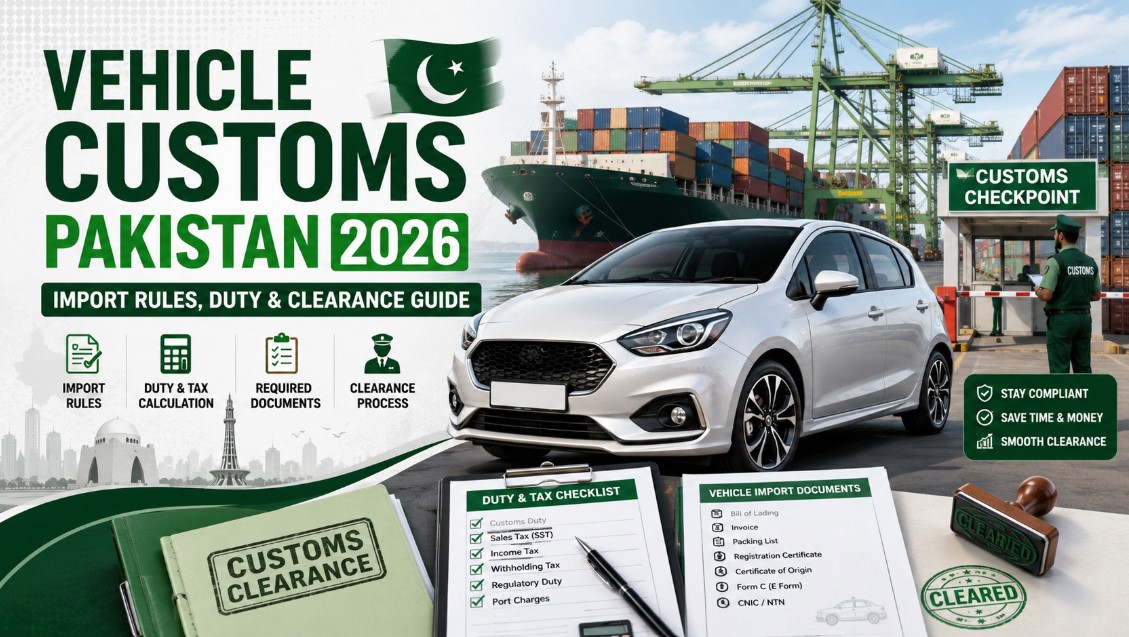
Understanding vehicle customs Pakistan rules is the first step before you import any car. Moreover, the process changed a lot in 2026 due to new inspection rules and duty cuts. In this post, you will learn the full clearance journey in simple steps. Furthermore, this guide covers eligibility, import schemes, duty rates, documents, and the official online process.
To make things clear from the start, importing a vehicle is not a single action. Instead, it is a chain of legal steps. First, you confirm who can import. Next, you pick a scheme and pay the right duty. Finally, you clear the car through Pakistan Customs. Therefore, this post breaks each stage down with current, verified detail.
What Vehicle Customs Clearance Means
Customs clearance is the legal release of your vehicle by Pakistan Customs. Specifically, it confirms that all duties, taxes, and rules are met. Without clearance, your car cannot leave the port. So, no registration or road use is possible until this step is done.
In simple terms, the vehicle customs Pakistan process checks three things. Firstly, it verifies your eligibility to import. Secondly, it values the vehicle and calculates duty. Thirdly, it confirms the car meets safety and policy rules. As a result, clearance protects both the buyer and the state. Above all, it keeps imports legal and traceable.
This matters most for overseas Pakistanis bringing cars home. However, it also applies to commercial importers and dealers. Therefore, knowing the rules saves you from heavy fines and delays. Indeed, a single missing document can hold a car at the port for weeks.
Who Can Import a Vehicle
Eligibility is the foundation of the whole process. New vehicles, on one hand, can be imported by anyone against full duty. Used vehicles, on the other hand, follow stricter rules. Specifically, only overseas Pakistanis and dual nationals can import used cars under special schemes.
However, not everyone qualifies even among overseas Pakistanis. For example, students who receive remittance from Pakistan are not eligible. Likewise, non-earning family members of overseas Pakistanis cannot import. Moreover, anyone who imported, gifted, or received a vehicle in the past two years is barred. Therefore, you must confirm your status before buying any car abroad.
To pay duty, you also need foreign exchange. In practice, the duty must be paid from abroad by you or an immediate family member. Additionally, a Family Registration Certificate (FRC) is needed if a blood relative pays. So, plan your funding source early to avoid problems.
The Three Import Schemes
Three legal schemes allow used-vehicle imports in 2026. Each one suits a different situation. Below is a quick comparison before the details.
Scheme
Who It Suits
Key Condition
Personal Baggage
Returning overseas Pakistanis
Minimum stay abroad required
Gift Scheme
Family member living in Pakistan
One vehicle per year
Transfer of Residence
Pakistanis relocating home
Long stay abroad required
As shown above, the duty structure stays the same across all three. Therefore, your choice depends on your personal case, not the cost.
Personal Baggage Scheme
Personal baggage suits Pakistanis returning after work abroad. Generally, you must have stayed abroad for a set minimum period. Many sources cite around 180 days of stay in the recent months. Furthermore, the vehicle must arrive within a defined window of your return. So, timing your shipment with your travel is important.
Gift Scheme
The gift scheme lets an overseas Pakistani gift a car to family at home. Importantly, the recipient must be an immediate family member in Pakistan. Additionally, only one vehicle per year is allowed under this route. However, the donor must still meet residence and funding rules. Therefore, this scheme works best for genuine family gifts, not resale.
Transfer of Residence Scheme
Transfer of Residence (TR) suits those moving back permanently. Typically, you must have stayed abroad for around 700 days in the past three years. Notably, motorcycles and scooters can only be imported under this scheme. Moreover, TR often suits families shipping a car with household goods. So, it is the common route for permanent returnees.
Age Limits for Imported Vehicles
Age rules decide whether a car is even importable. Cars, firstly, must not be older than three years. Other vehicles, such as vans or jeeps, can be up to five years old. Meanwhile, motorcycles fall only under the TR scheme.
These limits are strict and checked closely. Therefore, always confirm the manufacturing date before purchase. For instance, a car just over three years old will be rejected at the port. So, buy within the limit to avoid a costly re-export. In addition, all imported cars must be right-hand drive for Pakistani roads.
Duty and Taxes Explained
Duty is the largest cost in the whole process. However, it is not a single charge. Instead, several taxes stack on top of each other. Below is a breakdown of the main components.
Component
What It Is
Customs Duty
Base import tax by engine capacity
Regulatory Duty (RD)
Extra duty on certain engine sizes
Additional Customs Duty (ACD)
Small added customs levy
Sales Tax
Applied on the duty-paid value
Advance Income Tax
Varies by filer status
Federal Excise Duty (FED)
Applies to some categories
For used cars under the three schemes, duty is charged at fixed amounts. Specifically, these fixed rates are set in US dollars by engine slab for Asian-made cars. Moreover, a depreciation relief of 1% per month applies based on the car’s age, as per FBR. Therefore, an older car within the age limit pays slightly less.
One key point often surprises new importers. In practice, FBR ignores your invoice price for older cars. Instead, it uses its own valuation tables. So, the assessed value may be higher than your purchase price. For exact figures, always use the official FBR duty calculator at fbr.gov.pk.
Duty by Engine Capacity
Engine size is the biggest factor in your duty bill. Smaller engines, generally, pay much less. Larger engines, by contrast, face very high rates. Below is the broad direction of duty by capacity.
Engine Capacity
Duty Level (Direction)
Up to 800cc
Lowest rates, most affordable
801cc – 1000cc
Moderate, popular segment
1001cc – 1300cc
Higher, common sedans
1301cc – 1800cc
Significantly higher
Above 1800cc
Highest, luxury level
Importantly, these rates changed under the Finance Bill 2026-27. For example, customs duty on the up-to-800cc slab was cut from 50% to 30%. Likewise, the 1001cc–1300cc category received a notable reduction. As a result, small imported cars like 660cc and 1000cc models became cheaper. However, exact figures are still being finalized. Therefore, confirm current rates on the FBR portal before you commit.
Hybrid and Electric Concessions
Green vehicles enjoy special relief in Pakistan. Hybrids, firstly, get a 50% duty exemption up to 1800cc. Beyond that, hybrids from 1800cc to 2500cc get a 25% exemption. Therefore, hybrid imports remain attractive for many buyers.
Electric vehicles, meanwhile, often face even lower duties. In fact, EVs enjoy reduced or near-zero customs rates under green policy. Additionally, disabled persons can import a car up to 1350cc duty-free, subject to board approval. So, these concessions can change your total cost a lot. Consequently, the vehicle customs Pakistan bill differs widely by car type.
Latest 2026 Rules You Must Know
This section holds the freshest and most important updates. New inspection rules, firstly, reshaped used-car imports this year. In January 2026, the government issued SRO 61(I)/2026. Under this rule, a Pre-Shipment Inspection (PSI) certificate became mandatory for used vehicles before shipment from Japan.
However, this rule created problems for cars already in transit. To fix this, the Ministry of Commerce issued updates on June 23, 2026. As a relief, a one-time exemption now lets some cars clear without PSI. Specifically, the car must be under the Gift or TR scheme. Moreover, its Master Bill of Lading must be dated between January 16 and March 9, 2026.
Beyond that, customs now checks the original Japanese auction sheet closely. As a result, cars with certain damaged or flood grades are rejected. For shipments after March 9, 2026, a PSI certificate is required before export. Notably, only two PSQCA-approved inspection firms are authorized. These are M/s EAA Company (Pvt.) Ltd. and M/s Auto Terminal Pak (Pvt.) Ltd.
Separately, the Finance Bill 2026-27 brought major duty cuts. In short, customs duties on many imported cars were reduced. Small-engine cars, in particular, benefited the most. Furthermore, regulatory duty on large engines above 3000cc was slashed sharply. Therefore, 2026 is a turning point for the vehicle customs Pakistan landscape. Still, treat these figures as evolving and verify them officially.
Documents Required for Clearance
Correct documents are the heart of smooth clearance. Missing papers, on the other hand, cause long delays. So, prepare the full set before your car arrives. Below are the core documents you will need.
Original Bill of Lading (B/L) from the shipping line.
Purchase invoice or commercial invoice of the vehicle.
Export certificate, with an English translation if needed.
Original Japanese auction sheet for verification.
Pre-Shipment Inspection (PSI) certificate, where required.
Passport and valid Pakistan Origin Card (POC) or NICOP.
Bank proof of duty payment in foreign exchange.
Family Registration Certificate (FRC), if a relative pays the duty.
Additionally, commercial imports need extra certificates. For instance, an EDB certificate, PSQCA approval, and emission compliance may apply. Therefore, check the exact list for your import type. In every case, clear and complete papers speed up release.
How to Apply: Step by Step
Applying for clearance follows a clear order. Below is the full 2026 process from purchase to delivery.
Confirm eligibility. First, check your scheme, residence, and funding source.
Buy an eligible car. Next, pick a right-hand-drive car within the age limit and a clean auction grade.
Arrange inspection. Then, obtain a PSI certificate if your shipment date requires it.
Ship to a Pakistani port. Afterward, ship the car and collect your original Bill of Lading.
Hire a clearing agent. Meanwhile, appoint a licensed customs agent, or file yourself if registered.
File the Goods Declaration. After that, submit the declaration on Pakistan Single Window with all documents.
Pay duty and taxes. Once assessed, pay the generated PSID through your bank.
Get the Delivery Order. Finally, clear port charges, receive the Delivery Order, and take your car.
Throughout these steps, accuracy matters most. Therefore, double-check every figure and date before submission. Otherwise, even a small error can stall the whole file.
Clearance Through Pakistan Single Window
Pakistan Single Window (PSW) is the official online clearance system. Led by Pakistan Customs, it replaced older paper-based forms. Now, traders file one electronic Single Declaration for everything. As a result, the old Electronic Import Form (EIF) is no longer needed.
To use PSW, you must first complete a subscription. Moreover, your bank profile must be linked to the system. After login, you create an import declaration and enter the vehicle details. Then, the system fetches data from your profile and the shipping manifest. Next, it calculates duty and generates a PSID for payment.
Importantly, PSW uses a risk system to decide examination. So, some cars are physically checked, while others clear faster. After payment and checks, customs issues the release. You can access the portal and guides at psw.gov.pk. For official duty rules, also see the FBR vehicles page at fbr.gov.pk.
Ports and Clearing Agents
Most used cars enter Pakistan through Karachi ports. Specifically, terminals like KICT, PICT, and SAPT handle vehicle cargo. In addition, Port Qasim processes some shipments. Therefore, your car will likely land in Karachi for clearance.
A licensed clearing agent makes this stage far easier. In practice, the agent files your declaration and manages the examination. Moreover, a good agent warns you about valuation and duty in advance. However, agent fees vary widely, so compare a few first. So, choose an experienced, registered agent with a clear record.
For buyers in other cities, the process still runs through Karachi. After clearance, the car is transported to your city by carrier. Consequently, Lahore, Islamabad, and other buyers add transport costs. Still, the clearance itself happens at the port of arrival.
Costs Beyond Duty
Duty is not the only expense to plan for. Several side costs add up quickly. So, budget for them from the start. Below are the common extra charges.
Cost Type
Why It Applies
Port/terminal handling
Unloading and storage at the port
Demurrage
Penalty for delayed clearance
Clearing agent fee
Professional clearance service
Transport to city
Carrier delivery outside Karachi
Registration fee
Provincial Excise registration
Demurrage, in particular, can hurt the most. Indeed, every extra day at the port adds cost. Therefore, fast and correct filing saves real money. In short, preparation directly lowers your final bill.
Common Mistakes to Avoid
Many importers lose money through avoidable errors. Firstly, some buy cars over the age limit. Secondly, others ignore the auction grade and face rejection. Thirdly, a few delay clearance and pay heavy demurrage.
To stay safe, plan every step in advance. Moreover, confirm the PSI rule before shipping from Japan. Likewise, verify the FBR valuation, not just your invoice price. Additionally, never rely on verbal promises from unknown agents. Therefore, keep all documents and payments in writing. Above all, treat the vehicle customs Pakistan process as a strict legal task.
Communities and Help Resources
Active communities make this journey much smoother. For example, PakWheels forums host detailed import discussions daily. Similarly, Facebook groups for overseas car imports share live experiences. Moreover, members warn each other about scams and changing rules.
Beyond online groups, professional bodies also help. Specifically, customs agent associations guide importers on procedures. In addition, the PSW platform offers 24/7 support by phone and email. So, you are never alone during clearance. Indeed, one good contact can save you days of confusion.
These communities also track policy changes in real time. For instance, members posted quickly about the 2026 PSI rule. Likewise, they shared the latest Finance Bill duty updates fast. Therefore, joining one or two active groups is a smart move. Ultimately, shared knowledge protects your money and time.
After Clearance: Registration
Clearance is not the final step in the journey. Once released, you must register the car legally. Specifically, registration happens with your provincial Excise and Taxation department. After that, you receive number plates and a registration book.
Following registration, a few more checks complete the process. For commercial vehicles, a fitness certificate is also needed. You can learn the full process in our vehicle fitness certificate Pakistan guide. Moreover, you should confirm your record online for safety. Our guide on how to verify your vehicle in Sindh explains that step clearly. Therefore, these final actions make your imported car fully road-legal.
Frequently Asked Questions
What is the vehicle customs Pakistan process in simple words?
It is the legal release of your imported vehicle by Pakistan Customs. Specifically, you confirm eligibility, pay duty and taxes, and pass safety checks. After that, customs issues the release. Then, you can register and drive the car.
Who can import a used car into Pakistan?
Only overseas Pakistanis and dual nationals can import used cars. Moreover, they must use the personal baggage, gift, or transfer of residence scheme. However, students on remittance and recent importers are not eligible. Always confirm your status first.
How is import duty calculated on a vehicle?
Duty depends on engine capacity, car type, and age. For used cars under the schemes, fixed dollar rates apply by engine slab. Moreover, 1% per month depreciation applies based on the car’s age. For exact amounts, use the official FBR duty calculator.
What is the new PSI rule in 2026?
A Pre-Shipment Inspection (PSI) certificate is now required for used cars from Japan. Specifically, it must be obtained before shipment under SRO 61(I)/2026. However, a one-time exemption covers some cars shipped between January and March 2026. Only two approved firms can issue PSI certificates.
How long does vehicle customs clearance take?
Clearance time depends on documents, examination, and payment speed. Generally, a complete file clears within a few days to two weeks. However, missing papers or duty delays cause demurrage. Therefore, fast and accurate filing keeps costs low.
Can I clear my car without a clearing agent?
Yes, but only if you are registered on Pakistan Single Window. Otherwise, a licensed clearing agent is the practical choice. Moreover, an agent handles the declaration and examination for you. So, most individual importers prefer using one.