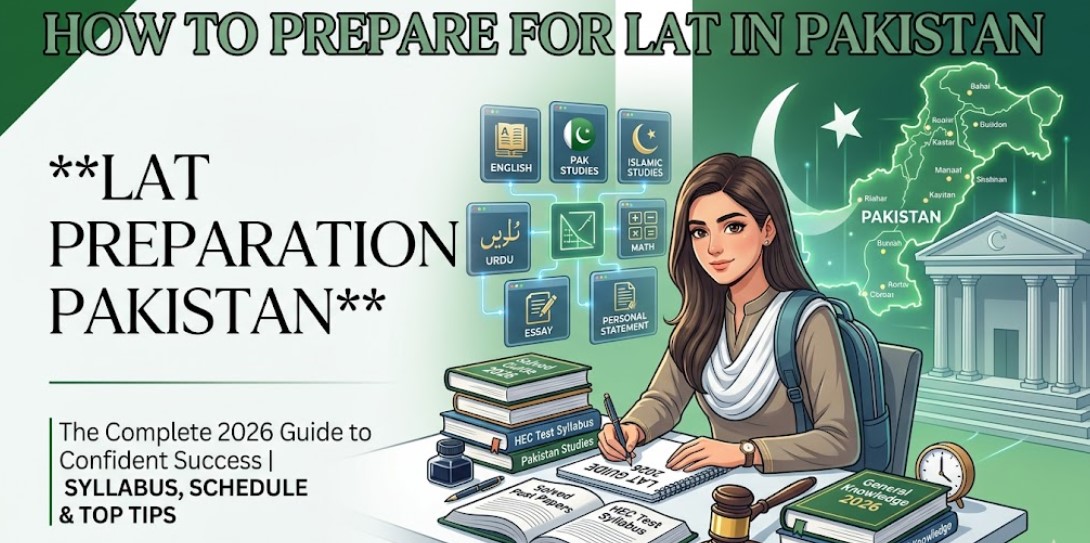
LAT preparation Pakistan is the most important step for any student wishing to enter the legal profession. The Law Admission Test (LAT) is a mandatory requirement set by the Higher Education Commission (HEC). This test ensures that only capable students enter the five-year LLB degree programs. In this post, we will provide a comprehensive roadmap for your success. We have updated all information for the 2026 academic year. Whether you are a fresh Intermediate student or a private candidate, this guide is for you.
Understanding the Law Admission Test (LAT)
The Law Admission Test is not just another exam. It is a filter designed to test your aptitude for legal studies. It assesses your communication skills, logical reasoning, and general awareness. Most universities in Pakistan will not even look at your application without a valid LAT result. Therefore, starting your LAT preparation Pakistan early is highly recommended.
The test is conducted multiple times a year by the Education Testing Council (ETC) under the HEC. This allows students to take the test when they are best prepared. However, each attempt requires a separate registration fee. It is best to pass it on your first try to save time and money.
Why Quality LAT preparation Pakistan is Crucial
A career in law requires precision, critical thinking, and a strong command of languages. The LAT serves as a baseline for these skills. If you struggle with the entry test, you might find the actual LLB curriculum very difficult. Proper preparation helps you build a strong foundation.
Furthermore, the competition is increasing every year. Thousands of students apply for a limited number of seats in top universities. A high score in the LAT can give you a significant advantage in the merit lists. For more on the universities you can join after the test, check out this law universities Pakistan admission fees guide.
HEC LAT Test Pattern 2026: The Marks Distribution
Before you dive into books, you must understand what you are being tested on. The LAT consists of two main parts: Objective (MCQs) and Subjective (Writing).
Part 1: Objective Section (75 Marks)
Subject
Number of MCQs
Total Marks
English
20
20
General Knowledge
20
20
Pakistan Studies
10
10
Islamic Studies
10
10
Urdu
10
10
Basic Mathematics
5
5
Part 2: Subjective Section (25 Marks)
Task
Language Choice
Marks
Essay Writing (max 200 words)
English or Urdu
15
Personal Statement (max 200 words)
English or Urdu
10
The total marks are 100. You must score at least 50 marks to pass. However, your aim should be 70+ for top-tier law schools.
Latest LAT Test Schedule for 2026
The HEC has announced the remaining cycles for the current year. Mark these dates on your calendar to ensure you do not miss the registration window.
Initial Cycle 3 (June 2026)
Announcement Date: May 10, 2026.
Registration Deadline: May 25, 2026.
Roll Number Slips: June 11, 2026.
Test Date: June 21, 2026.
Result Date: August 3, 2026.
Cycle 4 (September 2026)
Announcement Date: July 26, 2026.
Registration Deadline: August 10, 2026.
Roll Number Slips: August 28, 2026.
Test Date: September 6, 2026.
Result Date: October 16, 2026.
Cycle 5 (Final for 2026)
Announcement Date: October 4, 2026.
Registration Deadline: October 20, 2026.
Roll Number Slips: November 6, 2026.
Test Date: November 15, 2026.
Result Date: December 24, 2026.
(Note: Always verify dates on the official ETC portal before applying.)
Subject-Wise Preparation Strategy
Each section of the LAT requires a different approach. In this post, we will break down how to master each subject individually.
1. English MCQs (20 Marks)
This section usually tests your basic grammar and vocabulary.
Synonyms and Antonyms: You must learn at least 500-800 common academic words. Focus on words often used in news and formal writing.
Prepositions: This is a high-scoring area. Practice the rules of “fixed prepositions.” For example, know when to use “interested in” versus “accustomed to.”
Sentence Correction: Study the rules of subject-verb agreement. Many students lose marks here because of simple errors.
Practice Tip: Read an English newspaper like “The Dawn” daily. It improves your vocabulary naturally.
2. General Knowledge (20 Marks)
General Knowledge is the widest section of the test.
World Geography: Know the capitals and currencies of at least 50 major countries. Study the names of the largest oceans, mountains, and deserts.
International Organizations: Learn about the UN, OIC, SAARC, and EU. Know their headquarters and current heads.
Current Affairs: Keep track of major global events from 2025 and early 2026. Focus on international summits and major conflicts.
Legal General Knowledge: Sometimes, HEC asks about famous international court cases or legal terms.
3. Pakistan Studies (10 Marks)
This is usually easier for local students.
Pre-Partition (1857-1947): Focus on the 14 Points of Jinnah, the All India Muslim League, and the Independence Movement.
Post-Partition: Study the history of constitutions in Pakistan (1956, 1962, 1973). Know the names of past presidents and prime ministers.
Geography: Memorize the names of dams, peaks (like K2), and major rivers in Pakistan.
4. Islamic Studies (10 Marks)
Pillars of Islam: Know the details of Hajj, Zakat, and Fasting.
Seerah of the Prophet (PBUH): Focus on major battles (Ghazwat) and the years they occurred.
Holy Quran: Basic facts like the number of Surahs, Manzils, and Sajdas are frequently asked.
Note for Non-Muslims: Non-Muslim candidates can choose Ethics (Akhlaqiat) instead of Islamic Studies.
5. Urdu Grammar (10 Marks)
Vocabulary: Learn the meanings of difficult Urdu words (Mutradif) and their opposites (Mutazad).
Proverbs (Zarb-ul-Amsal): HEC loves to ask about the completion of famous Urdu proverbs.
Grammar: Basic rules like Ism, Fael, and Harf are essential.
6. Basic Mathematics (5 Marks)
Arithmetic: Practice percentages, ratios, and averages.
Mental Math: Remember that calculators are not allowed. You must be fast with basic addition, subtraction, and multiplication.
BODMAS Rule: Ensure you know the correct order of operations.
Mastering the Subjective Section
The subjective part carries 25% of the marks. Many students fail here despite doing well in MCQs.
Essay Writing (15 Marks)
You can write the essay in English or Urdu. The word limit is 200 words. Do not exceed this limit.
Structure: Start with a strong introduction. Use two body paragraphs for your arguments. End with a clear conclusion.
Sample Topics for 2026:
The impact of Artificial Intelligence on education.
Role of women in the economic development of Pakistan.
Pros and cons of social media for the youth.
How to improve the justice system in Pakistan.
Climate change challenges for developing nations.
Personal Statement (10 Marks)
This is your chance to tell the examiner why you want to be a lawyer.
Authenticity: Do not copy-paste from the internet. Write about your real motivation.
Clarity: Explain how a law degree fits into your future goals.
Tone: Keep it professional and humble. Mention any social work or leadership roles you have held.
Sample Topic: “Why do you want to join the legal profession?”
Best Resources for LAT preparation Pakistan
Using the right books can save you weeks of time. Here are the top recommendations for 2026.
Dogar Brothers LAT Guide: This is the most popular choice. It includes solved past papers from 2018 to 2026.
Caravan Publishers LAT Book: Known for its extensive General Knowledge and Pakistan Studies sections.
KIPS Entry Test Series: Good for those who want extra practice on English and Math.
Online Portals: Websites like LAT360 or the official ETC website provide practice MCQs and test patterns.
While you are preparing for entry tests, you might also be interested in how other professional tests work. For instance, you can read about MDCAT preparation Pakistan 2026 if you are curious about medical admissions. Similarly, learn how to apply for ECAT 2026 Pakistan for engineering tracks.
How to Register for the LAT 2026
The registration process is entirely online. Follow these steps carefully.
Visit the ETC Portal: Go to etc.hec.gov.pk.
Create an Account: Use your CNIC number and a valid email address.
Complete Your Profile: Upload a digital passport-sized photograph. Enter your academic details from Matric and Intermediate.
Select the Test: Choose “Law Admission Test (LAT)” from the list of available tests.
Generate Challan: Download the fee challan. The fee is usually around Rs. 1,800 to Rs. 2,000.
Pay the Fee: Deposit the amount in the designated bank (usually HBL). Keep the stamped copy of the challan safe.
Submit Application: Enter the challan details on the portal and click “Submit.”
Exam Day Strategy for Success
Even with great LAT preparation Pakistan, you can fail if you do not manage your time on the test day.
Arrive Early: Reach the center at least 60 minutes before the test.
Required Documents: Bring your original CNIC or B-Form. You must also bring your printed Roll Number Slip. Without these, you will not be allowed to enter.
No Electronics: Do not bring mobile phones, smartwatches, or calculators.
Manage the MCQs: Start with your strongest subjects first. For most, this is Islamic Studies or Pakistan Studies. This builds your confidence.
Save Time for Writing: Give yourself at least 40 minutes for the Essay and Personal Statement. Write neatly. Examiners appreciate clear handwriting.
Frequently Asked Questions (FAQs)
1. Can I use a lead pencil for the LAT?
No, you must use a black or blue ballpoint pen to fill the bubble sheet. Do not use ink pens as they might smudge.
2. Is there negative marking in the LAT?
No, currently there is no negative marking in the Law Admission Test. You should attempt every single question.
3. How long is the LAT result valid?
The LAT result is valid for two years. You can use the same result for multiple admission cycles within this period.
4. Can I retake the test if I fail?
Yes, you can take the test as many times as you want. There is no limit on the number of attempts.
5. What if I am still waiting for my Intermediate result?
You are eligible to apply on a “result-awaiting” basis. You just need to provide your HSSC Part 1 marks during registration.
6. Is the LAT test held in every city?
HEC conducts the test in major cities like Lahore, Karachi, Islamabad, Peshawar, Quetta, and Multan. You can choose your preferred city during registration.
7. What is the passing score for top universities?
While 50 is the passing mark, top universities like Punjab University or QAU usually require a score of 70 or higher to be competitive.
8. Can I write the Essay in English and the Personal Statement in Urdu?
Yes, you can choose different languages for the two subjective tasks. However, it is usually better to stick to one language for both to show consistency.
9. Are private candidates allowed to take the LAT?
Yes, private students are fully eligible to take the test and apply for law admissions.
10. Does every law college require the LAT?
Yes, any college recognized by the Pakistan Bar Council (PBC) must require a valid LAT score for admission.
Conclusion
Success in LAT preparation Pakistan depends on your consistency and the quality of your study materials. By following the strategies mentioned in this post, you can easily secure a high score. Remember to focus on both the objective and subjective sections. Stay updated with the latest current affairs and practice your writing skills.
Your career in law is a noble path that serves justice in society. Getting into a good university is the first hurdle. With proper planning and hard work, you will surely clear the LAT with flying colors. If you need more help with admission guides, feel free to explore our other posts. Good luck with your studies!