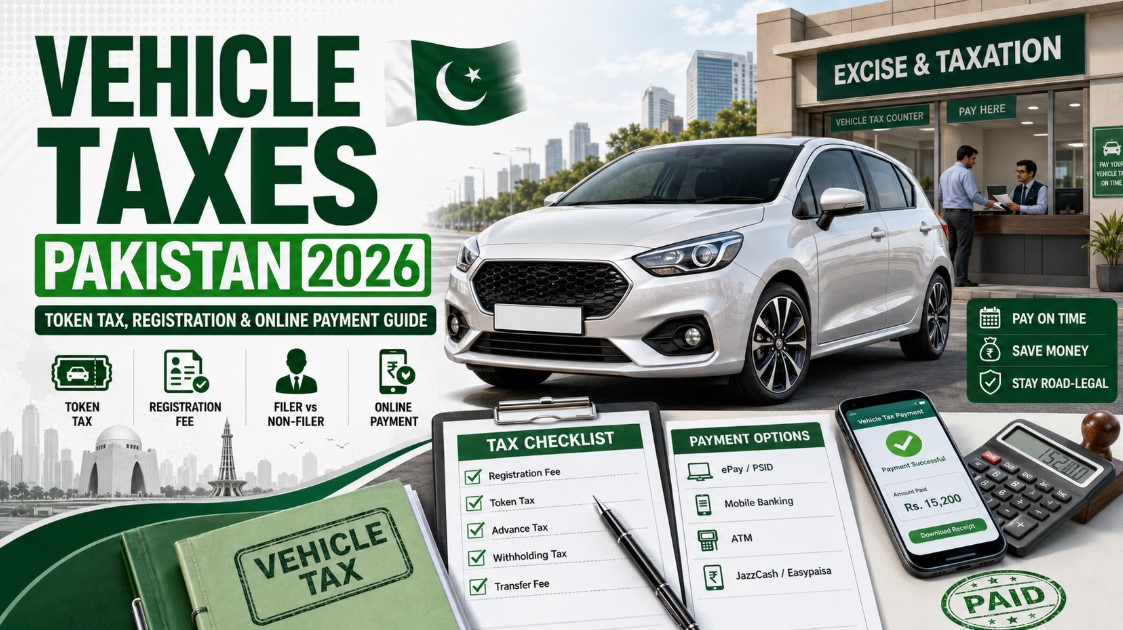
Knowing how vehicle taxes Pakistan rules work saves every car owner real money. Moreover, these taxes changed a lot under recent budgets and now depend heavily on your filer status. In this post, you will learn every major tax in simple steps. Furthermore, this guide covers token tax, registration fees, withholding tax, and online payment in clear detail.
To start with the basics, owning a car in Pakistan means paying several taxes, not one. First, you pay taxes when you register the vehicle. Next, you pay an annual token tax every year. Finally, you pay extra if you transfer ownership later. Therefore, this post breaks each tax down so you never overpay.
What Vehicle Taxes Cover
Vehicle taxes fund roads, records, and public services. Specifically, they keep your car legal on Pakistani roads. Without them, you cannot drive, transfer, or sell your vehicle. So, paying on time protects both your money and your record.
In practice, the vehicle taxes Pakistan system has two layers. Firstly, the federal government collects income-related taxes through the FBR. Secondly, each province collects its own token and registration charges. As a result, your total bill depends on where you live. Above all, your filer status changes how much you pay.
These taxes also affect resale and transfer. For example, unpaid token tax blocks any ownership change. Likewise, it can lead to fines at police checkpoints. Therefore, treating these dues seriously avoids future trouble. Indeed, a clean tax record makes selling your car far easier.
Main Types of Vehicle Taxes
Several distinct taxes apply across a car’s life. Each one has a different purpose and timing. Below is a quick overview before the details.
Tax Type
When You Pay
Collected By
Registration fee
Once, at first registration
Provincial Excise
Advance tax (231B)
Once, at registration
Federal (FBR)
Annual token tax
Every year
Provincial Excise
Withholding tax (234)
Yearly, with token
Federal (FBR)
Transfer of ownership fee
When buying/selling used
Provincial Excise
As the table shows, some taxes are one-time and others repeat. Therefore, planning for both types is smart. Moreover, knowing who collects each helps you pay the right office.
Registration Fee Explained
Registration is the first cost when you buy a new car. Specifically, the provincial Excise department charges a one-time registration fee. Today, this fee is based on your vehicle’s invoice value, not just engine size. So, a pricier car pays a higher registration fee.
Generally, the rate rises with engine capacity and value. For example, small cars up to 1000cc often pay around 1% of value. Meanwhile, mid-range cars pay closer to 2%, and larger cars pay more. However, exact percentages differ slightly by province. Therefore, always confirm the current rate on your provincial Excise website.
This fee also covers your number plates and registration card. In Sindh, for instance, a smart vehicle card costs an extra Rs 750. Additionally, this same fee applies when replacing an old booklet with a smart card. So, factor these small charges into your total budget.
Advance Tax at Registration (231B)
Advance tax is a federal charge collected at registration. Under Section 231B, the FBR takes this tax through the Excise department. Importantly, it is now calculated as a percentage of your vehicle’s value. Moreover, the rate rises with engine capacity.
Below is the approximate filer schedule for the current year. Always verify these figures with the FBR before paying.
Engine Capacity
Advance Tax (Filer)
Up to 850cc
0.5% of value
851 – 1000cc
1% of value
1001 – 1300cc
1.5% of value
1301 – 1600cc
2% of value
1601 – 1800cc
3% of value
1801cc and above
5% to 10% of value
Notably, two rules can lower this amount. Firstly, the rate drops by 10% each year from the first registration date. Secondly, filers pay far less than non-filers. In fact, non-filers usually pay double this advance tax. Therefore, becoming a filer before buying a car saves a large sum.
For imported vehicles, this tax applies after customs clearance. You can learn that earlier stage in our vehicle customs Pakistan clearance guide. So, an imported car owner should plan both stages together. Consequently, the total cost becomes clear before the car reaches the road.
Annual Token Tax
Token tax is the yearly fee that keeps your car legal. Every registered owner must pay it to the provincial Excise. Furthermore, the tax year runs from 1 July to 30 June. So, your token is due each financial year, not the calendar year.
Rates differ widely between provinces. Therefore, the same car can cost more in one province than another. Below are the key provincial systems explained.
Token Tax in Punjab
Punjab switched to a value-based token system for cars. Specifically, the annual amount depends on your car’s invoice value. Cars valued between Rs 1,000,000 and Rs 2,000,000 pay 0.2% of value yearly. Meanwhile, cars above Rs 2,000,000 pay 0.3% yearly.
However, small cars enjoy a special option. Vehicles up to 1000cc can pay a one-time lifetime token of Rs 20,000. After that, you never pay annual token again. Moreover, Punjab gives a 10% rebate if you pay before 31 August. So, early payment through the ePay Punjab app saves money every year.
Token Tax in Sindh
Sindh uses an engine-capacity system under its 1958 tax law. Generally, smaller engines pay less, and larger engines pay more. For motorcycles, the annual token is only Rs 80. For large cars of 2000cc and above, the combined yearly amount can reach around Rs 12,000 for filers.
To pay in Sindh, the Excise department offers an online system. Specifically, you can use excise.gos.pk or the e-Payment GOS app. After entering your details, the system generates a PSID for payment. Additionally, you can verify your vehicle record online too. Our guide on how to verify your vehicle in Sindh explains that simple step.
Token Tax in KPK and Islamabad
KPK and Islamabad follow the federal withholding schedule closely. In KPK, for example, an 1800cc car owner who files pays around Rs 6,000 yearly. By contrast, a non-filer pays about Rs 12,000 for the same car. So, the filer advantage is exactly double here.
Islamabad applies a progressive engine-based schedule as well. Moreover, motorcycles in KPK can choose a one-time lifetime token. Therefore, owners in these regions should check their exact bracket first. Ultimately, filing taxes cuts the bill sharply in both areas.
Withholding Tax with Token (234)
Withholding tax is a yearly federal charge under Section 234. Importantly, it is collected together with your annual token tax. The amount depends on engine capacity and your filer status. So, larger engines pay more, and non-filers pay double.
However, useful exemptions exist for many owners. Firstly, vehicles 10 years or older are fully exempt from this tax. Secondly, motorcycles and government vehicles are also exempt. Still, older cars must pay 75% of the regular token tax. Therefore, an old car is cheaper but not entirely free of dues.
This tax is adjustable against your yearly income tax. In practice, filers can claim it back when filing returns. Meanwhile, non-filers simply lose the higher amount. Consequently, the vehicle taxes Pakistan system rewards filers twice over.
Transfer of Ownership Tax
Transfer tax applies when you buy or sell a used car. Specifically, the new owner pays a fee to update the registration. This charge varies by engine capacity and province. So, a bigger engine usually means a higher transfer fee.
Before any transfer, one rule is strict. The seller must clear all outstanding token dues first. Otherwise, the Excise department will not process the change. Moreover, you need a Transfer of Ownership (T.O.) form and both CNIC copies. Additionally, the original registration book is required.
For safety, buyers should also verify the car’s full record. In fact, a quick check prevents fraud and hidden dues. Therefore, confirm the vehicle status before paying the seller. Indeed, this single step protects your money during any deal.
Filer vs Non-Filer: The Big Difference
Filer status is the biggest factor in your tax bill. Simply put, filers pay far less than non-filers everywhere. Across vehicle taxes, non-filers usually pay double the rate. Therefore, this gap adds up to large sums over time.
Below is a simple view of how status changes costs.
Situation
Filer
Non-Filer
Advance tax at registration
Standard rate
Around double
Annual withholding tax
Standard rate
Around double
Overall yearly cost
Lower
Much higher
To become a filer, you only need to file an income tax return. Moreover, the process is free and fully online through the FBR. After filing, your name appears on the Active Taxpayer List (ATL). You can check your status by CNIC at fbr.gov.pk. So, filing once unlocks lower vehicle taxes Pakistan rates for good.
Exemptions You Should Know
Several exemptions can reduce or remove certain taxes. Firstly, cars aged 10 years or more skip the withholding tax entirely. Secondly, motorcycles are exempt from this federal tax. Thirdly, government vehicles and foreign diplomats are exempt too.
However, exemptions are not total in every case. For example, an old car still pays 75% of its token tax. Likewise, registration and transfer fees still apply on used deals. Therefore, read each rule carefully before assuming a full waiver. In short, exemptions help, but some dues always remain.
Penalties for Late Payment
Late payment is costly and easy to avoid. New cars, firstly, must be registered within 30 days of purchase. Otherwise, escalating penalties apply on top of the registration fee. The longer you wait, the higher the fine grows.
Below is the rough penalty ladder for cars.
Delay After Purchase
Approximate Penalty
31 – 60 days
Rs 10,000
91 – 120 days
Rs 50,000
Beyond 180 days
Up to Rs 200,000
Unpaid token tax also creates serious problems. For instance, it blocks any transfer of ownership. Moreover, traffic and Excise officials can impound your car at checkpoints. Therefore, paying on time keeps your vehicle safe and legal. Consequently, a small yearly payment avoids a heavy future fine.
How to Pay Vehicle Tax Online
Paying online is now quick and simple in most provinces. Below is the general process from start to finish.
Open the right portal. First, use ePay Punjab or MTMIS Punjab in Punjab. Meanwhile, use excise.gos.pk in Sindh.
Enter your details. Next, type your vehicle registration number and CNIC.
Generate a PSID. Then, the system calculates your dues and creates a PSID number.
Choose a payment method. After that, pay via mobile banking, ATM, JazzCash, or Easypaisa.
Save your receipt. Finally, keep the digital confirmation for your records.
In Punjab, the ePay app generates a 17-digit PSID for payment. Moreover, you can pay at major banks like HBL, UBL, and NBP. In Sindh, the e-Payment GOS app works the same way. Therefore, you rarely need to visit an Excise office in person.
Tips to Lower Your Vehicle Tax
A few smart habits can cut your yearly bill. Therefore, keep these tips in mind.
File your tax return. Becoming a filer can halve your vehicle taxes.
Pay before 31 August. Early payment earns a 10% token rebate in Punjab.
Pick lifetime token. For cars up to 1000cc, the one-time option saves yearly fees.
Buy smaller engines. Lower-cc cars face much lighter tax brackets.
Verify before transfer. Checking dues first avoids inherited penalties.
By applying these tips, you reduce both stress and cost. Moreover, filing taxes brings benefits far beyond vehicles. Indeed, filers also save on property, banking, and more.
Communities and Help
Active communities make tax season far easier. For example, Facebook groups for car owners share live payment tips daily. Similarly, forums like PakWheels discuss token tax and filer issues often. Moreover, members warn each other about deadlines and penalties.
Beyond online groups, professional help is widely available. Specifically, registered tax advisors can file returns and calculate dues for you. Additionally, provincial Excise help desks answer payment questions directly. So, you are never stuck during the process. Indeed, one good advisor can save you both time and money.
These communities also track budget changes each year. For instance, members post quickly when new rates take effect on 1 July. Likewise, they share official calculator links and payment guides. Therefore, joining one or two groups keeps you fully updated. Ultimately, shared knowledge protects every vehicle owner.
Related Obligations After Tax
Paying tax is only one part of legal car ownership. After registration, a few more steps complete your duties. For commercial vehicles, a fitness certificate is also required. You can read the full process in our vehicle fitness certificate Pakistan guide.
Beyond fitness, keeping your records clean is essential. In fact, verifying your car online prevents future disputes. Moreover, imported cars must complete customs duties first. Therefore, these linked steps work together for full compliance. So, handling them early keeps your vehicle fully road-legal.
Frequently Asked Questions
What are the main vehicle taxes Pakistan owners must pay?
Owners pay a registration fee, advance tax, and annual token tax. Moreover, withholding tax is collected yearly with the token. Additionally, a transfer fee applies when buying or selling a used car. Therefore, several taxes apply across a vehicle’s life.
How much is the annual token tax in Pakistan?
Token tax depends on your province and vehicle. In Punjab, cars pay 0.2% to 0.3% of value yearly. Meanwhile, Sindh charges by engine capacity, and motorcycles pay only Rs 80. For exact figures, always check your provincial Excise calculator.
Do filers pay less vehicle tax than non-filers?
Yes, filers pay significantly less across the board. In most cases, non-filers pay double the advance and withholding tax. Therefore, filing your return is the easiest way to save. Moreover, becoming a filer is free and fully online.
Are old cars exempt from vehicle tax?
Cars aged 10 years or more are exempt from withholding tax. Likewise, motorcycles and government vehicles are exempt too. However, old cars still pay 75% of the annual token tax. So, exemptions help but do not remove every charge.
How can I pay my vehicle tax online?
You can pay through your provincial Excise portal easily. In Punjab, use the ePay Punjab app to generate a PSID. In Sindh, use excise.gos.pk or the e-Payment GOS app. Then, pay via mobile banking, ATM, or Easypaisa.
What happens if I pay my token tax late?
Late payment leads to fines and serious problems. Specifically, unpaid token tax blocks any ownership transfer. Moreover, your car can be impounded at checkpoints. Therefore, paying on time avoids both penalties and hassle.