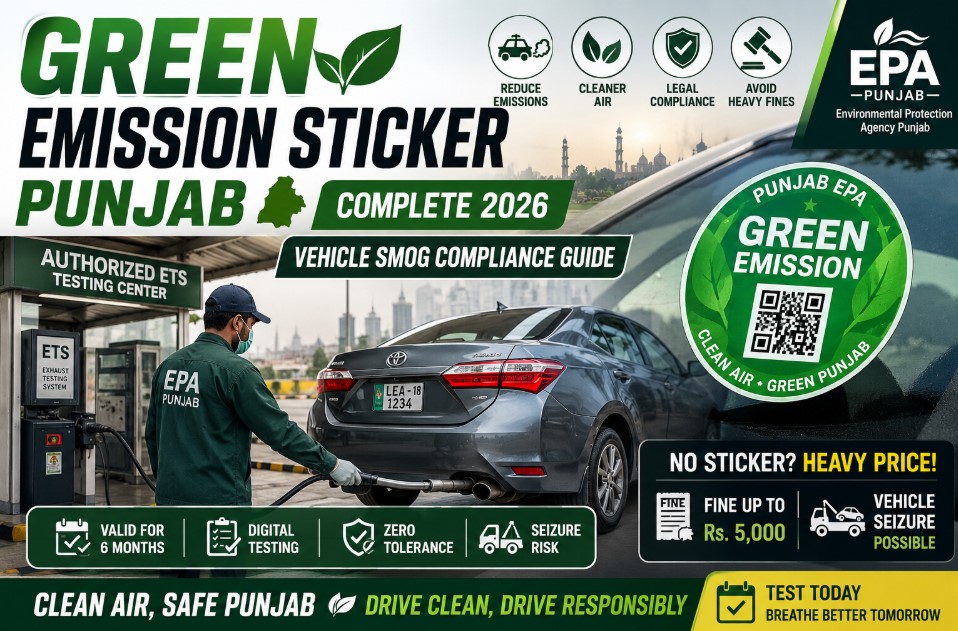
Green emission sticker Punjab mandates have transformed the legal requirements for operating an automobile within the province in 2026. Consequently, the Punjab Environmental Protection Agency (EPA) has launched an aggressive anti-pollution campaign to combat the severe winter toxic smog. Therefore, every vehicle operating on the roads of Lahore and other major districts must now strictly comply with these environmental standards.
In this post, we will look at the comprehensive procedure for obtaining your official compliance certificate. We will explore the authorized testing center locations, the step-by-step inspection protocol, and the latest fee structures. Furthermore, this guide outlines the severe penalties, roadside checks, and impoundment laws currently active for non-compliant drivers. Whether you own a private motorcycle, a family sedan, or a heavy cargo truck, this ultimate guide covers everything you need to know about the green emission sticker Punjab today.
The Environmental Crisis: Understanding the Smog Drive
The province of Punjab faces an unprecedented air quality challenge every winter. Specifically, the metropolitan hub of Lahore frequently ranks as the most polluted city globally on the real-time Air Quality Index (AQI). Particulate matter (PM2.5) levels regularly exceed safe international limits by over 30 times. Consequently, vehicular emissions have been identified as a primary contributor to this toxic atmospheric blanket.
To combat this environmental hazard, the Punjab government has shifted from soft warnings to a zero-tolerance enforcement model. The Exhaust Testing System (ETS) was formally introduced to regulate moving sources of pollution. Therefore, acquiring a green emission sticker Punjab is no longer an optional environmental gesture. Instead, it is a strict legal necessity for survival on the roads. The current campaign targets both carbon monoxide and noise pollution levels simultaneously to clean up the urban corridors.
What is the Exhaust Testing System (ETS)?
The Exhaust Testing System is a technology-driven vehicle screening program managed by the Punjab EPA. This automated infrastructure replaces old, corrupted manual emission checks with digital sensors.
The Mechanics of the Test
When a vehicle enters an authorized testing booth, specialized gas analyzers are attached to the exhaust pipe. These sensors measure the density of hydrocarbons, nitrous oxides, and carbon monoxide passing through the silencer. Furthermore, digital decibel meters are placed near the engine to evaluate noise pollution levels. The data is processed instantly by a central cloud server. Consequently, the human operator cannot alter the final pass or fail results.
The Compliance Marker
If your vehicle successfully meets the Punjab Environmental Quality Standards (PEQS), you are issued a physical token. This token is the official green emission sticker Punjab, which features a secure QR code. Drivers must prominently display this adhesive marker on the front windshield of their automobile. Traffic wardens can scan this code from a distance to verify your vehicle’s live compliance data instantly.
Priority Targets and the 3-Year Exemption Rule
The implementation of the ETS policy follows a structured, phase-wise rollout strategy across the province. Consequently, some vehicles face immediate enforcement while others enjoy temporary relief.
Vehicles Prioritized in the First Phase
The Punjab EPA has placed special focus on older mid-tier vehicles. Specifically, automobiles manufactured between the years 2010 and 2015 are the primary targets of current roadside checkpoints. Statistics reveal that these vehicles are highly likely to have worn-out catalytic converters. Therefore, tracking down a green emission sticker Punjab center is an urgent priority if your car falls within this age bracket.
The 3-Year Brand-New Exemption
Conversely, the government provides a clear exemption window for newer automobiles. Vehicles that are not older than three years are exempt from mandatory emission testing.
Current Standing: In early 2026, any vehicle manufactured in 2023, 2024, or later does not require immediate screening.
The Logic: Modern factory-fresh engines utilize advanced fuel injection and clean exhaust filters. Consequently, they are automatically presumed to meet state environmental parameters.
However, once your vehicle crosses its third anniversary, it must enter the regular testing pool immediately.
Authorized ETS Testing Booth Locations in Lahore
To facilitate the massive population of motorists, the Punjab government has established multiple digital checking hubs. These booths operate under extended hours to prevent massive traffic congestion.
Major Urban Deployment Points
Currently, active testing booths are deployed across primary thoroughfares in Lahore. For instance, you can find fully operational kiosks at:
Mall Road: Positioned near the Governor House corridor for central commuters.
Ferozepur Road: Conveniently located near the main metro transit lines.
Johar Town: Situated near the main expo center loop for western residents.
DHA Lahore: Multiple mobile van stations are active across Phase 5 and Phase 6 commercial zones.
Canal Bank Road: Dedicated testing points near the Harbanspura intersection.
Operating Hours and Timing Strategy
The testing booths are structured to accommodate busy working professionals. Specifically, they remain open during two distinct daily shifts. The morning shift runs from 7:00 AM until 12:30 PM. Meanwhile, the evening shift opens at 5:00 PM and runs until 10:30 PM. Choosing the late-night shift is highly recommended to avoid long daytime queues.
Step-by-Step Guide: How to Get Your Sticker
Securing your green compliance marker is a fast process if your engine is well-maintained. Follow this official roadmap to ensure a successful testing routine.
Step 1: Visual Inspection and Document Review
First, drive your vehicle to the nearest authorized ETS kiosk. The on-duty operator will perform a quick visual review of your engine bay. You must present your valid identification documents. Keeping your official car buying documents Pakistan folder updated is useful here, as the operator will cross-reference your chassis number with the excise database.
Step 2: Attaching the Diagnostic Equipment
Second, the technician will insert the automated analyzer probe into your vehicle’s exhaust tailpipe. You will be instructed to keep the engine idling at a specific RPM range. The digital system will analyze the gas output for approximately 5 minutes. Simultaneously, the acoustic sensors will register your engine’s decibel levels.
Step 3: Processing the Digital Certificate
Third, the server will evaluate the data against the PEQS threshold. If your vehicle passes, the system generates a digital certificate immediately. The operator will then hand over your secure green emission sticker Punjab token. You must paste it onto the top-left corner of your front windshield.
The Protocol for Failed Tests
However, if your vehicle exceeds the pollution limits, you will receive a diagnostic rejection slip. This slip details the exact areas of failure, such as high carbon density or a leaking silencer. The state provides a mandatory 7-day grace period to fix the mechanical faults. You must visit a certified mechanic, perform the necessary repairs, and reappear for a re-test within one week to avoid legal penalties.
Penalties, Fines, and the Roadside Seizure Law
The Punjab government has backed the ETS initiative with severe legal penalties. The environmental protection teams collaborate directly with the Lahore Traffic Police to run aggressive joint checkpoints.
The Initial Fine Structure
If you are caught driving a vehicle without a valid green emission sticker Punjab token, you face an immediate financial penalty.
First-Time Offense: A direct traffic challan of Rs. 2,000 is issued on the spot.
Repeat Offenses: If you are caught a second time without compliance, the fine escalates sharply to Rs. 5,000.
The Absolute Seizure Mandate
Beyond standard traffic fines, the EPA has implemented its toughest anti-pollution directive yet. Any commercial or private automobile found operating without a valid exhaust certificate during peak smog days faces instant confiscation. The vehicle is towed away to a designated police yard. Recovering your impounded car requires paying the accumulated fines, paying the storage yard fee, and providing an official undertaking that you will transport the vehicle directly to an ETS center via a flatbed tow truck.
The Vital Role of the Green Sticker in Used Car Sales
The implementation of strict environmental screening has fundamentally changed the second-hand automobile market in Pakistan. Consequently, buyers must alter their purchasing habits to stay protected.
A Critical Component of Vehicle Evaluation
Historically, buyers only checked the paint condition and engine sound before closing a deal. However, in 2026, running a digital exhaust check has become a core safety pillar. Incorporating this step into your standard used car inspection Pakistan guide routine is highly critical. A car might look pristine, but a hidden failure in the catalytic converter can cost you over Rs. 150,000 in replacements.
The Risk of Inherited Liabilities
If you purchase an older vehicle without a certified green emission sticker Punjab history, you inherit all its environmental liabilities. The excise department will flag the vehicle file as non-compliant during ownership processing. Therefore, smart buyers demand a fresh ETS passing certificate from the seller before signing any sale agreement or transferring funds.
Technical Parameters: What the Machines Evaluate
To pass the emission screening on your first attempt, you should understand the precise technical metrics evaluated by the digital bays.
1. Carbon Monoxide (CO) Volume
Carbon monoxide is a highly toxic, colorless gas produced by incomplete fuel combustion. The PEQS limits require your vehicle’s CO output to stay below a strict percentage threshold. High CO levels usually point to a dirty oxygen sensor, a clogged air filter, or an incorrect air-fuel mixture.
2. Hydrocarbon (HC) Density
Hydrocarbons are essentially unburnt fuel particles escaping through your exhaust. High HC density indicates that your engine is not burning its fuel efficiently. This issue is frequently caused by worn-out spark plugs, a malfunctioning ignition coil, or low engine compression.
3. Noise and Decibel Limitations
The acoustic test ensures your vehicle does not contribute to urban noise pollution. The legal limit is generally capped at 85 decibels from a distance of 7.5 meters. Altered exhaust pipes, damaged mufflers, or the installation of illegal pressure horns will result in an immediate failure.
Maintenance Tips to Pass the ETS Test Safely
Preparing your vehicle before visiting an inspection booth is the best way to avoid rejection and fines. Simple maintenance can drastically improve your exhaust metrics.
Perform a Premium Engine Tune-Up
Replace your dirty spark plugs and install a fresh air filter before your test date. A clean air filter ensures your engine receives enough oxygen for complete combustion. Consequently, your carbon monoxide emissions will drop significantly.
Clean the Catalytic Converter
The catalytic converter is responsible for converting toxic gases into safer emissions. Over time, it can become clogged with carbon soot. Use a high-quality fuel additive or visit a professional workshop for a specialized exhaust flush. This measure alone can save an older vehicle from failing the test.
Check for Exhaust Leaks
Inspect your silencer pipe for any physical holes or loose joints. Exhaust leaks can cause incorrect sensor readouts at the testing booth. Therefore, ensure your entire exhaust system is perfectly sealed from the engine block to the tailpipe.
Comparison Table: ETS Status and Requirements (2026)
Vehicle Category
Manufacturing Age
Test Cost (2026)
Sticker Validity
Mandatory Actions
Brand-New Cars
Under 3 Years Old
Exempt
N/A
No action required until year 4
Mid-Tier Sedans
2010 to 2015 Models
Free (Phase 1)
6 Months
Immediate testing mandatory
Commercial Trucks
All Models
Free / Subsidized
6 Months
High-priority screening required
Motorcycles / Rickshaws
All Models
Free / Subsidized
6 Months
Random roadside checks active
✅ FAQ Section
What is the primary cost of a green emission sticker Punjab token?
During the initial launch phases in 2026, the government has kept the basic emission testing service free of charge at all authorized urban kiosks. This encourages maximum compliance ahead of the heavy smog season.
How long is the green emission sticker valid?
A successful green emission sticker Punjab certificate is valid for exactly 6 months. Consequently, vehicle owners must reappear for a digital exhaust screening twice a year to keep their road legality active.
Where should I paste the green sticker on my car?
The compliance sticker must be visibly pasted on the top-left or top-right corner of your front windshield. This placement allows traffic cameras and wardens to verify your compliance status easily.
What happens if my vehicle fails the exhaust test?
If your vehicle fails, you receive a diagnostic sheet and a 7-day grace period. You must repair the specified mechanical faults and return to any authorized kiosk for a free re-test within one week.
Are electric vehicles (EVs) required to get a green sticker?
No, electric vehicles produce zero tailpipe emissions. Therefore, they are entirely exempt from the Exhaust Testing System program. Owners can show their vehicle registration smart card indicating “EV” status at checkpoints.
Summary and Final Actionable Tips
In summary, staying compliant with the green emission sticker Punjab regulations is your primary duty as a responsible motorist in 2026. The advanced digitalization of environmental laws means that evasion is no longer possible. First, check your vehicle’s manufacturing year to determine if you fall under the mandatory screening tier. Second, perform a basic engine tune-up to ensure your exhaust emissions stay safely within the PEQS thresholds.
Always prioritize getting tested before the heavy winter smog sets in to avoid the massive queues at urban centers. By keeping your vehicle clean and maintaining an active compliance sticker, you protect your wallet from heavy impoundment fines. Most importantly, you contribute directly to cleaner, safer air for the future generations of Punjab. Drive clean, book your test early, and secure your green sticker today!