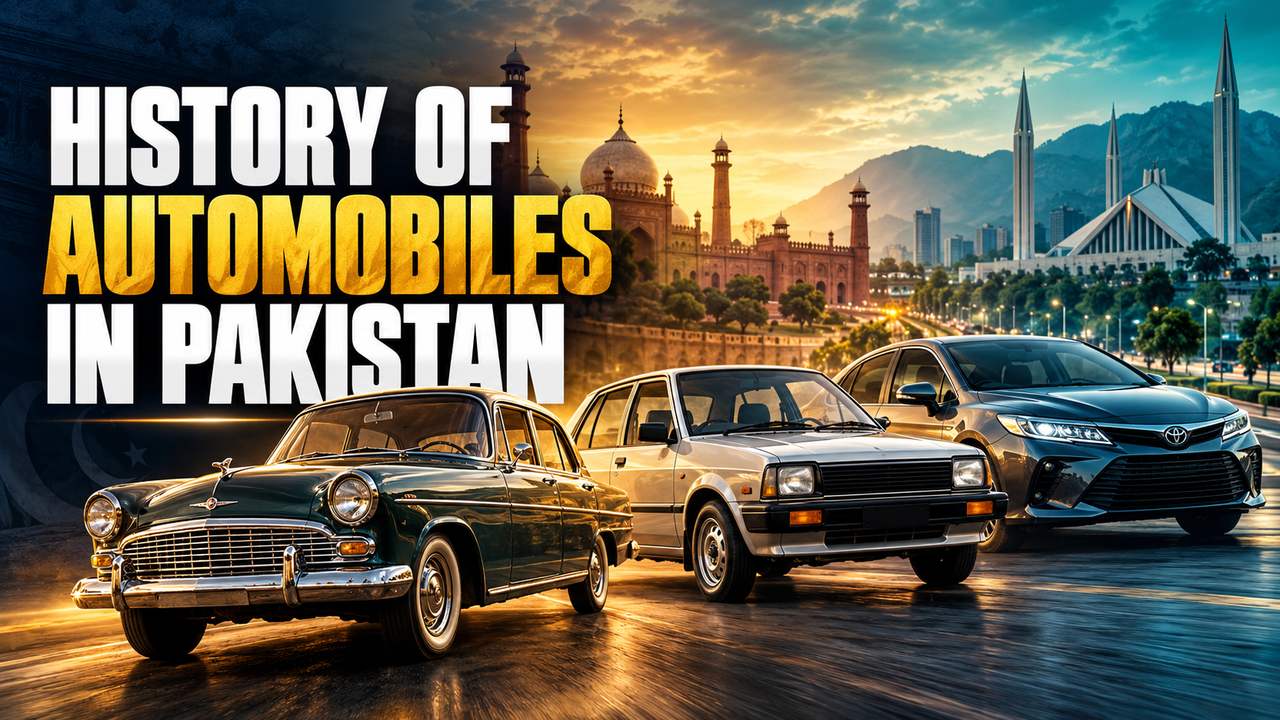
From Bedford trucks in the 1950s to Chinese electric SUVs in 2026, cars in Pakistan have come a long way. Yet few people know how the local industry grew, especially in its early years. So this guide walks through the automobile history of Pakistan, decade by decade.
In addition, it covers the key companies, policies and turning points.
Automobile History in Pakistan at a Glance
To begin with, here is a quick timeline of the biggest milestones. After the table, we then explain each era in more detail.
Year
Milestone
1953
Local assembly of Vauxhall cars and Bedford trucks begins in Karachi.
1972
Government forms Pakistan Automobile Corporation (PACO) and nationalises carmakers.
1982
Suzuki joint venture starts, and the SS80 (Suzuki FX) enters production.
1989
Suzuki Mehran launches, and Indus Motor Company comes into being.
1993
Indus Motor starts Toyota production in Karachi.
1994
Honda Atlas rolls out its first car, and PAMA is formed.
2006
Suzuki offers factory-fitted CNG on the Liana.
2016
Auto Policy 2016-21 invites new brands.
2017
Kia Lucky Motors and Hyundai Nishat start operations.
2019
Kia plant starts work, and the Mehran ends production.
2021
Government announces the 2021-26 auto policy.
2024
BYD enters Pakistan with Mega Motors.
2026
Personal Baggage car imports end, and Geely launches with Bestway.
The 1950s: Where Automobile History in Pakistan Starts
At first, the car industry in Pakistan was small. In 1953, a plant in Karachi began assembling Vauxhall cars and Bedford trucks with General Motors. Similarly, Ford trucks arrived through a local partner around the same time.
Generally, the 1950s and 1960s brought kit assembly, not real manufacturing. For example, Haroon Industries assembled Skoda cars from kits in 1956. Later, Jeep models and Lambretta and Vespa scooters, as well as Massey Ferguson tractors, joined the market.
Parts makers also appeared during this period. For instance, General Tyre started in 1963. As a result, a small supplier base began to form around Karachi.
In short, the first chapter of automobile history in Pakistan was about assembly, not design. Even so, it trained the first generation of local engineers and mechanics.
The 1970s: Nationalisation and PACO
The 1970s, however, changed everything. In 1972, the government formed the Pakistan Automobile Corporation (PACO) and took over many private auto companies. For example, Ghandhara Motors became National Motors.
Thus, nationalisation gave the state control of the industry. However, it also slowed new investment for several years. Meanwhile, motorcycles kept growing, because Dawood Yamaha brought Yamaha bikes in 1974, and Suzuki bikes followed in 1976.
Even so, ordinary families still struggled to afford a car. In fact, this gap set the stage for the next big change.
The 1980s: Suzuki Arrives and Changes Everything
The 1980s brought Japanese partners into the country. In 1982, the government and Suzuki Motor Corporation formed a joint venture, which later became Pak Suzuki Motor Company. In the same year, Awami Auto also began producing the SS80, which many people remember as the Suzuki FX.
Then, in 1989, Suzuki launched the Mehran as the SS80’s replacement. In fact, the Mehran stayed in production for about three decades. Similarly, the first-generation Cultus, known as the Khyber, entered production in 1989.
Similarly, trucks and buses got new partners. For example, Hinopak Motors began in 1986, and Ghandhara Nissan started producing Nissan Diesel trucks in 1987.
The 1990s: Toyota and Honda Join the Market
The 1990s created the “big three” that still lead the market. Firstly, House of Habib companies, Toyota Motor Corporation and Toyota Tsusho formed Indus Motor Company as a joint venture in 1989. Then, in 1993, it began production at Port Qasim, Karachi, at about 20 vehicles a day.
Since then, daily output has grown to 288 units on a double shift. In fact, the company says it has sold more than 1.1 million vehicles.
Honda followed soon after, although its first car took a little longer. In November 1992, Honda and the Atlas Group set up Honda Atlas Cars as a new company. After that, its first car rolled off the line on 26 May 1994. In addition, carmakers formed the Pakistan Automotive Manufacturers Association (PAMA) in the same year.
As a result, buyers finally had real choice in the sedan market. In fact, the Corolla and Civic rivalry that started in this decade still shapes the market today. Our Toyota Corolla review shows how far that model has come since those days.
Motorcycles: The Other Half of the Story
Of course, cars get the headlines. However, motorcycles move most families, so no account of automobile history in Pakistan is complete without them.
Year
Motorcycle milestone
1962
Lambretta scooters begin local production
1974
Dawood Yamaha introduces Yamaha motorcycles
1976
Suzuki motorcycles arrive through Sindh Engineering
Motorcycle production passes 2.5 million units a year
2021
Jolta Electric starts electric motorcycle production
The biggest shift came during the 2000s. Because many local assemblers copied the Honda CD70 design with Chinese parts, prices dropped sharply. As a result, a basic bike came within reach of millions of working families.
Today, brands such as Honda, Yamaha, Suzuki, United and Road Prince compete for those buyers. Our upcoming guide to motorbike brands in Pakistan compares them in detail.
The 2000s: Growth, Bikes and the First Auto Policy
The 2000s brought rapid growth, especially in motorcycles. In particular, many new assemblers began building copies of the Honda CD70 with Chinese parts. Because of this, bikes became affordable for millions of families.
Meanwhile, the government launched its first formal auto policy in the mid-2000s, so that local assembly could grow under clearer rules. Suzuki also offered factory-fitted CNG on the Liana in 2006, because CNG was popular at the time.
However, the decade ended badly for the car industry in Pakistan. After 2008, the rupee fell and several automakers then cut production or left. Fortunately, sales recovered soon, by around 2010.
2016 to 2021: New Brands Under the Auto Policy
During the 2010s, the Auto Policy 2016-21 offered tax incentives to new manufacturers. As a result, a wave of new brands entered the market.
Company
Brand
Key early date
Kia Lucky Motors (now Lucky Motor Corporation)
Kia, later Peugeot
Founded 2017; plant operational September 2019
Hyundai Nishat Motor
Hyundai
Founded 2017
MG JW Automobile
MG
Signed an MOU with MG Motor UK in 2016
Master Motors
Changan
Assembler of Changan cars
Sazgar
Haval and BAIC
Assembler of Chinese SUVs
Meanwhile, the old guard also changed. For example, Suzuki ended the Mehran in March 2019, after about 30 years. Later, in December 2021, the government announced a new five-year auto policy for 2021 to 2026. Also, Jolta Electric began making electric motorcycles in 2021.
2022 to 2026: A New Chapter in Automobile History in Pakistan
The years after 2021, however, were rough. Imports faced curbs, the rupee weakened and the SBP policy rate reached 22% in 2023. Because of this, car loans became very costly, and sales fell sharply. Our guide to car loan rates in Pakistan shows how rates have eased since then.
Auto financing also tells the same story. Bank auto loans hit a record of about Rs 368 billion in June 2022. However, they fell after that, and then climbed back to about Rs 386 billion by July 2026.
Still, new technology arrived. For instance, Indus Motor launched the Corolla Cross in FY 2023-24 as its first locally made hybrid. Then, in August 2024, BYD entered Pakistan with Mega Motors, a subsidiary of Hub Power Company.
2025 and 2026 also brought big policy shifts. In September 2025, Pakistan allowed commercial import of used vehicles up to five years old.
Later, in January 2026, the government ended the Personal Baggage route for used cars. Meanwhile, Suzuki launched the Fronx in May 2026. Finally, on 25 October 2026, Geely officially launched in Pakistan with Bestway Group.
Notably, talks on the next auto policy were still under way in October 2026. Therefore, this chapter of automobile history in Pakistan is still unfolding. For the latest on electric models, see our guide to electric cars in Pakistan.
Iconic Cars in Automobile History in Pakistan
Some cars did more than sell well. Instead, they defined their era and changed what families expected from a car.
Car
Years
Why it mattered
Suzuki SS80 (FX)
From 1982
First mass-market Suzuki small car
Suzuki Mehran
1989 to 2019
Affordable family car for three decades
Suzuki Khyber
1989 to 2000
First-generation Cultus hatchback
Toyota Corolla
From 1993
Set the standard for family sedans
Honda Civic
From 1994
Brought sporty style to the sedan market
Toyota Corolla Cross Hybrid
From FY 2023-24
First locally made hybrid from Indus Motor
BYD Atto 3
From 2024
Among the first BYD electric cars sold here
Indeed, each of these models marks a clear chapter in automobile history in Pakistan. For example, the Mehran stands for affordable motoring, while the Corolla Cross Hybrid stands for the move to cleaner cars. Likewise, BYD’s arrival shows how quickly Chinese EV makers have entered the market.
Lessons From Automobile History in Pakistan
Looking back, a few patterns repeat again and again:
Policy drives the market: each new auto policy brought new brands.
The rupee matters: every big currency fall hurt sales and prices.
Interest rates matter: high rates kill car financing quickly.
Small cars rule: the Mehran, Alto and Cultus show demand for affordable cars.
Technology arrives late: hybrids and EVs came years later than in other markets.
Above all, automobile history in Pakistan shows that buyers want more choice and better value. Today, with Chinese, Korean and Japanese brands competing, buyers therefore have more options than ever. Our list of the best cars in Pakistan shows what that choice looks like now.
FAQs
When did automobile history in Pakistan begin?
It began in 1953, when a Karachi plant started assembling Vauxhall cars and Bedford trucks with General Motors. From there, the industry grew step by step, especially after Japanese partners arrived in the 1980s.
Which was the first Suzuki car made in Pakistan?
Awami Auto began producing the Suzuki SS80, known as the FX, in 1982. Later, in 1989, the Mehran replaced it as Suzuki’s main small car.
When did Toyota start production in Pakistan?
Indus Motor Company came into being in 1989. However, it started production in 1993 at its Port Qasim plant in Karachi.
What changed in automobile history in Pakistan after 2016?
The Auto Policy 2016-21 brought new brands such as Kia, Hyundai, MG and Changan. Later, Chinese EV makers like BYD and Geely joined.
Is BYD made in Pakistan?
BYD entered Pakistan in August 2024 with imported models such as the Atto 3, Seal and Sealion 6. Meanwhile, it has announced a local plant at Port Qasim, Karachi.
Final Word
All in all, the car industry here has moved from kit assembly to locally made hybrids and Chinese EVs in about 70 years. Each decade brought new partners and new policies, but also new problems.
Above all, the next auto policy will decide how fast local hybrid and EV production grows. Also, keep an eye on monthly sales data, since it shows which brands are winning. For official sales and production data, visit the Pakistan Automotive Manufacturers Association.