You can learn web development Pakistan students dream about without spending a single rupee. Moreover, the internet is full of free, high-quality courses and tools. In this post, you will get a simple roadmap and the best free resources. Furthermore, this guide shows you how to practice, build projects, and start earning.
To begin, web development is one of the most useful skills today. Specifically, it powers every website and web app you use. As a result, skilled developers are in high demand everywhere. Therefore, when you learn web development Pakistan’s growing tech market opens up for you.
Why Learn Web Development?
Web development brings many strong benefits. Firstly, it is a skill in very high demand. Secondly, it lets you earn through freelancing from home. Thirdly, it opens doors to remote jobs worldwide. So, it is a smart choice for your future.
The best part is that anyone can start. Specifically, you do not need a formal degree to begin. Moreover, your skills and projects matter more than paper. Additionally, all the learning tools are free online. Therefore, cost is never a barrier here.
Pakistan is a great place for this skill. Specifically, our country is a top freelancing nation. Moreover, thousands of Pakistanis earn online through web work. Therefore, this skill fits our market perfectly. Indeed, it can change your income and career.
Front-End, Back-End, and Full-Stack
Web development has three main areas. Basically, each one covers a different part of a website. So, understanding them helps you plan your path. Below is a simple explanation.
Front-end is the part users see and touch. Specifically, it covers the design, buttons, and layout. Moreover, it uses HTML, CSS, and JavaScript. Meanwhile, back-end is the hidden part behind the scenes. Specifically, it handles servers, logic, and databases.
Full-stack combines both sides together. Specifically, a full-stack developer builds the whole website. Moreover, this skill set is highly valued. However, most people start with front-end first. Therefore, learn the basics before you specialize.
What You Need to Start
Starting out needs very little equipment. Basically, a few simple tools are enough. So, you can begin today with what you have. Below is the short list.
You only need a handful of things. Firstly, a basic computer or laptop works fine. Secondly, a steady internet connection is essential. Thirdly, you need a free code editor like VS Code. Moreover, a web browser such as Chrome completes the setup.
One more free tool is very useful. Specifically, create a free GitHub account early. Moreover, GitHub stores and shares your code. Therefore, it becomes your online portfolio. Consequently, these free tools are all you need.
The Free Learning Roadmap
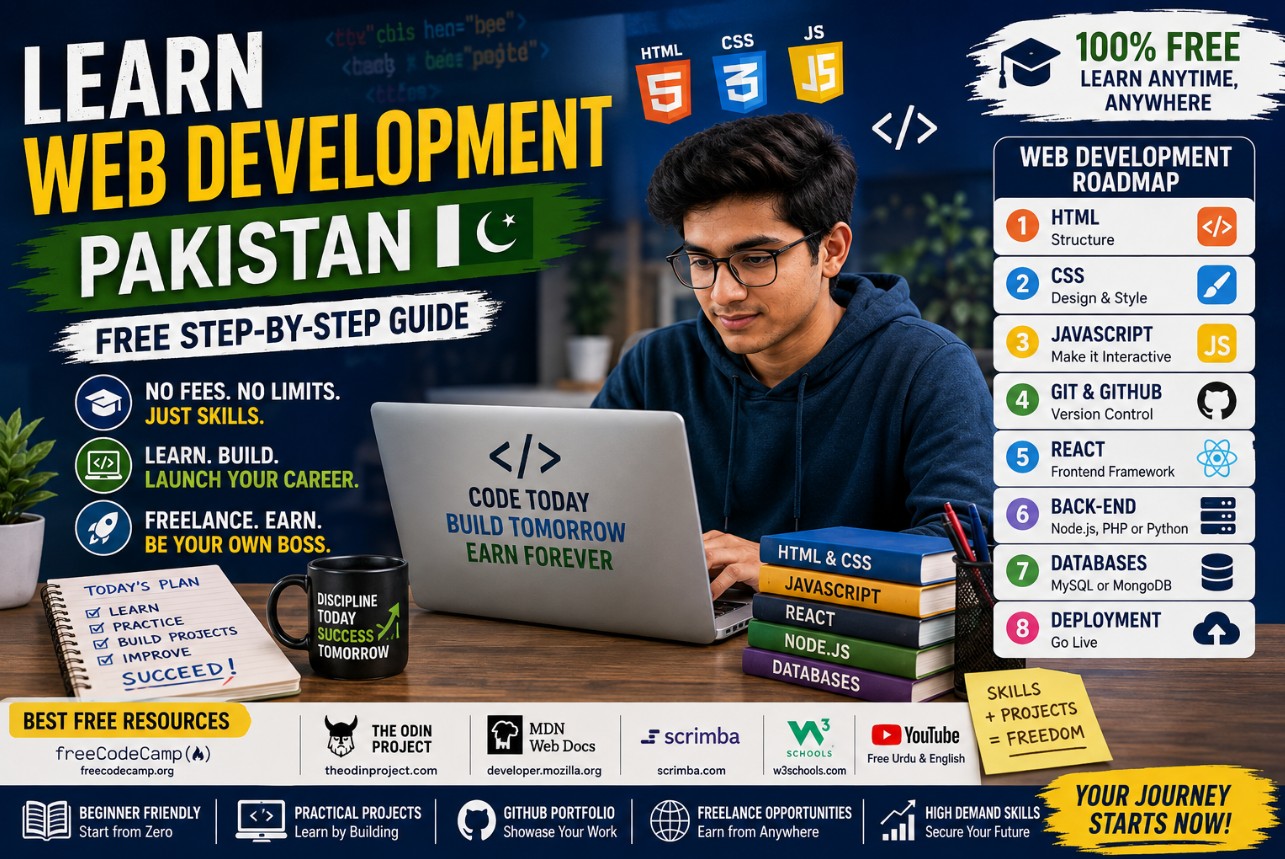
A clear roadmap keeps you from feeling lost. Basically, you learn each skill in the right order. So, follow these steps one by one. The table below shows the path.
Step
What You Learn
1. HTML
The structure of web pages
2. CSS
Styling and responsive design
3. JavaScript
Making pages interactive
4. Git and GitHub
Saving and sharing your code
5. React
A popular front-end framework
6. Back-end
Servers with Node.js, PHP, or Python
7. Databases
Storing data with MySQL or MongoDB
8. Deployment
Putting your website online
As the table shows, HTML and CSS come first. Then, JavaScript adds life to your pages. After that, you move to frameworks and the back-end. Therefore, follow this order for the smoothest journey. Indeed, skipping steps only causes confusion later.
Best Free Websites to Learn
Many free websites teach web development brilliantly. Basically, they offer full courses at zero cost. So, you can pick the ones that suit you. The table below lists the top choices.
Website
Best For
freeCodeCamp
Full free curriculum and certificates
The Odin Project
Full-stack projects
MDN Web Docs
Reference for every tag
Scrimba
Interactive coding from day one
W3Schools
Quick beginner tutorials
YouTube
Free video lessons (English and Urdu)
freeCodeCamp
freeCodeCamp is a top pick for beginners. Basically, it offers a complete, structured, project-based path. So, you learn by building real things. Moreover, it gives free certificates on completion.
This platform is very beginner-friendly. Specifically, it runs in your browser with light setup. Moreover, its 2026 update added new full-stack and database tracks. Therefore, it is an excellent place to start. Indeed, many developers begin their journey here.
The Odin Project
The Odin Project offers a full-stack roadmap. Basically, it is a free, open-source curriculum. So, it takes you from beginner to full-stack developer. Moreover, it focuses heavily on real projects.
This course teaches an important professional skill. Specifically, it trains you to find solutions on your own. Moreover, that skill is vital for real jobs. Therefore, it suits those wanting deep, practical learning. However, it needs a local setup on your computer.
MDN Web Docs
MDN Web Docs is the developer’s reference bible. Basically, Mozilla keeps it free and always updated. So, it explains every HTML tag and CSS rule. Moreover, it also has a full learning section.
Keep MDN open while you build. Specifically, use it to check anything you forget. Moreover, professionals rely on it every day. You can explore it at developer.mozilla.org. Therefore, it is your trusted companion throughout learning.
Scrimba and W3Schools
Two more sites make learning easier. For example, Scrimba lets you code from the very first lesson. Moreover, its interactive style suits hands-on learners. Meanwhile, W3Schools offers simple beginner tutorials. Additionally, it has a built-in editor to practice instantly. Therefore, both are great support tools.
Free Local Options in Pakistan
Pakistan also offers free local learning. Basically, some programs teach web skills at no cost. So, they are worth exploring too. Below are the main ones.
DigiSkills is a strong free government option. Specifically, it teaches WordPress and web basics in Urdu. Moreover, it prepares you for freelancing directly. You can enrol at digiskills.pk. Therefore, it is perfect for Urdu-speaking beginners.
Other free local help exists too. For example, Bano Qabil offers free IT courses in some areas. Likewise, many Urdu YouTube channels teach web development. Moreover, these explain concepts in a familiar language. Therefore, local resources make learning even easier.
A Simple Monthly Plan
A simple plan keeps you moving forward. Basically, it breaks learning into clear stages. So, you always know what to do next. The table below shows a realistic timeline.
Time
Focus
Month 1–3
HTML, CSS, and JavaScript basics
Month 3–8
Real projects and full-stack skills
Ongoing
Deepen JavaScript and push projects to GitHub
As the table shows, the basics come in the first months. Then, you spend more time building real projects. Finally, you keep improving and sharing your work. Therefore, steady progress beats rushing. Indeed, consistency is the real secret.
The WordPress Shortcut
WordPress is a faster route to earning. Basically, it powers over 40% of all websites. So, learning it opens quick freelance work. Moreover, it needs less heavy coding than full development.
This path suits those wanting fast income. Specifically, you can build client websites without deep coding. Moreover, DigiSkills teaches WordPress for free. Therefore, it is a smart shortcut for beginners. However, learning to code still gives deeper career growth.
Build Projects, Not Just Watch
This is the most important tip of all. Basically, watching videos alone will not make you a developer. So, you must build things with your own hands. Moreover, real projects teach far more than tutorials.
Many beginners fall into “tutorial hell”. Specifically, they watch endlessly but never build. However, every developer who got hired built projects. Therefore, close the tutorials and start creating. Indeed, breaking and fixing code is how you truly learn.
How to Practice and Build a Portfolio
A portfolio proves your real skills. Basically, it shows clients and employers what you can do. So, building one is essential. Below is how to do it.
Start with small, simple projects. For example, build a personal page or a to-do app. Then, try a clone of a simple website. Moreover, push every project to your GitHub account. Additionally, practice on challenge sites for extra skill.
Your portfolio grows with each project. Specifically, add your best work to show your range. Moreover, a live project impresses more than a certificate. Therefore, keep building and improving steadily. Consequently, your portfolio becomes your strongest tool.
Free Learning vs a Formal Degree
Free learning is enough for many developers. Basically, most web dev jobs value skills over degrees. So, a self-taught path can fully succeed. Moreover, your portfolio matters most to employers.
However, some students prefer a formal degree too. Specifically, a computer science degree adds deep theory. For example, IBA Karachi offers a respected computer science program. If that path interests you, see our IBA Karachi admission guide. Therefore, you can choose self-learning, a degree, or both.
Earning After You Learn
Earning is the exciting goal for many learners. Basically, web skills sell very well online. So, you can start freelancing once you are ready. Moreover, Pakistan’s freelance market is booming.
Several paths lead to income. Specifically, sites like Fiverr and Upwork connect you to clients. Moreover, local companies also hire web developers. Additionally, internships build valuable experience. Therefore, a strong portfolio helps you land work faster.
Tips to Succeed
A few habits make learning far easier. Firstly, practice a little every single day. Secondly, always code along, never just watch. Thirdly, combine several resources instead of one. Moreover, join communities for support and motivation.
More small habits help a lot. For example, keep MDN open as your reference. Likewise, push your projects to GitHub regularly. Additionally, celebrate small wins to stay motivated. Therefore, these habits turn effort into real skill.
Common Mistakes to Avoid
Many beginners make the same errors. Basically, these mistakes slow down progress. So, avoiding them saves you time. Below are the common ones.
A few habits hold learners back. Firstly, watching endless tutorials without building is common. Secondly, skipping the basics causes later confusion. Thirdly, giving up too early wastes real effort. Moreover, copying code without understanding it is unhelpful.
Staying consistent solves most problems. Specifically, small daily practice beats rare long sessions. Moreover, building projects cements your learning. Therefore, focus on doing, not just watching. Indeed, patience and practice always win.
Communities and Help
Helpful communities make learning much easier. For example, forums like Stack Overflow answer coding questions. Similarly, Discord and Reddit groups offer support. Moreover, YouTube channels teach in both English and Urdu. So, you can learn from developers worldwide.
Beyond communities, official resources add value. Specifically, MDN and DigiSkills offer trusted, free learning. Additionally, documentation is your most reliable guide. Therefore, help is always within reach. Indeed, no learner is ever truly alone.
These communities also share useful advice. For instance, members recommend the best free courses. Likewise, they review portfolios and share job tips. Consequently, staying connected speeds up your growth. Ultimately, shared knowledge helps you learn web development Pakistan’s tech future needs.
Frequently Asked Questions
Can I learn web development Pakistan style completely free?
Yes, you can learn it entirely for free. Specifically, sites like freeCodeCamp and MDN cost nothing. Moreover, DigiSkills offers free local courses in Urdu. Therefore, money is never a barrier to starting.
How long does it take to learn web development?
It usually takes several months of steady practice. Specifically, basics take about one to three months. Meanwhile, job-ready skills take longer with projects. Therefore, consistency matters more than speed.
Do I need a degree to become a web developer?
No, a degree is not required for most jobs. Specifically, skills and a portfolio matter far more. Moreover, many developers are fully self-taught. However, a computer science degree can still help.
Which language should I learn first?
Start with HTML, then CSS, then JavaScript. Specifically, HTML builds the structure of pages. Moreover, CSS styles them and JavaScript adds action. Therefore, this order is the best foundation.
What is the fastest way to earn from web skills?
Learning WordPress is often the fastest route. Specifically, it lets you build client sites quickly. Moreover, DigiSkills teaches it for free. Therefore, it suits those wanting quick freelance income.
Is watching YouTube enough to learn?
Watching alone is not enough to succeed. Specifically, you must build real projects yourself. Moreover, practice teaches far more than videos. Therefore, always code along and create.
Can I learn web development on a low-end computer?
Yes, a basic computer works perfectly fine. Specifically, web development needs very little power. Moreover, the code editor and browser are free. Therefore, expensive hardware is not necessary.