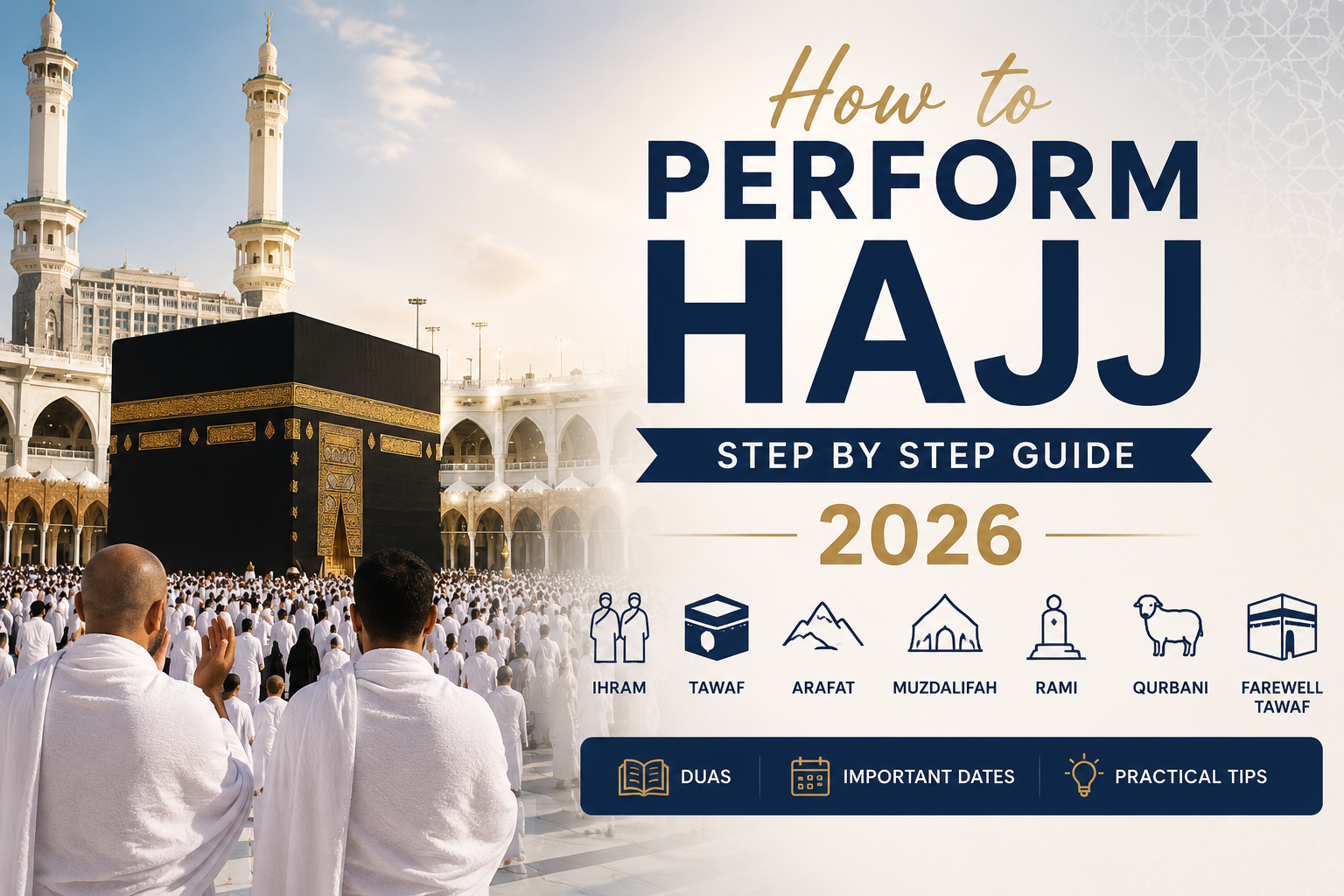
“Whoever performs Hajj for the sake of Allah and does not engage in sexual relations or commit sin will return like the day his mother gave birth to him.” — Prophet Muhammad ﷺ (Bukhari, Muslim)
Hajj is one of the most profound acts of worship in Islam — a journey that millions of Muslims across the world have made for over fourteen centuries, standing together on the same ground, wearing the same simple white cloth, calling out to the same God. Every year, nearly two million pilgrims from every corner of the earth converge on Makkah to fulfil this fifth and final pillar of Islam. Understanding how to perform Hajj — every ritual, every sequence, every intention — is one of the most important preparations a Muslim can make before undertaking this sacred journey.
This complete 2026 guide covers everything: what Hajj is and who must perform it, the three types of Hajj, the step-by-step rituals from Day One to the Farewell Tawaf, key duas, practical tips, and the most common mistakes to avoid.
What Is Hajj?
Hajj is the annual pilgrimage to Mecca, Saudi Arabia. It is the fifth and final pillar of Islam, along with the declaration of faith (shahada), five daily prayers, obligatory charity (zakat), and fasting during the month of Ramadan. The word comes from the Arabic root “h-j-j”, which means “intending a journey” or “to set out for a definitive purpose.” It is obligatory once in a lifetime for all adult Muslims who are physically and financially able to undertake the journey.
Each year, approximately 2 to 3 million Muslims from around the world gather for this sacred act of worship during the Islamic month of Dhul Hijjah — the twelfth and holiest month of the Islamic calendar. The first ten days of this month are among the most virtuous days of the entire year in Islam, and Hajj itself takes place within them. If you want to understand the full spiritual significance of this sacred period before embarking on your pilgrimage, our detailed guide on the first 10 days of Dhul Hijjah explains the special acts of worship, virtues, and recommended deeds that precede and accompany the Hajj season. This profound pilgrimage commemorates the actions of Prophet Ibrahim (Abraham), his wife Hajar, and their son Prophet Isma’il (peace be upon them all). Each ritual symbolises a deeper spiritual journey: leaving behind worldly attachments, cultivating patience, and renewing one’s relationship with Allah (SWT).
Hajj 2026 Dates
In 2026, the Hajj will take place from May 25 to May 27, but many pilgrims arrive in Saudi Arabia weeks before to prepare for the journey. Hajj 2026 is expected to begin around 26 May (8 Dhul Hijjah 1447 AH), with the Day of Arafat falling on 27 May, subject to the official moon sighting.
Important: All dates are estimates based on astronomical calculations. The Saudi Supreme Court confirms exact dates after the crescent moon sighting of Dhul Hijjah, which may shift everything by one day. Plan flexible travel around 22–31 May 2026 to be safe.
Hajj Day
Gregorian Date (Est.)
Islamic Date
Key Event
Day 1 — Yawm al-Tarwiyah
May 25, 2026
8 Dhul Hijjah
Travel to Mina, enter Ihram
Day 2 — Yawm Arafah
May 26, 2026
9 Dhul Hijjah
Standing at Arafat (most important day)
Day 3 — Yawm al-Nahr
May 27, 2026
10 Dhul Hijjah
Eid al-Adha — Rami, Qurbani, Halq
Day 4
May 28, 2026
11 Dhul Hijjah
Days of Tashriq — stoning all three Jamarat
Day 5
May 29, 2026
12 Dhul Hijjah
Stoning — depart Mina or stay
Day 6 (optional)
May 30, 2026
13 Dhul Hijjah
Final stoning (for those who stayed)
Farewell Tawaf
Before departure
—
Final circuit of the Kaaba
Who Must Perform Hajj?
Hajj is obligatory — Fard — on every Muslim who meets all of the following conditions:
Adult — has reached the age of puberty
Sane — of sound mind and mental capacity
Muslim — Hajj is exclusively an Islamic obligation
Free — not in a state of slavery
Physically able — has the health and strength to complete the pilgrimage
Financially able — can afford the costs of the journey and has enough for the family left at home
Safe passage — a secure route to Makkah exists
For women — must be accompanied by a Mahram (a male relative she cannot marry) according to the majority scholarly position
Those who complete the Hajj earn the title of Haji. Makkah, the holiest site in Islam and the birthplace of Prophet Muhammad (SAW), houses many historical sites that pilgrims visit during Hajj rituals.
The Three Types of Hajj
Hajj may have three types — Tamattu, Qiran, and Ifrad. Each of them has its own rituals. Depending upon the type of Hajj, pilgrims should perform the rites.
1. Hajj al-Tamattu (Most Recommended)
Hajj Tamattu involves complete Umrah and Hajj. It is performed during the Hajj days of Dhul Hijjah. Sacrifice is mandatory. After performing Tawaf and Sa’i in Umrah, pilgrims get a temporary release from Ihram. After the break, the pilgrim re-enters the state of Ihram from the 8th of Dhul Hijjah to perform the Hajj rituals. This is the type our Prophet Muhammad ﷺ commanded his companions to perform in the Farewell Pilgrimage, and it is the most widely practised type today.
2. Hajj al-Qiran
Hajj Qiran combines Umrah and Hajj without any break. Offering sacrifice is obligatory. The pilgrim enters Ihram for both Umrah and Hajj simultaneously at the Miqat and remains in the state of Ihram until after the Hajj rituals are complete. This type is more physically demanding as the state of Ihram is maintained throughout.
3. Hajj al-Ifrad
Hajj Ifrad focuses solely on performing the rituals of Hajj only. Performing Umrah isn’t part of this Hajj. It doesn’t require animal sacrifice. The pilgrim enters Ihram solely for Hajj at the Miqat. This is typically chosen by residents of Makkah and the surrounding areas.
Spiritual Preparation Before Hajj
Before any ritual can begin, the heart must be prepared. Make sincere repentance (tawbah). Turn to Allah with genuine intention to change, not merely to perform a ritual. Reconcile with family members with whom there is unresolved conflict. Study the fiqh of Hajj. Ignorance of a rite can invalidate it. Learn the conditions, pillars, and sequence of rituals before you travel. Many mosques and Islamic centres offer Hajj preparation courses in the months before the season. Memorise key supplications. The Talbiyah, du’as for Tawaf, Sa’i, Arafat, and the Jamarat should be learned with their meanings so you engage spiritually rather than reading from a card.
In the weeks before Hajj, increase voluntary prayers (especially Tahajjud — the night prayer), Quran recitation, and remembrance of Allah (dhikr). Fasting is also among the most recommended acts of worship in the lead-up to Hajj — particularly on the first nine days of Dhul Hijjah — as it purifies the soul and sharpens spiritual focus before the pilgrimage begins. Our comprehensive guide on the benefits of fasting in Islam explores the spiritual, physical, and psychological dimensions of fasting — an act of worship that prepares the heart for the level of devotion Hajj demands.
Collect du’a requests from family and loved ones. The Day of Arafah is one of the most powerful opportunities for supplication in all of Islam — your prayers there carry enormous weight for yourself and everyone you carry in your heart.
How to Perform Hajj — Step by Step
Before Arrival — Intention and Registration
Before you arrive at Makkah to begin Hajj, it’s important to make your intention (niyyah) within your heart. The intention must be to perform the Hajj for the sake of Allah alone, with a desire for good in the hereafter. It should not be done with the intention of being seen by others or for worldly gain.
If applying from outside Saudi Arabia, registration is completed through the Nusuk platform (nusuk.sa) — the Saudi Ministry of Hajj and Umrah’s official registration portal. Nusuk offers three package tiers based on duration and services. Costs vary significantly by country and hotel tier. From the US, expect $11,000–$15,000 per person. From the UK, £4,500–£12,000+.
Pakistani pilgrims register through the Ministry of Religious Affairs and Interfaith Harmony (mora.gov.pk) via the government Hajj scheme or through licensed private Hajj organisers.
Step 1 — Enter Ihram at the Miqat
Next, you’ll enter into the state of Ihram (ritual purity). For men, this means wearing the designated white cloth with one piece wrapped around your shoulder and one around your waist. Ladies may wear any clothing of their choice but should ensure they observe the rules of Hijab. Face coverings, however, are not permitted. Fully-covering shoes are also not permitted. Footwear must be in the form of sandals for both women and men.
The Miqat is a designated boundary point that must not be crossed without entering Ihram. For UK pilgrims travelling by air, the Miqat is usually Yalamlam or Al-Juhfah (near Rabigh). It is recommended to prepare Ihram before the flight, as the Miqat is often announced on board. For Pakistani pilgrims, the Miqat is typically Qarn al-Manazil (also called As-Sayl al-Kabeer) or Yalamlam depending on the flight path.
Before wearing Ihram:
Perform Ghusl (full bath)
Trim nails and remove unwanted hair if needed
Apply non-scented lotion or Vaseline to prevent chafing
(Here I am, O Allah, here I am. Here I am, You have no partner, here I am. Verily all praise, grace, and sovereignty belong to You. You have no partner.)
Recite the Talbiyah constantly — walking, in transport, at all times — until the first stoning on the Day of Nahr.
Ihram prohibitions include:
No cutting or trimming of hair or nails
No use of perfume or scented products
No sexual relations
No hunting
No covering the head (for men)
No wearing of sewn garments (for men)
No marriage contracts
Step 2 — Day 1 (8 Dhul Hijjah): Travel to Mina
Enter the state of Ihram from your accommodation in Makkah (for Hajj al-Tamattu’) or from the Miqat (for Hajj al-Ifrad/Qiran). Travel to Mina after Fajr prayer. Pray all five daily prayers at Mina (Dhuhr, Asr, Maghrib, Isha of the 8th; Fajr of the 9th). Each 4-rak’ah prayer is shortened to 2 rak’ahs. Spend the night in Mina. Focus on worship, Quran recitation, and dua.
This day is known as Yawm al-Tarwiyah (the Day of Quenching). Use the time in Mina for Ibadah, recitation of the Talbiyah, dhikr, and preparation — mentally and spiritually — for the most important day ahead.
Step 3 — Day 2 (9 Dhul Hijjah): The Standing at Arafat — Wuquf
This is the most critical day of Hajj. Our Prophet ﷺ said: “Hajj is Arafah.” (Tirmidhi, Nasai)
Travel to the Plain of Arafat after Fajr. Pray Dhuhr and Asr combined (shortened) at Dhuhr time. Perform Wuquf (the Standing) — the essential pillar of Hajj. Spend from after Dhuhr until Maghrib in intensive supplication, dhikr, Quran recitation, and seeking forgiveness.
The Standing at Arafat is the single most important act of the entire pilgrimage. The best of du’a is du’a on the day of ‘Arafah. Face the Qiblah. Raise your hands. Weep. Ask for everything — forgiveness, mercy, guidance, health, ease. Make du’a for your family. Make du’a for the Muslim Ummah. The time between the Dhuhr Adhan and sunset at Arafat is among the most sacred windows in the Islamic calendar.
Anyone who misses the Standing at Arafat has missed Hajj entirely. It is the single non-negotiable Fard pillar of the entire pilgrimage.
Step 4 — Night of 9th: Move to Muzdalifah
Depart for Muzdalifah after sunset. Do not pray Maghrib at Arafat. Pray Maghrib and Isha combined upon arrival at Muzdalifah.
After sunset, depart Arafah and move to Muzdalifah. There, perform Maghrib and Isha prayers combined and spend the night in worship or rest.
At Muzdalifah, collect pebbles for the Rami ritual. Collect 49 pebbles if you plan to stay in Mina for two days, or 70 pebbles if you plan to stay for three. The pebbles should be small — approximately the size of date seeds or chickpeas.
Spend the night under the open sky. Sleep is permitted and is itself considered worship during this night. Pray Fajr at Muzdalifah (at its earliest time). Make dua until the sky brightens. Depart to Mina before sunrise.
The elderly, the sick, and women with children are permitted to leave Muzdalifah after midnight.
Step 5 — Day 3 (10 Dhul Hijjah): Yawm al-Nahr — The Day of Sacrifice
This is Eid al-Adha — one of the two great Islamic celebrations — and it is the busiest and most demanding day of Hajj. Four major acts must be completed:
5a. Rami al-Jamarat — First Stoning
Stone Jamarah al-Aqabah (the large pillar) with 7 pebbles, saying “Allahu Akbar” with each throw.
The act of throwing stones at the Jamarat is known as Rami. The ritual of Rami is symbolic of the actions of Ibrahim (AS) when he was faced with the trial of having to sacrifice his son, Isma’il (AS) upon the commandment of Allah (SWT). On the way to carry out the commandment, Iblis (Satan) repeatedly tried to tempt Ibrahim (AS) into disobeying Allah (SWT). As Ibrahim (AS) reached Jamarat al-Aqaba, Allah (SWT) ordered Angel Jibreel (AS) to instruct Ibrahim (AS) to throw seven stones at Iblis.
On Day 3, throw seven pebbles at the Jamarah al-Aqabah only — the large pillar closest to Makkah. After each pebble, say “Allahu Akbar.” Stop reciting the Talbiyah after this stoning.
5b. Qurbani — Animal Sacrifice
After the first stoning, perform Qurbani, the ritual slaughter of a sheep, goat, cow, camel, or other animal, in remembrance of Prophet Ibrahim’s (AS) willingness to sacrifice his son for the sake of Allah (SWT).
Most pilgrims today arrange their Qurbani through their Hajj operator or through authorised Saudi government vouchers, ensuring the sacrifice is carried out on their behalf in the approved slaughterhouses. Completing this step fulfils the Hady requirement for Hajj al-Tamattu and al-Qiran.
5c. Halq or Taqseer — Shaving or Trimming Hair
Men: Shave head completely (halq – more virtuous) OR trim evenly (qasr). Women: Do NOT shave. Gather hair and trim a fingertip’s length (approx. 1 inch) from ends.
Shaving the head is the Sunnah for men and carries greater reward. After this act, most of the Ihram restrictions are lifted — this is called Tahallul al-Awwal (the first exit from Ihram). You may wear normal clothing, use scented products, and resume all activities except marital relations.
5d. Tawaf al-Ifadah — Circumambulation of the Kaaba
Fard — Hajj is invalid without it. Perform 7 circuits around Ka’bah, pray 2 rak’ah behind Maqam Ibrahim, drink Zamzam.
It is the major pillar (fard) of Hajj, without it, Hajj is invalid. The preferred time is on the 10th of Dhul Hijjah, after Rami, Hady, and Halq. However, it remains valid if performed on any of the Days of Tashriq (11th, 12th, or 13th of Dhul Hijjah).
Walk around the Kaaba seven times in an anti-clockwise direction, beginning and ending at the Black Stone (Al-Hajar al-Aswad). After completing the seven circuits, pray two Rak’ah behind Maqam Ibrahim (or anywhere in the Masjid if it is too crowded), then drink Zamzam water.
For pilgrims performing Hajj al-Tamattu, Sa’i (walking between Safa and Marwa) must also be performed after Tawaf al-Ifadah. For those who already performed Sa’i as part of their Umrah earlier, this Sa’i is not required again.
After completing Tawaf al-Ifadah and Sa’i, full exit from Ihram (Tahallul al-Thani) is achieved — all previous restrictions are fully lifted, including marital relations.
Return to Mina for the night.
Step 6 — Days 4 and 5 (11th and 12th Dhul Hijjah): Days of Tashriq — Stoning All Three Jamarat
On the 11th Dhul Hijjah, you will proceed to your second day of Rami (the stoning of the devil). On this occasion you pelt each of the three pillars in order. You will begin with Jamarah al-Ula (the small pillar), then Jamarah al-Wusta (the second/middle pillar) and finally, Jamarah al-Aqaba (the third/large pillar). You stop after the first and second Jamarat to make Du’a facing the qibla. Each one should be stoned with seven consecutive pebbles accompanied by the Takbir.
This means 21 pebbles per day — 7 for each of the three pillars. The time window for stoning on the Days of Tashriq is after Dhuhr until sunset, though some scholars permit stoning before Dhuhr in cases of necessity.
Spend the nights of the 11th and 12th in Mina. These nights in Mina are Wajib (obligatory) — missing them without a valid excuse requires a penalty sacrifice (Dam).
Leaving Early (Nafr Awwal): Allah says: “It is no sin for him who makes haste on the second day, nor sin for him who stays longer.” (Quran 2:203) A pilgrim who completes the stoning on Day 4 (11th) and Day 5 (12th) may depart Mina on the 12th of Dhul Hijjah — but must leave before sunset. If the sun sets while you are still in Mina, you must stay for the 13th.
Staying the Extra Day (Nafr Thani): Pilgrims who remain until the 13th of Dhul Hijjah must complete one final round of stoning all three Jamarat before departing. Staying the extra day carries additional reward.
Step 7 — Tawaf al-Wada: The Farewell Circumambulation
Before leaving Mecca, pilgrims perform a final Tawaf around the Kaaba, known as the Tawaf al-Wada or a “farewell Tawaf”, signifying a spiritual farewell to the holy sanctuary.
Once the rites in Mina are complete, one final ritual remains before leaving Makkah. Perform seven circuits around the Kaaba. No Sa’i is required after this Tawaf. After completing: Do not linger unnecessarily. Leave promptly, heart full of gratitude, praying that Allah accept your Hajj.
This Tawaf is Wajib for all pilgrims except residents of Makkah and women in a state of menstruation — the latter are exempt without any penalty.
Hajj is now complete. Say goodbye to Makkah with full gratitude and hope that your Hajj has been accepted.
Summary of Hajj Pillars (Fard) and Obligatory Acts (Wajib)
Four Fard (Pillars) — Missing any invalidates Hajj entirely
Pillar
When
Ihram — Intention and entering sacred state
Before crossing Miqat
Wuquf at Arafat — The Standing
9 Dhul Hijjah, after Dhuhr until Maghrib
Tawaf al-Ifadah — Circumambulation of Kaaba
10 Dhul Hijjah or Days of Tashriq
Sa’i between Safa and Marwa
After Tawaf al-Ifadah (or Tawaf al-Qudum)
Key Wajib Acts — Missing requires a penalty sacrifice (Dam)
Entering Ihram at the Miqat (not before or after)
Spending the night at Muzdalifah
Spending the nights of Tashriq in Mina
Stoning the Jamarat on each day within the correct window
Shaving or trimming hair (Halq/Taqseer) in the correct sequence
Tawaf al-Wada (Farewell Tawaf) before leaving Makkah
Essential Duas for Hajj
Talbiyah — Recited from Ihram until the Day of Nahr stoning: “Labbayk Allahumma Labbayk. Labbayka Laa Shareeka Laka Labbayk. Innal Hamda Wan-Ni’mata Laka Wal-Mulk. Laa Shareeka Lak.”
Dua at the Black Stone (Al-Hajar al-Aswad):“Bismillahi Allahu Akbar.”
Dua for Tawaf (general):“Subhaan-Allah wal-hamdu Lillahi wa laa ilaha ill-Allah wa Allahu Akbar.”
Dua between Yemeni Corner and Black Stone:“Rabbanaa aatinaa fid-dunyaa hasanatan wa fil-aakhirati hasanatan wa qinaa ‘adhaab an-naar.” (Our Lord, give us good in this world and good in the Hereafter, and save us from the torment of the Fire.)
At Arafat: Make any personal du’a from the heart. No specific formula is prescribed. Ask Allah for everything.
At Jamarat (with each stone):“Allahu Akbar.”
Practical Tips for Hajj 2026
Hajj 2026 falls in late May, when Makkah temperatures routinely hit 42–48°C. Every packing decision should prioritize heat survival, mobility, and ihram compliance.
Stay hydrated constantly. Carry Zamzam and a personal water bottle at all times. Heat exhaustion is the single greatest physical risk.
Wear durable sandals. You will walk kilometres daily across uneven ground in extreme heat. Comfort and durability matter enormously.
Travel light. A sheet, sleeping bag, one change of clothes, soap, tissue, and a towel is the recommended packing formula.
Learn the rituals before you go. Hajj moves fast and you will not have time to learn on the spot. Study the day-by-day sequence, watch instructional videos, and attend a Hajj preparation workshop if your local mosque offers one.
Get vaccinated. The Nusuk health guidelines list the Meningitis ACWY vaccine as mandatory, to be administered at least 10 days before arrival. Consult your doctor about additional vaccinations including influenza, Hepatitis A, and COVID-19 boosters.
Use the upper levels of the Haram for Tawaf. The Tawaf area will be extremely crowded during this time. Try to use the upper levels of the Haram or the roof. You might want to do this around midnight when it tends to be quieter.
Stay with your group. Mobile phone charges happen fast in large crowds. Save your group leader’s number, your hotel address, and the Saudi emergency numbers before every major ritual.
Take care of your ihram garments. Carry safety pins. One garment coming loose in a crowd of two million is more dangerous than it sounds.
Common Mistakes to Avoid
Missing the Standing at Arafat. This is the most critical error possible. Missing Wuquf entirely means Hajj must be repeated. Do not miscalculate the timing.
Breaking Ihram rules unknowingly. Common violations include using scented soap, covering the head (for men), cutting nails or hair, and wearing sewn garments. Each violation requires a Dam if done intentionally.
Picking up pebbles from the Jamarat area. Pebbles must be collected from Muzdalifah or the ground around Mina — not from beneath the Jamarat themselves.
Leaving Mina after sunset on Day 5. If the sun sets while you are still in Mina on the 12th of Dhul Hijjah, you must stay the additional night and complete the stoning on the 13th. Plan your departure before sunset.
Skipping the Farewell Tawaf. It is Wajib for all non-Makkan residents. Missing it requires a Dam (penalty sacrifice).
Not making du’a at Arafat. The Day of Arafah is the centrepiece of Hajj. Pilgrims who spend this time in casual conversation rather than supplication miss the most valuable spiritual opportunity of the entire journey.
FAQs — How to Perform Hajj
Q: When is Hajj 2026? Hajj 2026 is expected to begin on approximately May 25, 2026 (8 Dhul Hijjah 1447 AH), with the Day of Arafah on May 26. Exact dates are confirmed by the Saudi Supreme Court after the official moon sighting. All plans should allow for a one-day variation.
Q: What are the three types of Hajj? The three types are Hajj al-Tamattu (Umrah then Hajj with a break between — most recommended), Hajj al-Qiran (Umrah and Hajj combined without a break), and Hajj al-Ifrad (Hajj only, no Umrah). Hajj al-Tamattu is most widely practised today.
Q: What is the most important day of Hajj? The Day of Arafah (9 Dhul Hijjah) is the most important day. The Standing (Wuquf) at the Plain of Arafat from after Dhuhr until Maghrib is the single essential pillar of Hajj. Our Prophet ﷺ said: “Hajj is Arafah.”
Q: How many times do you circle the Kaaba during Tawaf? Seven times in an anti-clockwise direction, beginning and ending at the Black Stone.
Q: Can a woman perform Hajj without a Mahram? According to the majority scholarly position, a woman must be accompanied by a Mahram (a male relative she cannot marry). Some scholars permit groups of trustworthy women to travel together under specific conditions. Consult a qualified Islamic scholar for guidance on your specific situation.
Q: What happens if you miss a Wajib act of Hajj? Missing a Wajib act — such as staying the night at Muzdalifah or completing the Rami within the correct time window — requires a penalty sacrifice (Dam). The Hajj itself remains valid. Missing a Fard pillar, however, invalidates the Hajj entirely.
Q: What is the Talbiyah and when do I recite it? The Talbiyah is the declaration “Labbayk Allahumma Labbayk…” recited from the moment of entering Ihram until the first stoning at Jamarah al-Aqabah on the Day of Nahr (10 Dhul Hijjah). It is recited constantly while walking, travelling, and at all other times.
Q: How many pebbles do I need to collect at Muzdalifah? Collect 49 pebbles if you plan to spend two days in Mina (leaving on the 12th), or 70 pebbles if you plan to spend three days (leaving on the 13th). Take a few extra in case some are dropped or lost.
Q: What vaccinations are required for Hajj 2026? The Meningitis ACWY vaccine is mandatory and must be administered at least 10 days before arrival in Saudi Arabia. Consult your doctor about additional recommended vaccinations including Hepatitis A, influenza, and COVID-19.
Q: How do Pakistani pilgrims register for Hajj? Pakistani pilgrims register through the Ministry of Religious Affairs and Interfaith Harmony (mora.gov.pk) via the government Hajj scheme or through MORA-licensed private Hajj tour operators. The Saudi Nusuk platform is used for direct registration from some countries.
Final Word
Hajj is the greatest journey a Muslim can make in this life. As the fifth pillar of Islam, Hajj serves as a way of soul purification, cleansing the heart and bringing forth purity and hope. Every ritual — the white cloth, the circling, the standing, the walking, the stones — is a physical act of complete surrender to Allah. Every step is a step walked by the Prophet ﷺ. Every stone is thrown where Ibrahim (AS) threw his. Every supplication at Arafat rises from a plain where the Prophet ﷺ delivered his final address to humanity.
Prepare thoroughly. Learn every ritual before you go. Make your intention pure. And when you stand on the Plain of Arafat and raise your hands, ask for everything — because that is the day and the place where Allah SWT listens, and nothing asked with a sincere heart goes unanswered.