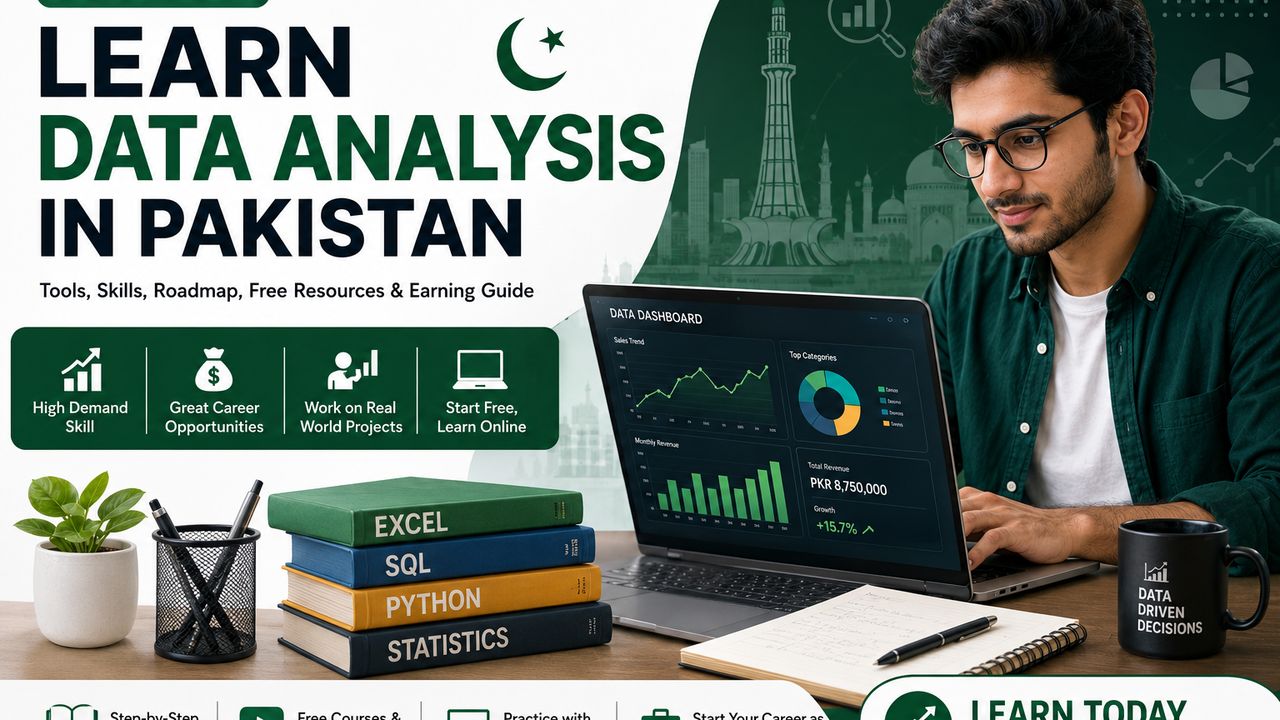
Learning data analysis Pakistan companies now need is one of the smartest career moves you can make. Moreover, it is a high-demand, well-paid skill in almost every industry. In this post, you will discover the tools, skills, and a clear roadmap. Furthermore, this guide covers free resources, projects, and how to start earning.
To begin, data analysis means turning raw data into useful answers. Specifically, you collect, clean, and study data to find insights. As a result, businesses use these insights to make better decisions. Therefore, when you master data analysis Pakistan’s growing tech field opens up for you.
What Is Data Analysis?
Data analysis is the process of studying data for answers. Basically, it turns numbers into clear, useful information. So, it helps businesses understand what is happening. Moreover, it guides smart, data-driven decisions.
The process follows a few clear steps. Specifically, you first collect and clean the data. Then, you analyze it to find patterns and trends. Additionally, you visualize it with charts and dashboards. Therefore, the final goal is clear, useful insights.
This skill is used across every field today. Specifically, banks, telecom firms, and startups all rely on it. Moreover, companies collect huge amounts of data daily. Therefore, they need analysts to make sense of it. Indeed, data is now one of the most valuable assets.
Why Learn Data Analysis?
Data analysis offers many strong benefits. Firstly, it is in extremely high demand worldwide. Secondly, it pays very well compared to many jobs. Thirdly, it is needed in almost every industry. So, it is a smart, future-proof career.
The demand keeps growing every single year. Specifically, companies now collect data faster than ever. Moreover, they struggle to understand it all. Therefore, skilled analysts are wanted everywhere. Consequently, this creates many job openings.
The best part is that you can start from scratch. Specifically, no degree or experience is required to begin. Moreover, free resources teach everything you need. Therefore, anyone can enter this field. Indeed, motivation matters more than a background.
What Does a Data Analyst Do?
A data analyst helps businesses use their data. Basically, they turn messy data into clear insights. So, their work supports important decisions. Below are their main tasks.
Analysts handle several key steps each day. For example, they collect data from many sources. Likewise, they clean and fix messy data. Moreover, they find useful patterns and trends. Additionally, they build charts and dashboards.
The final step is sharing what they find. Specifically, they explain insights in simple terms. Moreover, they help teams make smart choices. Therefore, communication is a key part of the job. Indeed, telling a clear story matters most.
Skills You Need to Learn
Data analysis needs a mix of key skills. Basically, some are about tools and some about thinking. So, learning them step by step is best. The table below shows the main ones.
Skill
Why You Need It
Excel
The foundation for handling data
SQL
To pull data from databases
Power BI / Tableau
To create charts and dashboards
Python
For deeper analysis and automation
Statistics
To understand data correctly
As the table shows, each skill plays a clear role. Moreover, you do not need all of them at once. Additionally, Excel and SQL are the best starting points. Therefore, learn them first. Below are the tools you will use.
The Tools You Will Use
Data analysts rely on several powerful tools. Basically, each tool handles a different task. So, knowing them helps you plan. The table below lists the main ones.
Tool
Best For
Excel / Google Sheets
Handling and cleaning data
SQL
Getting data from databases
Power BI / Tableau
Building dashboards and charts
Python
Advanced analysis and automation
Kaggle
Free datasets and practice
As the table shows, many key tools are free. Specifically, Google Sheets and Power BI cost nothing. Moreover, Kaggle offers free data and practice. Therefore, you can learn without spending money. Below are the best places to learn.
Best Free Ways to Learn
Many free resources teach data analysis brilliantly. Basically, you can learn everything at zero cost. So, you do not need expensive courses. The table below lists the top ones.
Resource
Best For
Google Data Analytics
Complete beginner path and certificate
Kaggle Learn
Free hands-on practice
freeCodeCamp
Data analysis with Python
Microsoft Learn
Power BI and Excel
DigiSkills.pk
Free government data analytics course
Google Data Analytics Certificate
Google’s certificate is the top beginner choice. Basically, Google built it for complete beginners. So, it teaches the full data analysis process. Moreover, it covers spreadsheets, SQL, and Tableau.
This program prepares you for real jobs. Specifically, it includes hands-on projects and practice. Moreover, you can start it for free. You can explore it through Google’s training at grow.google. Therefore, it is a trusted, respected foundation.
Kaggle Learn
Kaggle Learn is perfect for hands-on practice. Basically, it offers short, free micro-courses. So, you learn Python, SQL, and data cleaning quickly. Moreover, you practice on real datasets in the browser.
This platform is very efficient for beginners. Specifically, each course takes only a few hours. Moreover, it gives immediate practice. Therefore, it suits future analysts well. Indeed, real data practice builds true skill.
DigiSkills.pk
DigiSkills is a top free government option. Basically, it offers a data analytics course. So, it teaches these skills at zero cost. Moreover, it prepares you for freelancing and jobs.
This course suits local learners well. Specifically, it explains concepts clearly for beginners. Moreover, it gives a free certificate on completion. You can enrol at digiskills.pk. Therefore, it is a great free starting point.
A Simple Learning Roadmap
A clear roadmap keeps you on track. Basically, you learn each skill in the right order. So, follow these steps one by one. Below is a beginner path.
First, learn Excel and basic statistics. Specifically, master formulas, pivot tables, and cleaning. Then, learn SQL to pull data from databases. Next, learn a visualization tool like Power BI. Moreover, add Python later for deeper analysis.
The final stage focuses on real work. Specifically, build two or three complete projects. Then, turn them into a portfolio. Moreover, practice interview and resume skills. Therefore, this path takes you from beginner to job-ready.
Excel is the true foundation of this journey. Specifically, it is where most analysts begin. For a full deep-dive, see our learn Excel Pakistan guide. Therefore, master Excel before moving forward.
The Minimum Toolkit to Get Started
You do not need every tool to begin. Basically, a small core stack is enough at first. So, focus on the essentials. Moreover, this keeps you from feeling overwhelmed.
The minimum toolkit is simple and powerful. Specifically, Excel handles your basic data work. Meanwhile, SQL pulls data from databases. Additionally, one visualization tool builds your dashboards. Therefore, Excel, SQL, and Power BI form a strong start.
Python can wait until later. Specifically, it matters most for advanced or large tasks. Moreover, many analysts work for years without it daily. Therefore, do not rush into Python too early. Consequently, master the basics first.
Build a Strong Portfolio
A portfolio is essential in data analysis. Basically, it proves your skills to employers and clients. So, building one is a must. Moreover, it matters more than any certificate.
Your portfolio should show complete projects. Specifically, each project should follow the full process. Moreover, it should clean, analyze, and visualize data. Additionally, it should share clear insights. Therefore, two or three strong projects are enough.
Use real data for these projects. Specifically, Kaggle and public datasets work perfectly. Moreover, they make your work realistic and useful. Therefore, choose topics that interest you. Consequently, real projects impress employers most.
Practice with Real Data
Practice is where real learning happens. Basically, watching lessons alone is not enough. So, you must work with real data. Moreover, hands-on practice builds true skill.
Several ways help you practice well. Firstly, download free datasets from Kaggle. Secondly, build a dashboard from real numbers. Thirdly, clean messy data and find insights. Moreover, repeat these tasks until they feel easy.
Real projects teach far more than theory. Specifically, they show you how analysis truly works. Moreover, they give you portfolio pieces. Therefore, always practice alongside your learning. Indeed, doing is the real secret to skill.
Data Analysis and AI
Data analysis now uses powerful AI tools. Basically, AI can speed up many tasks. So, learning these tools is smart. Moreover, this is a growing 2026 trend.
AI helps at several stages of analysis. Specifically, it can help clean and organize data. Moreover, it suggests ideas for charts and visuals. Additionally, it speeds up exploring datasets. Therefore, AI makes analysts more productive.
However, learn the core skills first. Specifically, AI works best when you understand the basics. Moreover, strong foundations help you use AI wisely. Therefore, master the tools before relying on AI. Consequently, AI then becomes a real time-saver.
Data Analysis and Other Skills
Data analysis pairs well with other digital skills. Basically, combining skills makes you more valuable. So, learning more skills is smart. Below are a few great matches.
A structured bootcamp can speed up your growth. Specifically, some teach data and coding skills together. Moreover, many offer free training in Pakistan. Our coding bootcamps Pakistan guide lists the best options.
Marketing is another field that loves data. Specifically, data guides smart marketing decisions. Moreover, analysts help improve campaigns and results. Our learn digital marketing Pakistan guide shows how to start. Therefore, mixing skills builds a strong career.
Earning as a Data Analyst
Earning is an exciting goal for many learners. Basically, data skills are highly valued today. So, you can freelance or find a job. Moreover, demand keeps rising every year.
Several income paths are open to you. Specifically, companies in banking and telecom hire analysts. Moreover, startups need data skills too. Additionally, freelancers offer analysis and dashboard services. Therefore, strong skills lead to real opportunities.
The career path also grows over time. Specifically, you can move from analyst to senior roles. Moreover, many analysts become data scientists later. Therefore, this field offers long-term growth. Indeed, it is a career with a bright future.
Tips to Succeed
A few habits make learning far easier. Firstly, start with Excel as your foundation. Secondly, focus on Excel, SQL, and one visual tool first. Thirdly, build real projects for your portfolio. Moreover, practice on real datasets often.
More small habits help greatly. For example, learn to tell clear stories with data. Likewise, use AI tools to work faster. Additionally, join communities for support. Therefore, these habits turn effort into real skill.
Common Mistakes to Avoid
Many learners repeat the same errors. Basically, these mistakes slow down progress. So, avoiding them saves you time. Below are the common ones.
A few habits hold learners back. Firstly, jumping straight to Python is a common mistake. Secondly, skipping Excel and SQL weakens your base. Thirdly, having no portfolio blocks job chances. Moreover, only watching videos without practice is unhelpful.
Staying focused solves most problems. Specifically, real projects prove your skills. Moreover, practice cements your learning. Therefore, focus on doing, not just watching. Indeed, projects always win here.
Communities and Help
Helpful communities make learning much easier. For example, Kaggle connects data learners worldwide. Similarly, forums answer your analysis questions. Moreover, YouTube teaches in English and Urdu. So, you can learn from many others.
Beyond communities, official sources add value. Specifically, Google and Microsoft offer trusted training. Additionally, DigiSkills provides a free local course. Therefore, quality help is always within reach. Indeed, no learner is ever truly alone.
These communities also share useful advice. For instance, members review projects and give feedback. Likewise, they share the best free datasets. Consequently, staying connected speeds up your growth. Ultimately, shared knowledge helps you master data analysis Pakistan’s companies now demand.
Frequently Asked Questions
Can I learn data analysis Pakistan style completely free?
Yes, you can learn it entirely for free. Specifically, Google and Kaggle offer free learning. Moreover, DigiSkills provides a free local course. Therefore, money is never a barrier to starting.
Do I need coding to become a data analyst?
Not at the very start, no. Specifically, Excel and SQL are enough to begin. Moreover, Python matters more for advanced work. Therefore, you can start without heavy coding.
How long does it take to learn data analysis?
It usually takes several months of steady practice. Specifically, part-time learners often need six to nine months. However, full-time study is faster. Therefore, consistency matters more than speed.
Which tool should I learn first?
Start with Excel as your foundation. Then, learn SQL to pull data from databases. Moreover, add a visual tool like Power BI. Therefore, this core stack is the best start.
Do I need a degree to get a data analyst job?
No, a degree is not required for most jobs. Specifically, skills and a portfolio matter far more. Moreover, many analysts are self-taught. However, strong projects are essential.
Can I earn money from data analysis in Pakistan?
Yes, data skills are in high demand here. Specifically, banks and startups hire analysts. Moreover, freelancers offer analysis and dashboards. Therefore, strong skills lead to good income.
What should a data analysis portfolio include?
It should include two or three complete projects. Specifically, each should clean, analyze, and visualize data. Moreover, use real datasets from Kaggle. Therefore, show your full process clearly.
Is watching YouTube enough to learn data analysis?
Watching alone is not enough to master it. Specifically, you must practice on real data. Moreover, hands-on projects teach far more. Therefore, always apply what you learn.