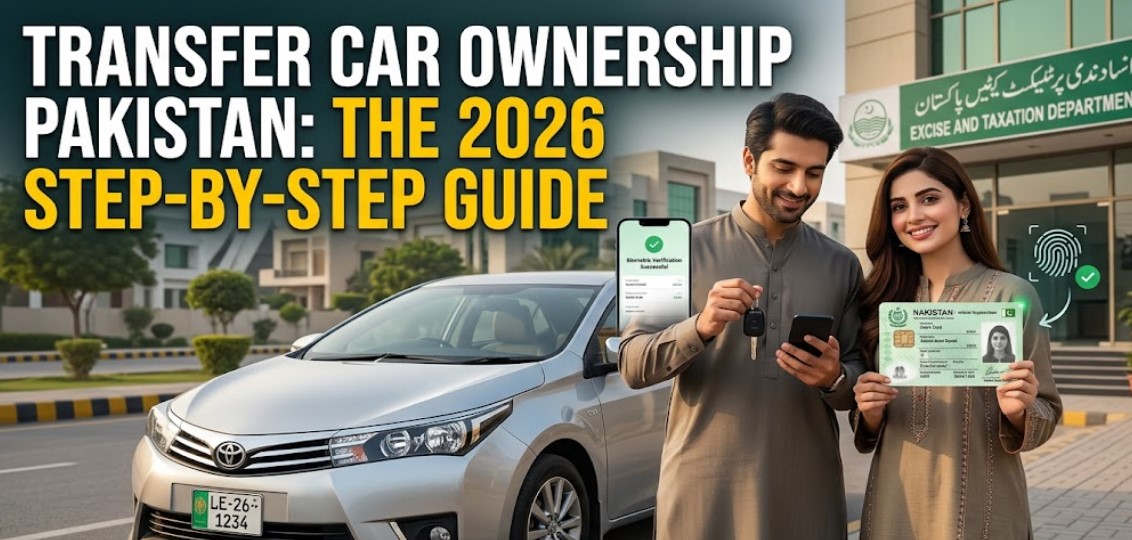
Transfer car ownership Pakistan is a mandatory legal process that every vehicle buyer and seller must complete. In 2026, this process is almost entirely digital and biometric based. It ensures the legal rights of the new owner. It also protects the seller from future liabilities. This post provides a comprehensive look at the current procedures across all provinces.
Why Transfer Car Ownership in Pakistan is Essential
Owning a car without a legal transfer is dangerous. Many people used to rely on “open transfer letters” in the past. However, the government has strictly banned this practice. You must update the record in the Excise and Taxation Department database.
If you do not transfer the car, the seller remains legally responsible. Any accident or crime involving the vehicle will lead back to them. Conversely, the buyer cannot claim full legal rights. They might face issues with insurance claims or police checks. Furthermore, selling the car again becomes nearly impossible without the previous owner’s biometric verification.
The Biometric Revolution of 2026
The year 2026 marks a fully integrated era for vehicle transfers. The National Database and Registration Authority (NADRA) now works closely with provincial Excise departments. This collaboration has made the system transparent. It has eliminated the need for “agents” or “middlemen.”
Biometric verification is now the backbone of the system. Both the buyer and the seller must provide their thumbprints. You can do this at NADRA e-Sahulat centers. Alternatively, many people now use the Pak Identity mobile app for remote verification. This is especially helpful for overseas Pakistanis or those in different cities.
Detailed Process for Each Province
The rules for how you transfer car ownership Pakistan can vary slightly by province. Each region has its own digital portal.
1. Punjab: The E-Pay System
Punjab has the most advanced digital infrastructure. The process starts with the E-Pay Punjab app.
Step 1: Download the E-Pay Punjab app on your smartphone.
Step 2: Select the ‘Excise and Taxation’ department.
Step 3: Choose the ‘Transfer of Motor Vehicle’ option.
Step 4: Enter the vehicle registration number.
Step 5: The app will show the current owner’s details. Confirm these details.
Step 6: Enter the buyer’s CNIC and local information.
Step 7: Generate a PSID (Payment Sales ID).
Step 8: Pay the transfer fee via mobile banking or ATM.
Step 9: Once paid, both parties get a window of 30 days for biometric verification.
For a smooth process, always verify the vehicle first. You can use this MTMIS vehicle verification guide to check the status in Punjab.
2. Sindh: Modernized Manual and Digital Hybrid
In Sindh, the process has also shifted toward biometrics. You often need to visit the Excise office in Karachi or other major cities.
Step 1: Visit the official Sindh Excise website to check for any outstanding dues.
Islamabad offers a very streamlined service. They use the ‘City Islamabad’ app.
Step 1: Open the app and navigate to vehicle transfer.
Step 2: Fill in the buyer and seller data.
Step 3: Pay the fees through the app’s integrated payment system.
Step 4: Book an appointment for physical inspection at the H-9 Excise office.
Step 5: Complete biometrics and receive your card via courier.
4. Khyber Pakhtunkhwa (KPK)
KPK has also adopted the biometric system for all major cities like Peshawar. The process involves visiting the district Excise office. You must bring the original registration book and the buyer. If you are also a resident there, you might want to know how to renew driving license in Peshawar to keep your documents updated.
Required Documents Checklist
To successfully transfer car ownership Pakistan, you need a specific set of documents. Having these ready will save you hours of time.
For the Seller:
Original CNIC: Must be valid and not expired.
Original Smart Card/Registration Book: This is the primary proof of ownership.
Original File (if applicable): Older cars have physical files.
Transfer Letter: Usually a typed document on a stamp paper.
Sale Deed: A formal agreement of sale.
No Objection Certificate (NOC): Required if the car was previously on a bank lease.
For the Buyer:
Original CNIC: Must be valid.
Passport Size Photographs: Usually 2 to 4 are required for manual files.
Proof of Residence: Utility bills or a copy of the rent agreement.
FBR Filer Status: A printout from the FBR website (Active Taxpayer List).
Fee Structure for 2026
The cost to transfer car ownership Pakistan depends on several factors. The engine capacity (CC) is the most important factor. Additionally, your tax filer status changes the amount significantly.
Engine Capacity (CC)
Transfer Fee (Estimated 2026)
Withholding Tax (Filer)
Withholding Tax (Non-Filer)
Up to 1000cc
PKR 2,500 – 5,000
PKR 10,000 – 15,000
PKR 30,000 – 45,000
1001cc to 1300cc
PKR 7,500 – 10,000
PKR 25,000
PKR 75,000
1301cc to 1600cc
PKR 12,000 – 15,000
PKR 50,000
PKR 150,000
1601cc to 1800cc
PKR 18,000 – 22,000
PKR 150,000
PKR 450,000
1801cc to 2000cc
PKR 25,000+
PKR 200,000
PKR 600,000
Note: These fees are subject to the 2025-2026 Federal Budget updates. Always check the live PSID on the E-Pay app for exact figures.
Detailed Step-by-Step Guide for Buyers
Successfully completing the transfer car ownership Pakistan process requires patience. Follow these exact steps for a hassle-free experience.
Step 1: Pre-Purchase Inspection
Never buy a car without checking the chassis and engine numbers. Match these numbers with the registration card. Look for any signs of tampering. If the numbers do not match, the Excise department will seize the vehicle.
Step 2: The Sale Agreement
Draft a sale agreement on a PKR 100 or PKR 500 stamp paper. Mention the total price and the date. Include the CNIC numbers of two witnesses. This document is your primary legal protection during the transition phase.
Step 3: Generating the PSID
The buyer usually initiates the digital transfer. In Punjab, use E-Pay. In other provinces, visit the web portal. The system will ask for the registration number. It will then generate a 17-digit PSID code.
Step 4: Fee Payment
Use the PSID to pay the fees. You can use JazzCash, EasyPaisa, or any banking app. Once you pay, the status of the vehicle changes to “Transfer Initiated” in the database.
Step 5: Biometric Verification
This is the most critical stage. The seller must visit a NADRA center first. They provide the application ID and perform the thumb scan. Then, the buyer does the same. You have a limited time (usually 30 days) to complete this. If you miss the deadline, the PSID might expire.
Step 6: Physical Inspection (Optional)
In some cases, the Excise inspector might want to see the car. This usually happens if the vehicle is very old or coming from another province. They will verify the physical chassis plate.
Step 7: New Smart Card
After all approvals, the system processes the new Smart Card. It is usually delivered to the buyer’s address via Pakistan Post within 15 to 30 days. You can track the status on the Excise website.
Common Challenges and Solutions
Many people face hurdles when they transfer car ownership Pakistan. Here are common issues and how to fix them.
Mismatched Biometrics
Sometimes, an older person’s fingerprints do not scan well. In this case, you must visit the NADRA office for a manual override. They may ask for alternative verification.
Deceased Owner
If the registered owner has passed away, the process becomes complex. You cannot use biometrics. Instead, you need a “Succession Certificate” from a court or NADRA. This certificate lists the legal heirs. All heirs must then sign off on the transfer.
Bank Leased Cars
If the car was on a loan, it is “Hypothecated” to the bank. You cannot transfer it until the bank issues an NOC. Once you pay off the loan, the bank provides a letter. You must submit this letter to the Excise office to “clear” the record first.
Non-Filer Penalties
The government imposes heavy taxes on non-filers. If you are a non-filer, your transfer cost could triple. It is often cheaper to become a filer before starting the transfer car ownership Pakistan process.
The Risks of Delayed Transfer
Some people delay the transfer to save money. This is a massive mistake.
Legal Liability: If the car is involved in a crime, the person named in the database is arrested first.
Insurance Issues: Insurance companies only pay the person named on the registration card.
Resale Value: A “second-owner” car on paper has better value than a car with a “skipped” transfer.
Police Harassment: Frequent checks by the Highway Patrol or Wardens can lead to fines if the documents are not in your name.
Important Tips for 2026
Check Token Tax: Ensure the seller has paid the annual token tax. Unpaid taxes will block the transfer.
Use Official Apps: Only use official government apps like E-Pay Punjab or City Islamabad.
Avoid Sub-Agents: No “agent” can bypass the biometric scan. Do not pay anyone who claims they can.
Keep Receipts: Save digital copies and printouts of every payment receipt.
Update Mobile Number: Ensure your mobile number is linked to your CNIC for OTP alerts.
Conclusion
Completing the transfer car ownership Pakistan process is simpler today than ever before. The digital shift has reduced corruption. It has also made the record-keeping much more accurate. By following the biometric steps and paying the required fees, you secure your investment. Always prioritize legal documentation over temporary convenience.
Whether you are in Lahore, Karachi, or Peshawar, the rules are clear. Use the apps, visit the NADRA centers, and get your Smart Card. This ensures you can drive with peace of mind across the beautiful roads of Pakistan.