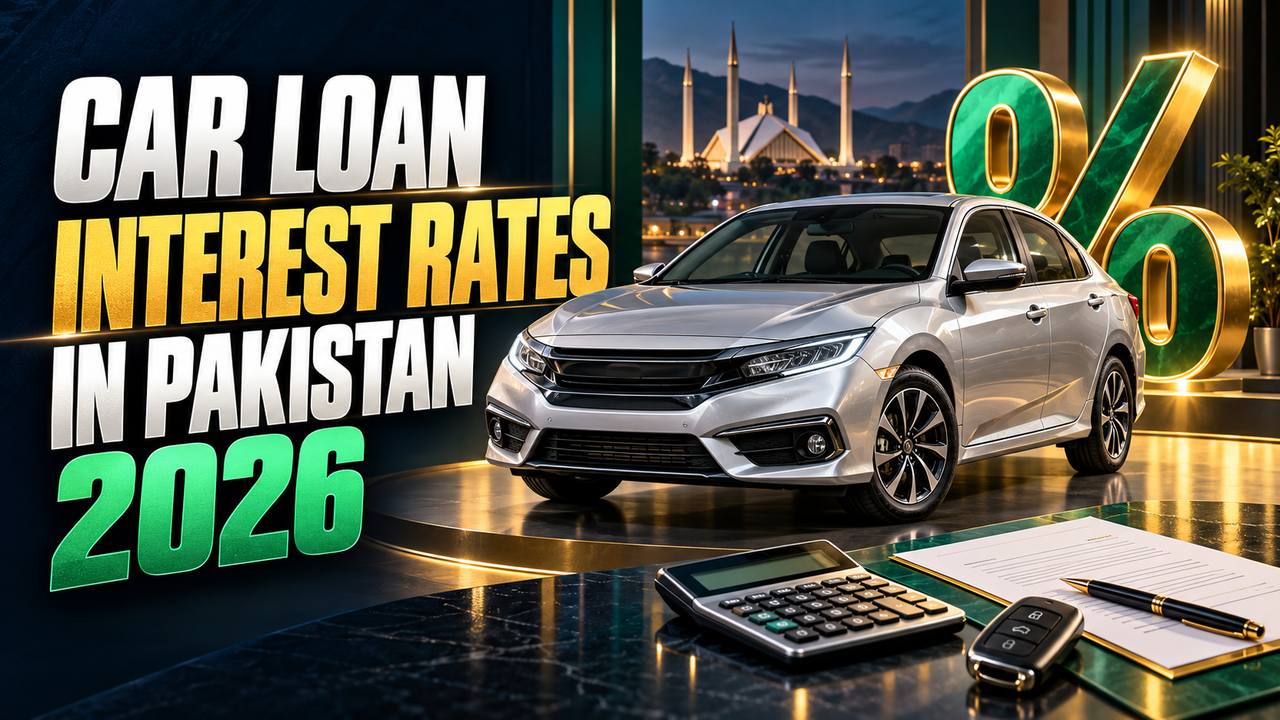
Car loan rates in Pakistan have swung a lot in the last few years. For instance, back in 2023, the SBP policy rate touched 22%. As a result, most buyers simply stayed away from bank finance. Today, however, the picture looks much better. Even so, a car loan is still not cheap, so know the real numbers before you sign.
Note: This article is general information rather than financial advice. Rates change every month, so always confirm the final figure with your bank.
Car Loan Rates in Pakistan Right Now (October 2026)
To begin with, almost every bank links its car loan to KIBOR, the Karachi Interbank Offered Rate. In turn, KIBOR follows the State Bank of Pakistan (SBP) policy rate. Therefore, when the SBP moves, your instalment moves too.
In April 2026, the SBP raised the policy rate by 100 basis points to 11.5%. It did this because the Middle East conflict pushed oil prices and inflation up. Since then, the SBP has kept the rate at 11.5% in its July and September 2026 meetings.
Benchmark
Rate
Why it matters
SBP policy rate
11.5%
The base for all bank lending
3-month KIBOR (offer, 23 Oct 2026)
12.00%
Used for some short-term loans
6-month KIBOR (offer, 23 Oct 2026)
12.41%
Used by a few banks
1-year KIBOR (offer, 23 Oct 2026)
12.75%
The usual base for car loans
Typical bank spread
3% to 5.5%
Added on top of KIBOR
Typical all-in rate
About 16% to 18%
What most buyers end up paying
People often search for the car loan interest rate in Pakistan but find old figures. In other words, most car loan rates in Pakistan now sit between about 16% and 18% a year.
On the other hand, some dealer campaigns go lower, because the carmaker pays part of the markup. You can check the KIBOR rate today on the SBP website, since it updates every working day.
How Banks Set Car Loan Rates in Pakistan
The formula is simple. Basically, your rate equals KIBOR plus the bank’s spread. For example, if 1-year KIBOR is 12.75% and the spread is 4%, you pay 16.75%.
The spread depends on a few things:
Tenure: longer loans usually carry a higher spread than short ones.
New or used car: used cars generally cost more to finance.
Your bank relationship: existing account holders often get a small discount.
Fixed or variable pricing: fixed deals usually start higher because the bank carries the risk.
The KIBOR date also matters. For instance, Bank Alfalah uses the 1-year KIBOR on the first day of each month. Meanwhile, Bank AL Habib uses the rate from the last day of the previous month. As a result, two banks with the same spread can still quote slightly different rates.
SBP Rules Every Car Loan Must Follow
The SBP also sets hard limits on auto finance through its prudential regulations. It tightened these rules in 2021 and again in 2022 because imports and the dollar came under pressure. As of 2026, the same limits still apply.
Rule
Current limit
Maximum auto finance from all banks combined
Rs 3 million (Rs 30 lakh)
Minimum down payment
30% of the car’s value
Maximum tenure, cars up to 1000cc
5 years
Maximum tenure, cars above 1000cc
3 years
Debt burden limit
All loan instalments within 40% of net monthly income
Imported vehicles
Bank finance effectively not allowed
These rules shape your choice more than the rate itself. For example, a 1300cc sedan can only go up to three years. As a result, the monthly instalment jumps, even when the rate looks fine.
Some banks also ask for more than 30% on used cars. Bank AL Habib, for instance, asks for at least 35% on used local cars.
Industry experts keep asking the SBP to raise the Rs 3 million cap. After all, car prices have climbed a lot. Even so, the cap was still in place in August 2026. Meanwhile, total auto loans reached about Rs 386 billion in July 2026, the 20th monthly rise in a row.
Bank-by-Bank Car Loan Rates in Pakistan
Banks in Pakistan publish spreads rather than final car loan rates. Therefore, the table below shows the pricing each bank lists on its own website. Then add the current 1-year KIBOR to get a rough all-in rate.
Bank
Product
Published pricing
Notes
Bank AL Habib
Apni Car
1-year KIBOR + 3% to 4.5% (variable); + 4% to 5.5% (fixed)
So a Bank Alfalah auto loan for a new car over three years works out at about 16.75% today. Similarly, a Bank AL Habib variable loan for two years starts at about 15.75%. However, these are starting points, so your final quote may differ.
An HBL car loan, though, is a little different. HBL often runs fixed-rate campaigns with carmakers, but the offer changes every few months. For this reason, check the current deal on its website or app before you compare.
Fixed vs Variable: Which Car Loan Rate Is Safer?
Most car loan rates in Pakistan float with KIBOR. Generally, a variable rate resets once a year on the loan anniversary. So if the SBP cuts rates, your instalment falls. But if the SBP raises rates, as it did in April 2026, your instalment rises.
In contrast, a fixed rate stays the same for the whole tenure. Therefore, you always know your monthly cost. However, banks charge extra for this certainty. At Bank AL Habib, for instance, fixed pricing runs about 1% above variable pricing.
So which one should you pick? Generally, choose fixed if your income is tight and you hate surprises. On the other hand, choose variable if you expect rates to fall and you can handle a higher instalment for a while.
Islamic Car Financing vs Conventional Loans
Islamic car financing in Pakistan mostly uses Ijarah or Musharakah. Under Ijarah, the bank buys the car and then rents it to you. Under Musharakah, however, you and the bank share ownership, and you buy the bank’s share bit by bit. For example, Meezan Bank Car Ijarah uses the first model, while UBL Ameen Drive uses Musharakah units.
Feature
Conventional loan
Islamic finance
What you pay
Markup on a loan
Rental for using the car
Pricing base
KIBOR + spread
Usually a KIBOR-linked rental rate
Ownership during term
Your car, with the bank’s lien
Bank owns or co-owns the car
Insurance
Conventional insurance
Takaful
Late payment
Late charges
Charity pledge instead of bank income
In practice, the monthly cost often lands close to a conventional loan, because both use KIBOR as a benchmark. Therefore, choose Islamic finance for your beliefs, not because you expect a much lower bill. Also, compare the full quote, including takaful and fees.
EMI Example: What You Will Really Pay
Numbers make this easier to understand. To illustrate, suppose you buy a car worth Rs 30 lakh. You pay a 30% down payment of Rs 9 lakh, so you borrow Rs 21 lakh.
All-in rate
3-year EMI
Total markup (3 years)
5-year EMI
Total markup (5 years)
15.75%
About Rs 73,600
About Rs 5.5 lakh
About Rs 50,800
About Rs 9.5 lakh
16.75%
About Rs 74,600
About Rs 5.9 lakh
About Rs 51,900
About Rs 10.1 lakh
17.75%
About Rs 75,700
About Rs 6.2 lakh
About Rs 53,000
About Rs 10.8 lakh
The five-year option only applies to cars up to 1000cc. In this case, a longer loan cuts the EMI by over Rs 20,000. However, it nearly doubles the total markup. Of course, you can test your own figures with any car loan calculator on a bank website.
Also remember the 40% rule. For example, a Rs 74,600 EMI needs a net income of about Rs 1.9 lakh a month. But that assumes you have no other loans.
Hidden Costs Beyond the Markup
However, the rate is only one part of the bill. Before you sign, ask for the Key Fact Statement (KFS). After all, it lists every charge in plain numbers.
Processing fee: many banks charge around Rs 8,000 to Rs 16,000, plus tax.
Insurance or takaful: often about 1.3% to 1.8% of the car’s value each year.
Tracker: some banks require one, while campaigns sometimes include it free.
Registration and token tax: you usually pay these upfront.
Early settlement charge: a percentage of the remaining balance.
Late payment charge: a fixed fee for each missed instalment.
For example, insurance alone on a Rs 30 lakh car can cost about Rs 39,000 to Rs 54,000 a year. Read our guide to car insurance in Pakistan before you accept the bank’s insurer.
How to Get Lower Car Loan Rates in Pakistan
Of course, you cannot control KIBOR. However, banks in Pakistan also set car loan rates based on your profile, and you can improve that.
Keep a clean credit record, because banks check your eCIB report.
Apply with the bank where your salary comes in, since it already knows your income.
Pay a bigger down payment so that you borrow less.
Pick a shorter tenure if you can manage the EMI.
Also watch for dealer campaigns from carmakers and banks.
Compare at least three KFS documents side by side.
Also, prepare your papers in advance. Our list of car buying documents in Pakistan helps you avoid delays at the bank and the dealer, too.
FAQs
Are car loan rates in Pakistan going down in 2026?
Not yet. In fact, the SBP raised the policy rate to 11.5% in April 2026 and held it in July and September. So car loan rates in Pakistan will only fall when the SBP starts cutting again.
Can I get a car loan above Rs 30 lakh?
No, not from Pakistani banks for a normal auto loan. That is because the SBP caps total auto finance at Rs 3 million per person across all banks. Therefore, you must pay the rest yourself.
Which bank has the lowest car loan rates in Pakistan?
It changes often, because campaigns come and go. Still, on published spreads, Bank AL Habib’s short variable loans start lowest at 1-year KIBOR + 3%. However, dealer campaigns can beat it, so compare live offers.
Is Islamic car financing cheaper?
Not usually. Because both types use KIBOR as a benchmark, monthly costs stay close. Instead, the main difference lies in the contract structure and Shariah compliance.
Can I pay off my car loan early?
Yes, most banks allow early settlement. However, they usually charge a fee on the remaining balance. So check the exact charge in your KFS first.
Final Word
To sum up, car loan rates in Pakistan right now mostly sit between 16% and 18%, built on a 1-year KIBOR near 12.75%. Above all, the SBP’s Rs 30 lakh cap, 30% down payment and tenure limits shape your EMI.