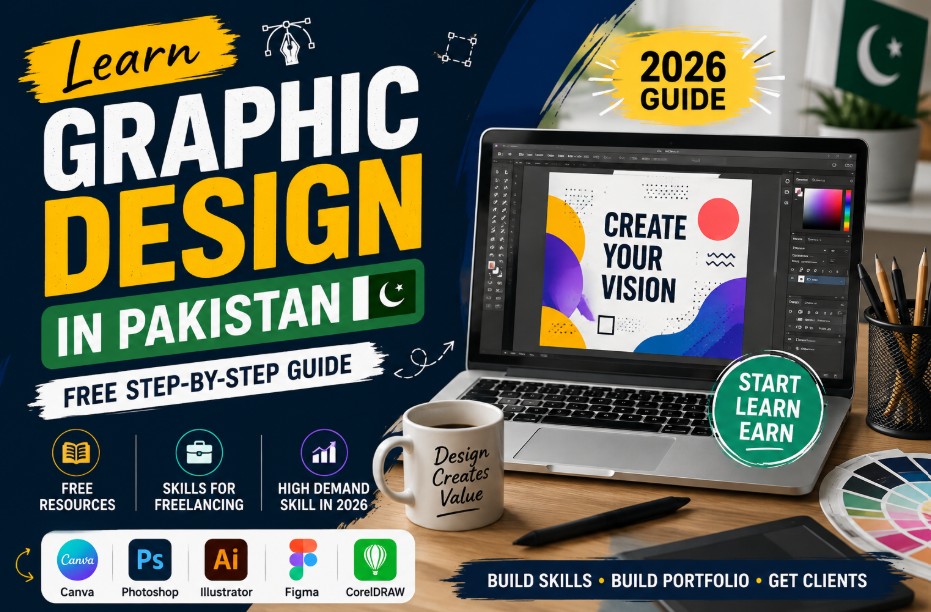
You can learn graphic design Pakistan students love without spending much money at all. Moreover, it is one of the most in-demand and beginner-friendly skills today. In this post, you will get a simple roadmap and the best free resources. Furthermore, this guide covers the tools, practice tips, and how to start earning.
To begin, graphic design is all about visual communication. Specifically, it uses images, colours, and text to share ideas. As a result, every brand and business needs good designers. Therefore, when you learn graphic design Pakistan’s huge freelance market opens up for you.
Why Learn Graphic Design?
Graphic design offers many strong benefits. Firstly, it is in very high demand everywhere. Secondly, it lets you earn through freelancing from home. Thirdly, it is beginner-friendly and easy to start. So, it suits students, housewives, and job seekers alike.
The best part is the low barrier to entry. Specifically, you do not need a formal degree to begin. Moreover, a strong portfolio matters far more than paper. Additionally, you can start with free tools. Therefore, anyone with a computer can begin today.
Pakistan is a great place for this skill. Specifically, our country is a top freelancing nation. Moreover, businesses constantly need logos, posts, and banners. Therefore, skilled designers earn well here. Indeed, many earn from international clients in dollars.
What Does a Graphic Designer Do?
A graphic designer creates visual content for brands. Basically, they turn ideas into eye-catching designs. So, their work appears almost everywhere you look. Below are some common examples.
Designers work on many types of projects. For example, they create logos and brand identities. Likewise, they design social media posts and banners. Moreover, they make brochures, posters, and packaging. Additionally, they design YouTube thumbnails and ads.
The work varies from simple to complex. Specifically, some jobs are quick social media graphics. Meanwhile, others are full brand identity systems. Therefore, there is work for every skill level. Consequently, you can grow steadily over time.
Skills You Need to Learn
Great design rests on a few key skills. Basically, these fundamentals matter more than any tool. So, learning them first is essential. Below are the main ones.
Four core principles guide all good design. Firstly, layout and balance arrange elements neatly. Secondly, colour theory helps you choose the right shades. Thirdly, typography covers fonts and how to pair them. Moreover, contrast and hierarchy guide the viewer’s eye.
These fundamentals apply to every project. Specifically, they work in logos, posts, and websites alike. Moreover, they separate amateurs from professionals. Therefore, study them before diving into software. Indeed, strong basics make every design better.
The Tools You Will Use
Designers use several powerful software tools. Basically, each tool suits a different kind of work. So, knowing them helps you choose wisely. The table below lists the main ones.
Tool
Best For
Canva
Easy designs and social media (beginners)
Adobe Photoshop
Photo editing and raster design
Adobe Illustrator
Logos and vector graphics
Adobe InDesign
Print layouts and brochures
Figma
UI/UX design (pays more)
CorelDRAW
Popular for print work in Pakistan
As the table shows, each tool has its strength. Moreover, you do not need to learn them all at once. Additionally, free options like GIMP and Photopea exist too. Therefore, start with one tool and grow. Below is the best order to learn them.
The Best Order to Learn Tools
Learning tools in the right order avoids overwhelm. Basically, you build confidence step by step. So, follow this simple sequence. Below is the recommended path.
Start with Canva for the first few weeks. Specifically, it is easy and teaches design sense. Then, move to Adobe Photoshop for deeper editing. Next, learn Illustrator for logos and vectors. Moreover, add Figma later if you want UI/UX work.
This phased approach works very well. Specifically, it prevents confusion and builds skill gradually. Moreover, UI/UX design with Figma often pays more. Therefore, plan your tool journey step by step. Consequently, you learn faster and stay motivated.
Free Ways to Learn in Pakistan
Pakistan offers many free ways to learn design. Basically, you can start without spending anything. So, cost is never a real barrier. The table below lists top free resources.
Resource
Best For
YouTube (Urdu channels)
Free video lessons
DigiSkills.pk
Free government course and certificate
Digital Pakistan
Free design certification
Canva Design School
Beginner design basics
Behance and Dribbble
Design inspiration
DigiSkills.pk
DigiSkills is a top free government option. Basically, it offers a full graphic design course. So, it teaches Photoshop and Illustrator step by step. Moreover, it gives a free certificate from Virtual University.
This course suits complete beginners well. Specifically, industry professionals teach it with real examples. Moreover, it includes practical exercises for the online market. You can enrol on the official site at digiskills.pk. Therefore, it is a great free starting point.
YouTube (Urdu Channels)
YouTube is the richest free learning source. Basically, it has full design courses for free. So, you can learn everything at your own pace. Moreover, many channels teach in Urdu for local learners.
Urdu tutorials make learning much easier. Specifically, they explain tools in a familiar language. Moreover, they cover Photoshop, Illustrator, and Canva. Additionally, they often include freelancing tips. Therefore, YouTube is perfect for Pakistani beginners.
Other Free Options
A few more free resources help greatly. For example, Digital Pakistan offers a free design certification. Likewise, Canva’s Design School teaches the basics. Moreover, Behance and Dribbble show inspiring real designs. Therefore, combine these to build strong skills.
A Simple Learning Roadmap
A clear roadmap keeps you on track. Basically, it breaks learning into simple stages. So, you always know your next step. Below is a beginner roadmap.
First, learn the design fundamentals and colour theory. Then, start creating simple designs in Canva. Next, learn Photoshop for editing and social posts. After that, learn Illustrator for logos and vectors. Moreover, practice each skill with real projects.
The final stages focus on real work. Specifically, build ten to fifteen sample designs. Then, create a portfolio to show your skills. Additionally, start offering services on freelancing sites. Therefore, this path takes you from beginner to earner.
How Much to Practice
Practice is the real secret to success. Basically, design is a skill you build by doing. So, regular practice matters most. Below is a simple guideline.
Aim for focused daily practice. Specifically, try sixty to ninety minutes each day. Moreover, consistency beats long, rare sessions. Additionally, recreate designs you admire to learn faster. Therefore, steady practice builds real skill.
Studying good designs also helps a lot. Specifically, look at logos and posts you like. Moreover, notice their colours, fonts, and layout. Therefore, learn from the best work around you. Indeed, your eye improves with every design you study.
Learn Fundamentals, Not Just Software
Many beginners make one big mistake here. Basically, they focus only on learning the software. However, tools alone do not make good design. Moreover, fundamentals matter far more.
Strong basics improve every design you make. Specifically, good layout and colour choices stand out. Moreover, clients notice professional, balanced work. Therefore, always study design principles alongside tools. Consequently, you become a designer, not just a software user.
Build a Strong Portfolio
A portfolio proves your real skills. Basically, it shows clients what you can create. So, building one is essential for work. Moreover, it matters more than any certificate.
Start with a set of sample designs. Specifically, create ten to fifteen strong pieces. Then, upload them to a portfolio site. Moreover, Behance and Dribbble are popular choices. Additionally, Instagram works well for showcasing designs.
Your portfolio should show your best work. Specifically, include a variety of design types. Moreover, keep only your strongest pieces. Therefore, quality beats quantity here. Indeed, a sharp portfolio wins more clients.
Pick a Niche
Choosing a niche helps you stand out. Basically, a niche is a specific design focus. So, it makes you the go-to expert. Moreover, specialists often earn more than generalists.
Several profitable niches exist in design. For example, logo and brand identity design is popular. Likewise, social media design is always in demand. Moreover, UI/UX design pays significantly more. Additionally, YouTube thumbnails are a growing niche. Therefore, pick one that suits your interest.
Design and Other Skills
Design pairs beautifully with other digital skills. Basically, combining skills makes you more valuable. So, learning a second skill is smart. Below are two great matches.
Web development is a perfect partner for design. Specifically, designers who code create websites and app screens. Moreover, UI and web design pay very well. If coding also interests you, see our learn web development Pakistan guide.
Business knowledge also boosts a design career. Specifically, design skills support marketing and branding work. Moreover, a business education adds strong career options. If a formal business education interests you, see our IBA Karachi admission guide. Therefore, mixing skills opens more doors.
Free Learning vs a Formal Degree
Free learning is enough for many designers. Basically, most design jobs value skills over degrees. So, a self-taught path can fully succeed. Moreover, your portfolio matters most to clients.
However, some students prefer a formal degree too. Specifically, a design degree adds deep theory and structure. For example, the National College of Arts offers respected design programs. You can explore them at nca.edu.pk. Therefore, choose self-learning, a degree, or both.
Earning as a Graphic Designer
Earning is the exciting goal for many learners. Basically, design skills sell very well online. So, you can start freelancing once you are ready. Moreover, Pakistan’s freelance market is booming.
Several income paths are open to you. Specifically, Fiverr and Upwork connect you to global clients. Moreover, local agencies and companies hire designers too. Additionally, international clients pay in dollars, which is higher. Therefore, a strong portfolio helps you earn faster.
Earnings grow with your skill and experience. Specifically, beginners can earn a modest monthly income. Meanwhile, experienced designers earn much more. However, actual amounts vary widely by client and skill. Therefore, focus on improving and building trust.
Tips to Succeed
A few habits make learning far easier. Firstly, practice a little every single day. Secondly, study design principles, not just tools. Thirdly, recreate designs you like to improve. Moreover, ask for feedback to grow faster.
More small habits help a lot. For example, build your portfolio as you learn. Likewise, pick a niche to stand out. Additionally, start freelancing before you feel “perfect”. Therefore, these habits turn effort into real results.
Common Mistakes to Avoid
Many beginners repeat the same errors. Basically, these mistakes slow down progress. So, avoiding them saves you time. Below are the common ones.
A few habits hold designers back. Firstly, learning only software without fundamentals is common. Secondly, copying designs without understanding them is unhelpful. Thirdly, skipping practice wastes real potential. Moreover, having no portfolio blocks freelancing.
Staying consistent solves most problems. Specifically, daily practice builds lasting skill. Moreover, real projects teach far more than watching. Therefore, focus on doing, not just learning. Indeed, action beats talent every time.
Communities and Help
Helpful communities make learning much easier. For example, design forums answer beginner questions. Similarly, YouTube channels teach in English and Urdu. Moreover, Facebook groups connect Pakistani designers. So, you can learn from thousands of others.
Beyond communities, official resources add value. Specifically, DigiSkills offers free structured learning. Additionally, design sites like Behance inspire and guide you. Therefore, trusted help is always within reach. Indeed, no learner is ever truly alone.
These communities also share useful advice. For instance, members review portfolios and give feedback. Likewise, they share the best free courses. Consequently, staying connected speeds up your growth. Ultimately, shared knowledge helps you learn graphic design Pakistan’s creative market rewards.
Frequently Asked Questions
Can I learn graphic design Pakistan style completely free?
Yes, you can learn it entirely for free. Specifically, YouTube and DigiSkills offer full courses. Moreover, Canva is free and beginner-friendly. Therefore, money is never a barrier to starting.
Do I need a degree to become a graphic designer?
No, a degree is not required for most jobs. Specifically, a strong portfolio matters far more. Moreover, many designers are fully self-taught. However, a design degree can still help.
Which software should I learn first?
Start with Canva for a few weeks first. Specifically, it teaches design sense easily. Then, move to Photoshop and Illustrator. Moreover, add Figma later for UI/UX work.
How long does it take to learn graphic design?
It usually takes a few months of steady practice. Specifically, basics come within the first weeks. Meanwhile, job-ready skills take longer with projects. Therefore, consistency matters more than speed.
Can I earn money from graphic design in Pakistan?
Yes, many designers earn through freelancing. Specifically, sites like Fiverr and Upwork offer clients. Moreover, agencies and companies also hire designers. However, earnings vary by skill and experience.
Is Canva good enough for professional design?
Canva is excellent for beginners and social media. Specifically, it is quick and very easy to use. However, professional work often needs Photoshop or Illustrator. Therefore, learn Adobe tools as you grow.
Which design niche pays the most?
UI/UX design often pays the most. Specifically, it uses tools like Figma. Moreover, logo and brand design also pay well. Therefore, choose a niche that fits your interest.
Do I need an expensive computer for design?
A decent computer helps, but you can start simple. Specifically, Canva runs even on basic machines. However, heavy Adobe tools need more power. Therefore, upgrade only as your work grows.