Car buying documents Pakistan are the essential paperwork you must verify before any vehicle transaction in 2026. In the first half of this year, the government has introduced significant digital reforms to eliminate fraud and simplify the registration process. Consequently, understanding the latest requirements for biometric verification and tax compliance is vital for every buyer.
In this post, we will explore the comprehensive list of documents needed for both brand-new and used vehicles. We will look at the specific differences between provincial excise departments and the impact of your tax filer status. Furthermore, this guide provides a deep dive into the 2026 biometric revolution through the Pak Identity app. Whether you are purchasing your first hatchback or exploring the luxury cars in Pakistan, having the right paperwork is the only way to ensure a legal and stress-free ownership experience.
The Importance of Proper Documentation in 2026
Buying a car in Pakistan is a significant financial commitment. However, the legal transfer of ownership is often where buyers face the most challenges. Historically, many people relied on “Open Transfer Letters,” but these are now completely illegal. In 2026, the Excise and Taxation departments across all provinces have tightened their grip on documentation.
If your car buying documents Pakistan are incomplete, you cannot legally prove ownership. Furthermore, you will face severe difficulties when paying token taxes or selling the vehicle later. Therefore, you must treat the paperwork with the same importance as the mechanical inspection. Modern digital systems now allow you to verify most documents online before you even meet the seller. This ensures that the vehicle is not stolen, snatched, or involved in any litigation.
1. Documents Required for Buying a New Car
When you purchase a brand-new car from an authorized dealership (3S Dealership), the documentation is generally more straightforward. However, you must still ensure that the dealer provides the “Original File” in its entirety.
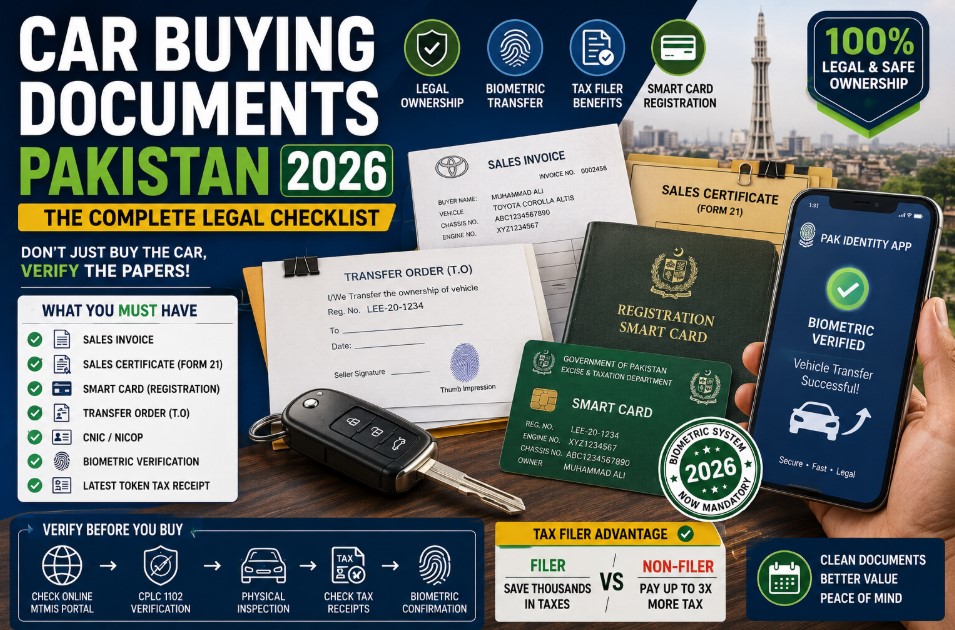
The Sales Invoice
The Sales Invoice is the primary document issued by the manufacturer (e.g., Toyota, Honda, or Suzuki). It must be in the name of the person who is registering the vehicle. Specifically, it contains the engine number, chassis number, and the total price paid including taxes. In 2026, many manufacturers issue “E-Invoices” which can be verified through their official portals.
The Sales Certificate (Form 21)
Commonly known as the “Birth Certificate” of the car, this document is issued by the factory. It confirms that the vehicle has been manufactured and sold to the specific buyer. Without this certificate, the Excise office will not issue a registration number. Consequently, you must keep the original copy in a very safe place.
Application Form F
Form F is the standard application for the registration of a new vehicle. You can download this from the provincial Excise websites. It requires your personal details, CNIC number, and the technical specifications of the car. In 2026, most dealerships in Karachi and Lahore offer to handle this for you for a small service fee.
CNIC of the Buyer
A clear, valid copy of your Computerized National Identity Card (CNIC) is mandatory. If you are a non-resident, you must provide your NICOP. Furthermore, your filer status on the FBR Active Taxpayers List (ATL) will be checked using this CNIC to determine your registration tax.
2. Documents Required for Buying a Used Car
Purchasing a used vehicle requires a more rigorous check of the car buying documents Pakistan. You are not just buying a machine; you are buying its entire legal history. If you are currently hunting for a pre-owned vehicle, refer to our used cars Pakistan best guide for inspection tips.
The Smart Card (Registration Certificate)
In 2026, the old “Registration Book” has been almost entirely replaced by the Smart Card. This card contains an embedded chip with all vehicle data. You must verify that the engine and chassis numbers on the card match the physical car perfectly. Similarly, check the “Owner Name” and ensure the person selling the car is the legal owner mentioned on the card.
The Transfer Order (T.O) Form
The T.O. form is a legal declaration by the seller that they have sold the vehicle to you. It must be signed by the seller and contain their thumb impression. However, in the 2026 digital era, the physical T.O. form is often supplemented by a digital entry in the Excise system.
Original Registration File
If the car was registered under the “File Return Scheme,” the original file contains the previous invoices and sales certificates. For older cars, the “Master File” is extremely valuable. If the seller says the “File is Duplicate,” the market value of the car drops by 10% to 15%. Consequently, always demand the original file.
The Sale Deed (Stamp Paper)
While not an official Excise document, a Sale Deed on a Rs. 100 or Rs. 500 stamp paper is a vital legal backup. It should state the sale price, date of transaction, and include signatures from two witnesses. This document protects you if the seller later claims the car was stolen or if you are stopped by the police before the transfer is finalized.
3. The 2026 Biometric Revolution: Pak Identity App
The biggest change in the car buying documents Pakistan landscape this year is the mandatory biometric verification. Starting in late January 2026, the Punjab and Sindh Excise departments have integrated their systems with the NADRA Pak Identity app.
How it Works
Both the buyer and the seller no longer need to visit the Excise office together. Instead, they can perform the biometric verification from their smartphones. Specifically, the seller initiates the transfer through the “e-Pay” or “Excise” app. Then, the buyer receives a notification to verify their identity.
Why Biometric is Mandatory
This system was introduced to end the era of fake transfers. It ensures that the person selling the car is alive and physically present (digitally). Furthermore, it links the vehicle directly to your CNIC in the NADRA database. Consequently, the “Open Letter” culture has been completely eradicated. If the seller refuses to provide biometrics, you should never buy the car.
4. Provincial Differences: Sindh vs. Punjab vs. Islamabad
While the core car buying documents Pakistan remain the same, each province has its own digital portal and minor procedural differences.
Punjab (e-Pay Punjab App)
Punjab has the most advanced digital system. You can pay all registration and transfer fees through the e-Pay app. Once paid, you receive a PSID number. You then visit a “Khidmat Markaz” for a quick physical inspection of the car. The Smart Card is then delivered to your doorstep via Pakistan Post.
Sindh (Excise, Taxation & Narcotics Control)
In Sindh, the process still involves a bit more manual work. You must visit the Civic Centre (Karachi) or regional offices. However, the online “Tax Calculator” on the Sindh Excise website is very helpful. It allows you to check the exact “Transfer Fee” and “Luxury Tax” before you make a payment.
Islamabad (ICT Excise)
Islamabad-registered vehicles are highly valued for their clean paperwork. The ICT Excise department uses the “City Islamabad” app. Interestingly, Islamabad allows for “Universal Plates,” meaning the registration number stays with the owner, not the car, in some specific cases.
5. Comparison Table: Filer vs. Non-Filer Tax Rates (2026)
Your tax status significantly impacts the total cost of your car buying documents Pakistan. The government uses higher taxes to discourage non-filers from buying high-value assets.
Vehicle Category
WHT for Filer (PKR)
WHT for Non-Filer (PKR)
Impact
Under 850cc
~10,000
~30,000
3x Higher
851cc – 1000cc
~20,000
~60,000
3x Higher
1001cc – 1300cc
~25,000
~75,000
3x Higher
1301cc – 1600cc
~50,000
~150,000
Huge Gap
1601cc – 1800cc
~150,000
~450,000
Luxury Penalty
Above 2000cc
3% of Value
10% of Value
Prohibitive
Note: These are estimated 2026 rates based on the latest Finance Act. Always check the FBR portal for real-time updates.
6. Special Documents for Imported (JDM) Cars
If you are buying a Japanese Domestic Market (JDM) car, you need additional car buying documents Pakistan to prove the legal import.
Bill of Lading: This shows when and how the car arrived at Karachi port.
Goods Declaration (GD) Copy: This is the most important import document. It proves that all customs duties and regulatory duties have been paid to the government.
Passport Copy of the Importer: Most JDM cars are imported under the “Gift Scheme” or “Personal Baggage Scheme.” You need a copy of the passport of the person whose name was used for the import.
Auction Sheet: While not a registration document, a verified Auction Sheet is vital for your own peace of mind. It tells you the actual condition of the car at the time it left Japan.
7. Documentation for Financed Cars
If you are not paying cash, the documentation changes slightly. For a detailed breakdown of the financial side, read our car finance Pakistan complete guide.
When a bank is involved, the car buying documents Pakistan will include an HPA (Hire Purchase Agreement). This means the bank’s name will be mentioned on the Smart Card as a “Mortgagee.” You cannot sell the car or transfer it to another name until you obtain an NOC (No Objection Certificate) from the bank after paying off the loan. Consequently, the bank keeps the original file (Master File) in their locker until the final installment is paid.
Step-by-Step Document Verification Process
Follow this checklist to ensure your car buying documents Pakistan are 100% authentic.
Online Verification: First, enter the registration number in the provincial MTMIS (Motor Transport Management Information System) portal. Check if the “Owner Name” and “Tax Paid” status match the seller’s claims.
CPLC Check: Specifically for Karachi, call the CPLC (Citizen-Police Liaison Committee) at 1102. Give them the engine and chassis numbers to ensure the car is not in their “stolen” database.
Physical Inspection: Match the chassis number stamped on the car’s frame (usually under the hood or seat) with the one on the Smart Card.
Tax Receipts: Demand the latest “Token Tax” receipt. If the tax is unpaid for several years, you will have to pay the arrears plus a heavy fine.
Biometric Confirmation: Finally, ask the seller to initiate the biometric transfer through the app. Only pay the full amount once the biometric process is confirmed in the system.
FAQs: Car Buying Documents Pakistan
Can I buy a car without a CNIC?
No. It is impossible to register or transfer a vehicle in Pakistan without a valid CNIC or NICOP.
What is an “Open Transfer Letter”?
It is a document where the seller signs the transfer form but leaves the buyer’s name blank. This is now illegal and can lead to the seizure of the vehicle in 2026.
What if the original file is lost?
You can apply for a “Duplicate File.” However, you will need to file an FIR at a police station and publish an advertisement in a newspaper. A car with a duplicate file has a much lower resale value.
Does a non-filer need extra documents?
No extra documents are needed, but the “Withholding Tax” (WHT) will be significantly higher. For luxury cars, the difference can be hundreds of thousands of rupees.
Summary and Final Tips
In summary, securing the correct car buying documents Pakistan is the most important part of the vehicle purchase process in 2026. The shift toward biometric verification and digital payments through apps like e-Pay Punjab has made the system more secure. Furthermore, being a tax filer provides you with a massive financial advantage during the registration of both new and used vehicles.
Always prioritize the original file and the Smart Card. Similarly, never skip the biometric step, as it is your only legal proof of a successful transfer. By following the detailed checklists in this post, you can protect your investment and enjoy your new ride with total peace of mind. Remember, a car with clean paperwork is a car that will always retain its value in the Pakistani market. Happy car hunting!