
Islam
Kaffarah Fidya Roza Explained: Rules for Missed Fasts (Roza)

Every single year, the holy month of Ramadan brings immense joy to Muslims worldwide. During this special time, millions of believers successfully complete their daily fasts. They experience deep spiritual growth and strong community bonding. However, life is truly unpredictable. Sometimes, severe sickness, long travel, or human mistakes interrupt this sacred practice. Therefore, many people frequently ask the exact rules of kaffarah fidya roza.
Fortunately, Islam is a highly practical and merciful religion. God does not want to place an impossible burden on anyone. Consequently, Islamic law provides very clear, manageable solutions for missed fasts. Specifically, you will often hear three important terms: Qaza, Fidya, and Kaffarah.
Are you currently trying to understand the exact rules of kaffarah fidya roza? Perhaps you are simply wondering how to make up for a broken fast. If so, you have certainly come to the right place. In this highly detailed guide, we will completely explain these important concepts. Furthermore, we will show you exactly how to calculate your payments. Ultimately, this guide will help you confidently fulfill your religious duties.
Understanding the Basics: Islam is a Religion of Ease
Before we dive into the specific rules of kaffarah fidya roza, we must understand a core Islamic principle. Islam consistently promotes ease and balance. The Holy Quran explicitly states that Allah intends for you ease and does not intend for you hardship.
Because of this beautiful principle, fasting remains obligatory only for those who can safely handle it. If a person faces extreme physical hardship, Islam offers immediate alternatives. Essentially, the religion provides a fair system. This system carefully ensures that everyone can participate in the blessings of Ramadan. They can participate even if they cannot physically stay away from food and drink.
This alternative system primarily relies on feeding the poor. Consequently, when someone cannot fast, the broader community still benefits from their charity. This beautiful cycle of giving perfectly captures the true spirit of Ramadan.
What is Qaza? (Making Up a Missed Fast)
First, we must briefly define Qaza. Qaza simply means making up a missed fast at a later date. This rule strictly applies to people who miss a fast for a temporary, valid reason.
For example, imagine you catch a severe flu during Ramadan. Naturally, you cannot fast safely. Therefore, you simply eat and drink to recover. Alternatively, perhaps you are traveling on a long, exhausting journey. Similarly, women who are menstruating or experiencing post-partum bleeding cannot fast.
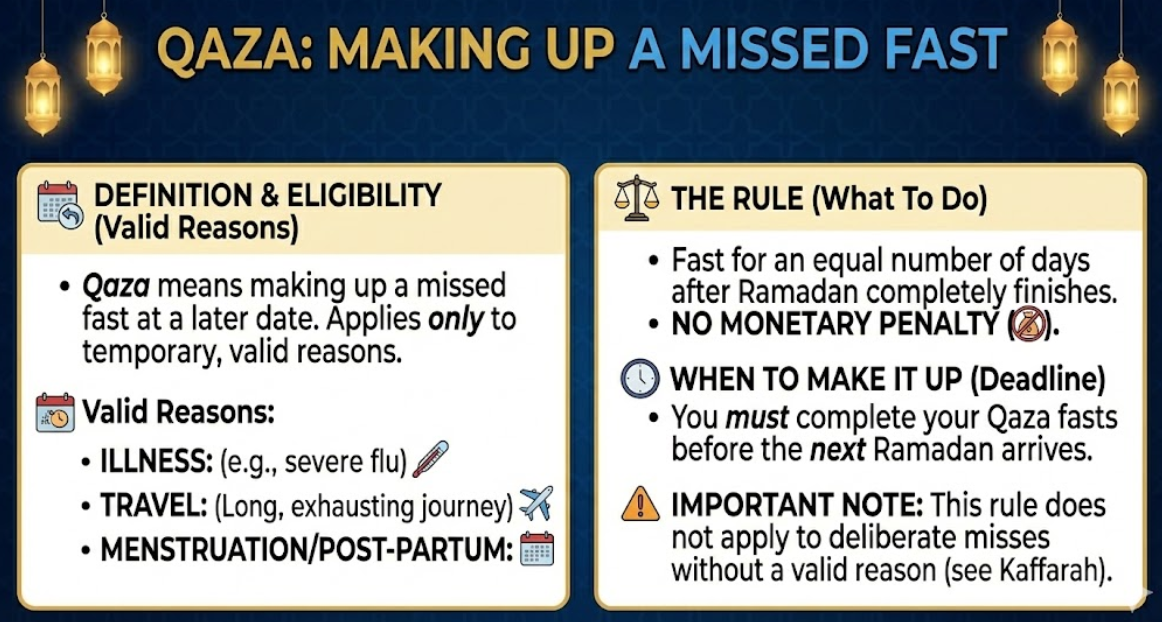
In all these specific cases, the person receives a temporary exemption. Consequently, they do not pay any money. Instead, they simply fast for an equal number of days after Ramadan completely finishes. You must complete your Qaza fasts before the next Ramadan arrives.
What is Fidya? (Compensation for the Unable)
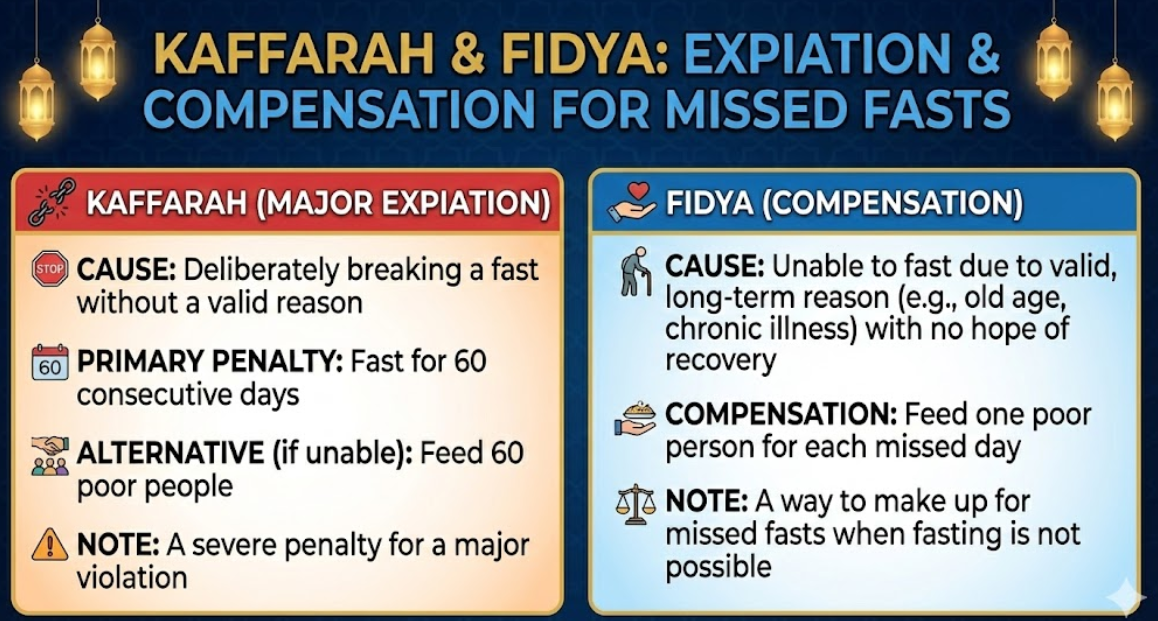
Now, let us closely examine Fidya. The word Fidya literally means a ransom or a compensation. In Islamic law, Fidya serves as a charitable donation. You must pay this donation if you cannot fast due to a permanent, unchangeable reason.

1. Who Exactly Qualifies for Fidya?
Fidya strictly applies to a very specific group of people. You cannot simply choose to pay Fidya because you feel lazy. Instead, it applies to:
- The Elderly: Very old individuals who are physically too weak to handle a long fast.
- The Chronically Ill: People suffering from permanent, severe medical conditions. For example, severe diabetes or kidney disease might prevent someone from fasting safely. If a doctor firmly advises against fasting permanently, the person pays Fidya.
- Pregnant or Nursing Women (in some cases): According to certain Islamic scholars, if a pregnant or nursing woman fears permanent harm to her baby, she might pay Fidya. However, many scholars require her to simply perform Qaza later. You should consult a local scholar for your specific situation.
2. How Much is the Fidya Payment?
The calculation for Fidya is actually quite simple. For every single fasting day you miss, you must provide two full, nutritious meals to one needy person. Alternatively, you can feed one poor person for the entire month of Ramadan.
Today, most people simply pay the cash equivalent of these meals. Islamic charities calculate this exact amount every single year before Ramadan begins. They base this monetary value on the current local price of staple foods like wheat, barley, or dates. Therefore, you simply multiply the daily Fidya rate by the total number of days you missed.
3. When Should You Pay Fidya?
Ideally, you should pay your Fidya during the holy month of Ramadan. You can pay it daily. Alternatively, you can confidently pay a lump sum at the very beginning or the very end of the month. By paying it early, you actively help poor families afford their own Suhoor and Iftar meals.
What is Kaffarah? (The Severe Penalty)
Next, we must thoroughly understand Kaffarah. This concept is drastically different from Fidya. While Fidya acts as a gentle compensation, Kaffarah serves as a heavy, serious penalty. The term Kaffarah translates to an expiation or an atonement for a deliberate sin.
1. What Triggers the Kaffarah Penalty?
You must pay Kaffarah only if you intentionally and deliberately break a valid fast without any lawful excuse. Specifically, this serious violation happens if you purposefully eat food, drink liquids, or engage in marital intimacy during the fasting hours.
For example, imagine you wake up, make your intention, and begin fasting perfectly. Then, at noon, you simply decide you are tired of fasting. You purposefully grab a glass of water and drink it. Consequently, you have deliberately broken a strict commandment of Allah. Therefore, the heavy rules of Kaffarah immediately apply to you.
2. How Do You Pay the Kaffarah Penalty?
Because intentionally breaking a fast represents a major sin, the penalty is appropriately massive. To properly fulfill your Kaffarah, you must do one of the following:
- Fast for 60 Consecutive Days: You must successfully fast for 60 days in a row. You must do this for every single fast you broke intentionally. If you miss even one day (without a highly valid medical excuse), you must completely restart the 60-day count from the very beginning.
- Feed 60 Needy People: Sometimes, a person is physically completely unable to fast for 60 consecutive days due to health reasons. If this is genuinely true, they receive a second option. They must provide two full meals to 60 poor people. Alternatively, they can feed one poor person for 60 days. Just like Fidya, you can also pay the exact cash equivalent to a trusted Islamic charity.
Clearly, understanding the rules of kaffarah fidya roza prevents major confusion. It clearly separates those who need mercy (Fidya) from those who need strict discipline (Kaffarah).
Key Differences: Kaffarah vs. Fidya
To make this topic completely clear, let us heavily compare these two concepts. When people search for kaffarah fidya roza, they usually want to know the exact differences.
- The Core Reason: You pay Fidya because you are permanently unable to fast. Conversely, you pay Kaffarah because you deliberately broke a fast without a valid excuse.
- The Physical Action: Fidya never requires you to fast later. It is purely a financial or food-based charity. On the other hand, Kaffarah strictly requires you to fast for 60 consecutive days first. You only pay money if you are physically incapable of the 60-day fast.
- The Total Cost: Fidya requires feeding just one person for one missed day. Kaffarah requires feeding 60 people for just one broken day. Therefore, Kaffarah is a significantly larger burden.
- The Spiritual Mindset: Paying Fidya brings a peaceful sense of fulfilling a duty. It is a merciful alternative. Paying Kaffarah requires deep, sincere repentance. It is a strict atonement for a major mistake.
Daily Worship: Intention and Breaking the Fast
Whether you are performing your regular Ramadan fasts, completing a Qaza makeup fast, or attempting a 60-day Kaffarah fast, the daily rules remain exactly the same. You must follow the traditional daily routine carefully.
1. Making the Proper Intention (Suhoor)
Every single valid fast must absolutely begin with a clear intention. You must make this intention before the break of dawn. Waking up for the pre-dawn meal (Suhoor) provides excellent physical energy. It also brings huge spiritual blessings. As you sit down to eat, you should firmly dedicate your fast to Allah. To make this moment truly special, you should learn and consistently recite the roza rakhne ki dua. This powerful prayer clearly sets your spiritual focus for the long hours ahead.
2. Breaking the Fast Joyfully (Iftar)
Eventually, the sun completely sets. At this exact moment, you finally complete your fasting day. This meal is known as Iftar. Breaking the fast is a highly joyous and spiritual occasion. Traditionally, believers break their fast with a sweet date and a sip of cool water. Just before taking this highly anticipated first bite, they actively recite the roza kholne ki dua. Through this short, beautiful prayer, they thank God for His abundant provision and their own daily strength.
Maximizing Ramadan When You Cannot Fast
Many people feel incredibly sad when they have to pay Fidya. They deeply miss the beautiful spiritual high of fasting alongside their community. However, Islam is beautifully comprehensive. Even if you cannot physically fast, you can still experience a profoundly spiritual Ramadan.
1. Increase Your Daily Charity
Since you are already paying Fidya, you possess a generous mindset. You should actively expand this generosity. Give extra charity (Sadaqah) throughout the month. Sponsor Iftar meals for the poor in your local community. By feeding fasting people, you receive the exact same spiritual reward as if you fasted yourself.
2. Connect Deeply with the Quran
Ramadan is globally celebrated as the Month of the Quran. Therefore, fasting is not the only required activity. You should dedicate several hours a day to reading the Holy Quran. Read the translation carefully. Try to deeply understand the divine messages and apply them practically to your daily life.
3. Focus on the Final Ten Nights
The ultimate peak of Ramadan always happens during the final ten days. Hidden inside the odd-numbered nights is Laylat al-Qadr (The Night of Power). Sincere worship on this single night brings more rewards than a thousand months of regular worship. Even if you are not fasting, you can pray, supplicate, and repent during these nights. To successfully stay focused, you should strictly follow a worship plan for the last 10 nights of Ramadan. This structured plan ensures you do not miss the massive blessings of these holy nights.
The Role of Islamic Charities
Today, fulfilling your Fidya or Kaffarah is easier than ever before. In the past, people had to personally find needy individuals. They had to buy raw ingredients, cook massive meals, and distribute the food manually.
Today, numerous highly trusted Islamic charities operate globally. They eagerly accept your Fidya and Kaffarah payments online. Afterward, they use these exact funds to provide hot, nutritious meals to poor communities, refugees, and disaster victims around the world. Consequently, your missed fast transforms directly into life-saving food for a desperate family. This highly organized system ensures your religious duty is fulfilled accurately and effectively.
Common Misconceptions About Missed Fasts
When discussing the rules of kaffarah fidya roza, many people frequently get confused. Let us quickly clear up a few major misconceptions.
- Misconception 1: I can just pay Fidya because my job is very hard. Truth: No. A difficult job does not excuse you from fasting. You must try to fast. If it becomes completely unbearable during the day, you may break it and do Qaza later. You cannot simply substitute it with money upfront.
- Misconception 2: I accidentally swallowed water while swimming. Now I must pay Kaffarah. Truth: No. Kaffarah strictly applies only to intentional breaking of the fast. If you swallow water completely by accident, your fast actually remains valid. You simply continue fasting.
- Misconception 3: I missed a fast because I was traveling. I will just pay Kaffarah to be safe.Truth: No. Travel provides a valid, lawful excuse. Therefore, you only need to perform Qaza (fasting one day later). Kaffarah is a severe penalty for unlawful, intentional violations.
Conclusion
Understanding the precise rules of kaffarah fidya roza is an absolute necessity for every practicing Muslim. Clearly, Islam builds a highly structured, fair, and incredibly merciful system. It perfectly balances strict spiritual discipline with immense human compassion.
If you are permanently unable to fast, the system of Fidya kindly allows you to participate in Ramadan through beautiful charity. It heavily protects your health while still feeding the poor. Conversely, if you make a terrible mistake and intentionally break a fast, the heavy system of Kaffarah firmly guides you back to the right path. It requires deep repentance and intense discipline to correct your severe error.
Ultimately, whether you are fasting every day, making up days later through Qaza, paying your charitable Fidya, or repenting through Kaffarah, the ultimate goal remains exactly the same. The goal is to deeply please Allah, purify your own soul, and build a much stronger, highly compassionate community. May this Ramadan bring immense peace, crystal clear understanding, and profound spiritual light to your life.
Frequently Asked Questions (FAQs)
1. What exactly does Kaffarah mean in Islam?
Kaffarah serves as a heavy religious penalty or expiation. You must pay it if you deliberately and intentionally break a valid Ramadan fast without a lawful excuse. It requires fasting for 60 consecutive days or feeding 60 poor people.
2. Who is strictly required to pay Fidya?
Fidya applies only to individuals who are permanently unable to fast. Specifically, this group includes very elderly people and those suffering from chronic, permanent illnesses. They pay Fidya because they can never safely make up the fast later.
3. If a woman misses fasts due to pregnancy, does she pay Fidya or Kaffarah?
She definitely does not pay Kaffarah. According to most scholars, a pregnant woman simply receives a temporary exemption. Therefore, she only needs to perform Qaza (make up the fasts) when she is healthy again. Some scholars allow Fidya if she fears for her baby, but you should consult a local scholar.
4. How do I calculate the cash amount for Fidya?
The cash amount completely depends on your local economy. It generally equals the cost of providing two full, basic meals in your specific city. Islamic charities publish the exact monetary rate every year before Ramadan starts.
5. Can I pay my Fidya completely in advance?
Yes. You can confidently pay your total Fidya as a lump sum at the very beginning of Ramadan. Alternatively, you can pay it daily throughout the holy month. This money rapidly helps charities prepare meals for the needy.

- How to Apply for Family Registration Certificate (FRC) — NADRA Complete Guide 2026

- How to Register a Complaint on Pakistan Citizen Portal — Complete 2026 Guide

- Toyota Corolla Pakistan review: 2025 Model Specs & Price

- Fuel Efficient Cars Pakistan: Top Choices for 2026

- Land Record Online Pakistan – How to Check Property Records Online (2026 Guide)