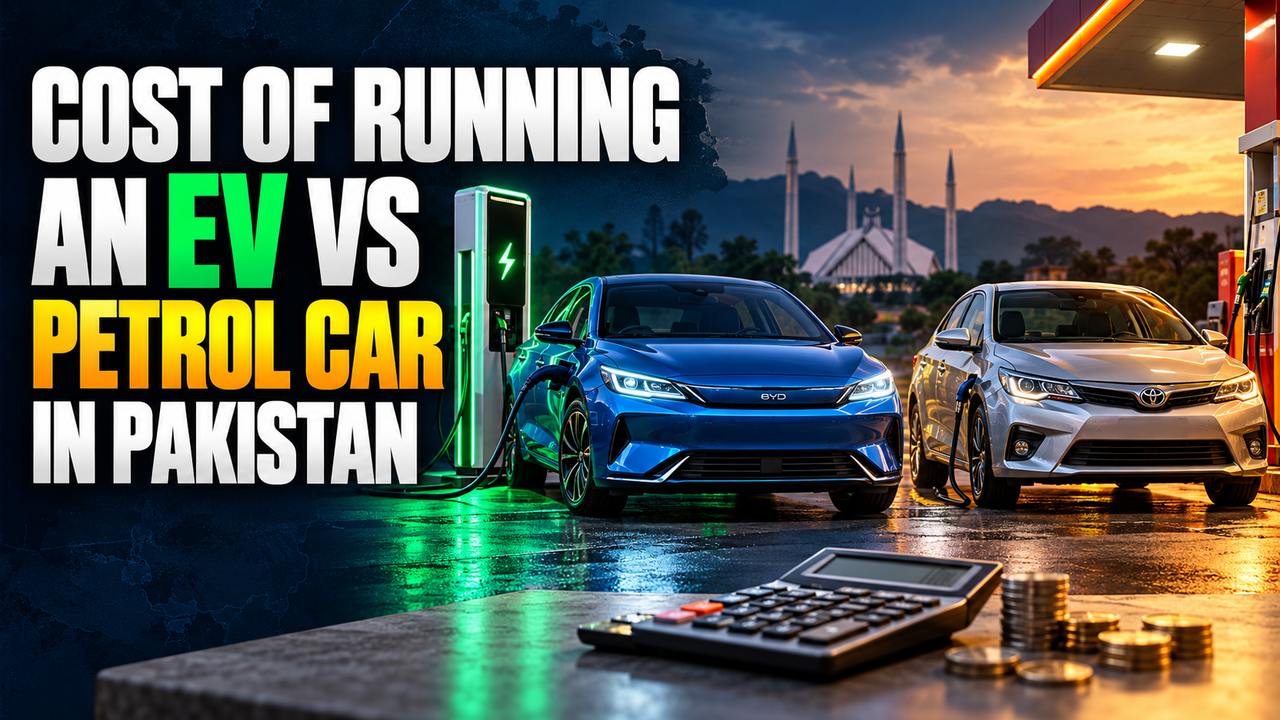
The EV vs petrol Pakistan debate usually starts with one question: how much will I really save? With petrol at Rs 377.71 per litre from 23 October 2026, the answer matters more than ever. In fact, the gap depends heavily on where you charge. This guide works out the cost per 100 km, then adds maintenance, insurance and resale.
This is general information, not financial advice. Fuel prices, electricity tariffs and car prices also change often. So treat these figures as worked examples, not exact quotes.
EV vs Petrol in Pakistan: The Short Answer
Above all, home charging makes a huge difference. In that case, the electric car running cost is roughly a fifth to a third of a petrol car’s cost per km. However, if you rely on public fast chargers, the saving shrinks a lot. Meanwhile, the EV still costs more to buy.
So the real answer depends on three things. Firstly, how much you drive. Secondly, where you charge. Finally, how long you keep the car. Below, we work through each part with simple numbers that you can check yourself.
The Prices We Used
Every example below uses these figures. Since the electricity unit price and petrol rate both change, you can swap in your own numbers.
Petrol: Rs 377.71 per litre, effective 23 October 2026.
Home electricity, 201 to 300 unit slab: Rs 33.10 per unit before taxes.
Home electricity, above 700 units: About Rs 47 per unit before taxes.
Home electricity, all-in estimate: About Rs 60 per unit with taxes at high usage.
Public DC fast charging: About Rs 100 to Rs 150 per unit, depending on the operator.
The home slab rates come from the uniform residential tariff for 2026. Meanwhile, NEPRA sets a base rate of about Rs 23.57 per unit for charging stations. Operators then add their own margin on top.
Cost Per 100 km: EV vs Petrol in Pakistan
Now let us compare 100 km of driving. For the petrol side, we take a crossover that gives 12 km per litre in mixed driving. For the EV, we assume about 6 km per unit. In fact, ChargePK uses this as a typical figure.
So the petrol car needs about 8.3 litres for 100 km. By contrast, the EV needs about 16.7 units.
Option
Energy for 100 km
Cost for 100 km
Petrol car (12 km/l)
8.3 litres
About Rs 3,150
Small petrol car (16 km/l)
6.25 litres
About Rs 2,360
EV, home at Rs 33.10
16.7 units
About Rs 550
EV, home at Rs 47
16.7 units
About Rs 780
EV, home all-in at Rs 60
16.7 units
About Rs 1,000
EV, public DC at Rs 100
16.7 units
About Rs 1,670
EV, public DC at Rs 150
16.7 units
About Rs 2,500
Clearly, home charging wins by a wide margin. In fact, the petrol car cost per km here is about Rs 31. For a home-charged EV, though, it is roughly Rs 5.5 to Rs 10.
However, an EV that only uses fast chargers costs almost as much per km as a small petrol car. Therefore, the EV vs petrol Pakistan comparison really depends on access to home charging.
Monthly and Yearly Fuel Cost
Let us scale this up. Suppose you drive 1,500 km a month, or 18,000 km a year. Here is what the energy bill looks like.
Option
Monthly Cost (1,500 km)
Yearly Cost (18,000 km)
Petrol car (12 km/l)
About Rs 47,200
About Rs 5.67 lakh
EV, home at Rs 33.10
About Rs 8,300
About Rs 1 lakh
EV, home all-in at Rs 60
About Rs 15,000
About Rs 1.8 lakh
EV, mostly public DC at Rs 120
About Rs 30,000
About Rs 3.6 lakh
As a result, a home-charging EV owner saves roughly Rs 3.9 lakh to Rs 4.7 lakh a year here. However, heavy charging can push your home bill into a higher slab. For this reason, the all-in row is the safer estimate.
On the other hand, low-mileage drivers save much less. For instance, at 750 km a month, every number above roughly halves. In that case, the yearly saving falls to around Rs 2 lakh.
Purchase Price: The Other Side of EV vs Petrol in Pakistan
But running cost is only half the story. For example, the petrol Toyota Corolla Cross 1.8 starts at about Rs 72.4 lakh. Meanwhile, the electric BYD Atto 3 costs about Rs 89.9 lakh. So the EV costs roughly Rs 17.5 lakh more upfront.
Using the all-in home rate, the yearly fuel saving is about Rs 3.9 lakh. Therefore, the price gap takes roughly four and a half years to recover. Of course, it pays back faster if you drive more. However, if you finance the car, markup on the extra Rs 17.5 lakh also adds to the real gap.
Also, new petrol cars now carry a NEV levy of 1% to 3%, depending on engine size. Meanwhile, locally made EVs keep a low 1% sales tax. You can compare models in our electric cars price list.
Maintenance Cost: EV vs Petrol in Pakistan
Petrol cars need regular engine care. For instance, you change engine oil and filters every few thousand kilometres. Over time, spark plugs and other engine parts also need replacing. Our guide on how to change engine oil in Pakistan shows what that involves.
By contrast, an EV has no engine oil, spark plugs, timing belt or clutch plate. In addition, regenerative braking reduces brake pad wear. However, EVs still need tyres, brake fluid, cabin filters, suspension work and AC service.
Maintenance Item
Petrol Car
EV
Engine oil and filter
Regular
Not needed
Spark plugs, timing belt
Yes
Not needed
Brake pads
Normal wear
Usually slower wear
Tyres and suspension
Yes
Yes, may wear faster due to weight
Battery
Small 12V battery
12V battery plus main pack
Overall, the yearly EV maintenance cost is usually lower than a petrol car’s. Even so, a main battery replacement after the warranty can be very expensive. So the EV in Pakistan wins on servicing, while petrol wins on battery peace of mind.
Insurance Cost
Car insurance in Pakistan usually costs a percentage of the car’s value. Because an EV often costs more, its premium is usually higher too. In fact, insurance is one area where petrol cars in Pakistan often cost less than an EV.
To illustrate, suppose your insurer charges 2% a year. Then a Rs 90 lakh EV costs about Rs 1.8 lakh to insure. Meanwhile, a Rs 72 lakh petrol car costs about Rs 1.44 lakh. In other words, the EV may cost around Rs 36,000 more each year. So compare real quotes using our guide to car insurance in Pakistan.
Electric Bikes: EV vs Petrol in Pakistan for Two-Wheelers
For bike riders in Pakistan, an EV often beats petrol by an even wider margin. For example, suppose a 70cc petrol bike gives 50 km per litre. Then 100 km needs 2 litres, or about Rs 755.
Meanwhile, a small e-bike uses roughly 2 units for the same distance. At Rs 33.10 per unit, that is only about Rs 66. So for a rider covering 1,500 km a month, petrol costs about Rs 11,300, whereas electricity costs roughly Rs 1,000. Clearly, delivery riders and daily commuters gain the most. Moreover, the federal PAVE subsidy of Rs 80,000 brings e-bike prices closer to petrol bikes.
However, budget e-bikes with gel batteries need a new pack every couple of years. Therefore, add battery replacement to your sums before deciding.
Tips to Cut Your EV Running Cost
Your charging habits decide most of the saving. So follow these simple tips.
Charge at home whenever possible, because it is by far the cheapest option.
Use fast chargers only on long trips, since they cost several times more per unit.
Watch your monthly units, so that charging does not push you into a much higher slab.
Charge in off-peak hours when your home has time-of-use billing.
Keep tyres at the right pressure, because soft tyres waste range.
Use the AC sensibly and pre-cool the car while it is still plugged in.
Before you buy, plan a proper wall charger and wiring. Our guide to installing a home EV charger in Pakistan explains the costs and safety steps.
Resale Value and Battery Risk
Petrol cars from Toyota, Honda and Suzuki have a strong resale market. On the other hand, the used EV market here is still young. As a result, buyers worry about battery health and future prices.
Therefore, keep all service records and battery health reports. Likewise, when buying a used EV, ask the dealer for a battery health check before you pay. Also, choose a brand with a local warranty and service network. In fact, a long battery warranty can protect resale value later.
When Petrol Still Makes Sense
Still, petrol is not dead yet. Here are cases where it may still be the better choice.
You drive less than 500 km a month, so savings stay small.
You have no home or office charging.
You often travel to areas with no chargers, such as remote northern valleys.
You want the lowest possible purchase price.
In those cases, a fuel-efficient petrol or hybrid car may suit you better. For example, if a hybrid crossover gives 18 km per litre, 100 km needs about 5.6 litres. That costs roughly Rs 2,100, which sits between a petrol car and a home-charged EV. Moreover, a hybrid needs no charger at all. Also, read our tips on how to reduce fuel consumption in cars.
FAQs
Is an EV cheaper than petrol per km in Pakistan?
Yes, when you charge at home. For example, our figures give about Rs 550 to Rs 1,000 per 100 km at home. By contrast, a 12 km/l petrol car costs about Rs 3,150.
Does public fast charging still save money?
Only a little in many cases. The EV charging cost per unit at fast chargers is about Rs 100 to Rs 150. So 100 km can cost Rs 1,670 to Rs 2,500, which is close to a small petrol car.
How long does it take to recover the higher EV price?
In our example, about four to five years at 18,000 km a year. However, it can be faster if you drive more.
What is the full EV vs petrol Pakistan cost picture?
Fuel and maintenance favour the EV, while purchase price and insurance favour petrol. Meanwhile, resale is still uncertain for EVs. Overall, the EV wins for high-mileage drivers with home charging.
Will rising electricity tariffs wipe out the savings?
Not easily. Even at an all-in rate of Rs 60 per unit, home charging costs about a third of petrol per km here. Still, check your slab before you buy.
Final Word
The EV vs petrol Pakistan comparison clearly favours EVs for daily drivers who charge at home. However, the higher purchase price, insurance and uncertain resale mean the payback takes a few years. Before deciding, read our guide to the main EV benefits in Pakistan and plan your charging setup. For the latest official electricity tariffs, check the NEPRA website.