Every year, the new crescent moon appears in the night sky. At this specific time, over 1.8 billion Muslims globally prepare for a month-long journey. This journey involves spiritual renewal, intense devotion, and strong self-discipline. Specifically, this sacred period is Ramadan. It is the ninth month of the Islamic lunar calendar. Importantly, the daily practice of fasting sits at the very heart of this holy month. If you looking to understand the core of Islamic traditions you are simply exploring one of the world’s most widely observed religious practices. If so, you might ask yourself: what is Roza? Consequently, this exact question frequently trends as a best search on internet. People from many different backgrounds want to understand this immense dedication. They want to know exactly why Muslims avoid food and drink from dawn until sunset.
However, Roza is much more than simply staying hungry. Instead, it acts as a deep spiritual detox and a strong shield against worldly temptations. Furthermore, it provides a clear way to connect directly with the Divine. In this detailed guide, we will explore exactly what Roza is. Moreover, we will dive deep into its spiritual, social, and physical importance. Finally, we will uncover the life-changing power of this ancient practice.
What is Roza? Understanding the Fourth Pillar of Islam
In Islamic terminology, “Roza” is the Persian and Urdu word for fasting. Meanwhile, Arabic speakers know this practice as Sawm or Siyam. Literally, Sawm translates to “to abstain” or “to refrain.”
Furthermore, Roza serves as the fourth of the Five Pillars of Islam. The other pillars include the declaration of faith (Shahadah), daily prayers (Salah), almsgiving (Zakat), and the pilgrimage to Mecca (Hajj). Therefore, Roza stands as a strictly required duty for all healthy, adult Muslims during the entire month of Ramadan.
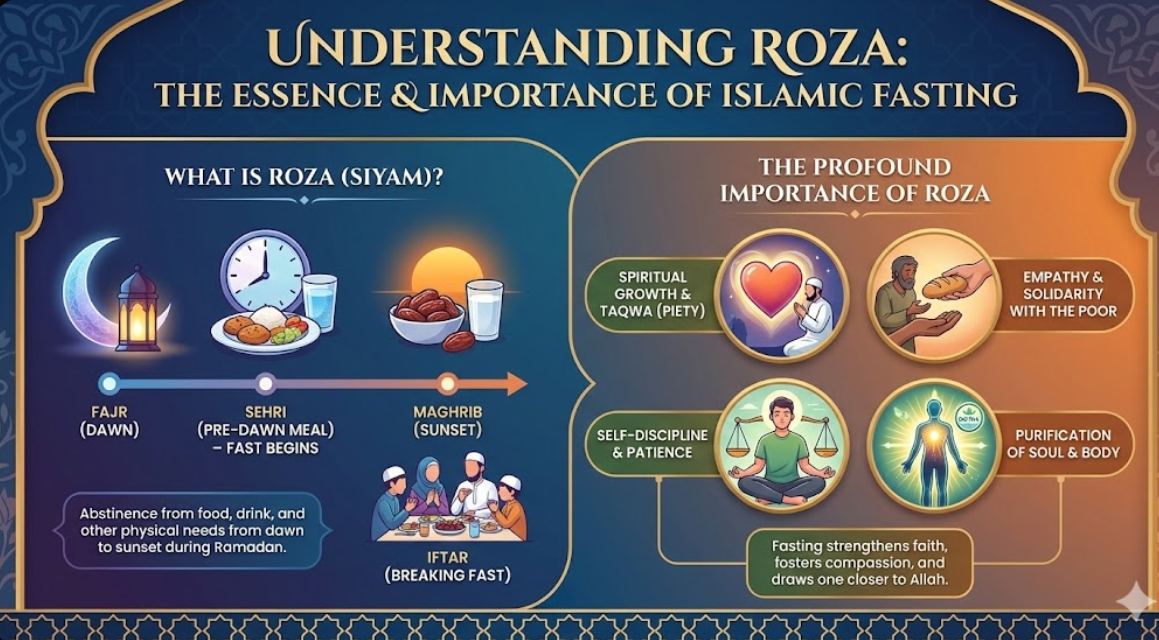
Specifically, the practice requires Muslims to completely avoid eating and drinking. This rule definitely includes drinking water. Additionally, individuals must stop smoking and avoid marital relations. This strict fast lasts from the first light of dawn (Fajr) until the sun completely sets (Maghrib).
Yet, physical fasting only forms the outermost layer of the practice. Truly, the core of Roza demands staying away from all sinful behaviors. For instance, a fasting person must constantly guard their tongue against lying, gossiping, and arguing. Also, they must protect their eyes from looking at unlawful things. Likewise, they must keep their heart entirely free from jealousy, anger, or greed. Prophet Muhammad (peace be upon him) famously warned his followers about this. He stated clearly that God does not need a person to leave their food and drink if they do not avoid false speech and bad behavior. Therefore, Roza fundamentally operates as a complete exercise in self-control.
The Spiritual Importance of Roza
The spiritual dimensions of fasting are incredibly vast. During this special time, believers actively turn down the noise of the physical world. As a result, they can clearly hear the voice of their soul. Here is exactly why Roza holds such huge spiritual importance:
1. Attaining Taqwa (God-Consciousness)
First, the Holy Quran explicitly states the primary purpose of fasting. Surah Al-Baqarah (2:183) says: “O you who have believed, decreed upon you is fasting as it was decreed upon those before you that you may become righteous.” This specific righteousness, known as Taqwa, means achieving a higher state of God-consciousness. For example, imagine you are very thirsty and entirely alone in a room with a glass of water. In this situation, only your absolute certainty that God is watching stops you from drinking. Thus, Roza trains the human heart to carry this deep awareness into every single aspect of daily life.
2. A Private Worship Rewarded by Allah
Generally, people can easily see most acts of worship. These visible acts include praying in a group or giving charity publicly. Fasting, on the other hand, remains an entirely private secret between the believer and the Creator. Someone could easily eat in secret and still claim they are fasting. Because it relies entirely on internal honesty, Allah highlights its truly special nature. In a famous Hadith Qudsi, God declares: “Every deed of the son of Adam is for him, except for fasting. It is for Me, and I will reward it.”
3. Seeking Forgiveness and Spiritual Renewal
Naturally, human beings make mistakes constantly. They also gather negative spiritual baggage throughout the year. Fortunately, Roza acts as a powerful eraser for these worldly mistakes. Prophet Muhammad (peace be upon him) explained this beautifully. He stated that whoever fasts during Ramadan with sincere faith will receive complete forgiveness for all previous sins. Consequently, Ramadan offers a perfect annual chance to wipe the slate clean and start fresh.
The Social and Moral Importance of Roza
Islam operates as a deeply communal religion. Therefore, the practice of Roza aims to reshape both the individual and the entire society.
1. Cultivating Empathy for the Less Fortunate
Reading about poverty is one thing. However, feeling the actual pain of hunger in your own stomach is a completely different experience. In this way, Roza serves as a great societal equalizer. For a few hours every day, both wealthy and poor people share the exact same physical feeling of hunger and thirst. Ultimately, this shared vulnerability softens the human heart. It rapidly breaks down walls of pride and builds deep, genuine empathy for those who lack regular access to food and clean water.
2. The Spirit of Unmatched Generosity
Because Roza opens our eyes to the daily struggles of others, Ramadan quickly becomes a month of immense charity. Islamic scholars highly encourage believers to increase their daily giving (Sadaqah). Moreover, many Muslims choose this specific month to officially pay their required annual charity (Zakat). Throughout the Muslim world, you will constantly see communities organizing free public meals. They invite anyone to join them at sunset. Consequently, they ensure that no one in the neighborhood goes to sleep hungry.
3. Strengthening Community and Family Bonds
While the daily act of fasting is mostly solitary, breaking the fast is a very joyous group event. Every evening, families, friends, and neighbors gather closely around the Dastarkhwan (dining spread) to share a meal. Later in the evening, communities stand shoulder to shoulder in the local mosques. They gather to perform special extended prayers known as Taraweeh. As a result, this shared practice builds a very powerful sense of unity and brotherhood.
The Physical and Health Benefits of Fasting
Muslims observe Roza purely out of strict religious obedience. Interestingly, modern medical science has also found a treasure trove of physical benefits linked directly to intermittent fasting.
1. Detoxification and Digestive Rest
Our human digestive system works tirelessly every single day. Therefore, fasting for 13 to 15 hours gives the stomach, liver, and intestines a much-needed daily break. During this resting period, the body naturally shifts its main focus. Instead of digesting food, it actively works on detoxifying the system. Furthermore, it repairs damaged cells and removes harmful toxins that have built up over the year.
2. Improving Insulin Sensitivity and Brain Function
Additionally, fasting naturally helps lower blood sugar levels. It also greatly improves insulin resistance. Consequently, this change can highly benefit your overall metabolic health. Furthermore, staying away from food triggers the sudden release of helpful proteins in the brain. These specific proteins promote the rapid growth of new neurons. They also protect the brain against severe oxidative stress. Ultimately, this biological process leads to better focus and mental clarity during the long fasting hours.
3. The Science Behind Breaking the Fast with Dates
Prophetic tradition (Sunnah) highly recommends breaking the fast with ripe dates and water. Scientifically, this specific practice is incredibly wise. After a long day of fasting, the body’s blood sugar levels drop significantly. Fortunately, dates contain easily digestible natural sugars, fiber, potassium, and magnesium. Thus, they provide an instant, healthy energy boost. They restore the body quickly without shocking the resting digestive system. In short, they gently prepare the stomach for the heavier main evening meal.
Key Rules and Conditions: The Daily Routine of Roza
To fully understand what is Roza, you must look closely at how a fasting day works. You also need to know the basic rules that strictly govern it.
1. The Pre-Dawn Meal (Suhoor)
The fasting day always begins in the quiet, dark hours before dawn. During this early time, Muslims eat a special meal called Suhoor (or Sehri). Waking up for this meal is highly encouraged by religious leaders. Importantly, it provides the vital physical energy needed for the long day ahead. Before the call to the Fajr prayer starts, a Muslim must make a firm intention (Niyyah) to fast. They do this solely for the sake of Allah. Furthermore, it is very helpful to memorize and recite a specific roza rakhne ki dua. This prayer formally dedicates the day’s fast to the Creator.
2. The Breaking of the Fast (Iftar)
Eventually, the sun completely sets, and the Maghrib prayer call echoes loudly. At this exact moment, the fast concludes with a joyful meal known as Iftar. Unquestionably, this is a time of huge spiritual joy and deep gratitude. Before taking the very first bite—usually a sweet date and a sip of water—believers actively recite the roza kholne ki dua. Through this short prayer, they thank God for the food and the physical strength to finish the fast.
3. Who is Exempt from Fasting?
Islam truly acts as a religion of balance and ease. Therefore, fasting is only required for healthy, adult Muslims. The Quran explicitly excuses anyone who would suffer severe hardship or medical harm from fasting. Specifically, this exempt group includes:
- Sick individuals (dealing with either temporary or chronic illnesses).
- Elderly people who feel physically too weak.
- Travelers currently traveling on a long journey.
- Women who are pregnant, nursing a baby, or menstruating.
Generally, people with temporary excuses simply make up their missed fasts later in the year. Conversely, those with permanent inabilities (like a chronic illness) must feed a needy person for every single missed day. The community calls this charitable act Fidyah.
How to Prepare for Roza: Best Practices
To get the absolute most out of this blessed month, preparation is definitely key. Here are some highly practical tips to help you succeed during Ramadan.
1. Hydrate Properly at Night
Dehydration causes the most severe fatigue during a fast. Therefore, you should drink plenty of water between Iftar and Suhoor. Specifically, try to aim for at least eight large glasses. Also, actively avoid sugary drinks and excess caffeine like tea or coffee. These liquids will only make you feel much thirstier the next day.
2. Eat a Balanced Suhoor
You should never skip the pre-dawn meal. Instead, focus entirely on eating complex carbohydrates and lean proteins. For example, foods like oats, eggs, and whole-grain breads digest very slowly in the stomach. Consequently, they provide a much steadier stream of energy throughout the long fasting hours.
3. Set Clear Spiritual Goals
Ramadan usually goes by very quickly. Thus, it is highly important to set clear, achievable daily goals. You might decide to read just a few pages of the Quran every single day. Alternatively, you could commit to giving a small amount of money to charity daily. Whatever you ultimately choose, consistency is the true key to success.
Why people ask What is Roza?
Every year, the month of Ramadan approaches rapidly. During this specific time, queries like “what is roza” consistently become a top search on Google. This huge increase in global search volume highlights a truly beautiful curiosity. Today, we live in a highly connected modern world. Consequently, people increasingly want to learn about the unique cultures, beliefs, and practices of their neighbors, coworkers, and friends.
Often, non-Muslims notice their colleagues waking up well before dawn. They see them politely declining a midday coffee break or lunch invitation. Yet, these fasting coworkers manage to maintain a positive and peaceful attitude throughout the entire workday. Naturally, this behavior sparks a lot of genuine curiosity. Therefore, searching for the true meaning of Roza becomes a wonderful step toward global empathy. It quickly builds cross-cultural understanding in our society. Overall, it shows a shared human desire to appreciate the intense discipline that defines the lives of nearly a quarter of the world’s population for one entire month every year.
Maximizing the Blessings of the Holy Month
Ramadan is definitely not a passive month of just sitting around waiting for sunset. Instead, it serves as a highly active time of spiritual growth. To truly gain the vast benefits of Roza, believers pair their daily fasting with intense evening worship.
1. Engaging with the Quran
Many scholars proudly call Ramadan the “Month of the Quran.” This title exists because the very first verses of the Holy Book were revealed to Prophet Muhammad (peace be upon him) during this exact month in the Cave of Hira. Fasting and the Quran connect deeply with one another. Therefore, Muslims eagerly dedicate extra hours every day to reading, reciting, and thoroughly understanding the divine text. They constantly seek to align their personal moral compass with its clear, timeless teachings.
2. Seeking Laylat al-Qadr (The Night of Power)
The final ten days of Ramadan hold the absolute most sacred value. Hidden carefully within the odd-numbered nights of this final stretch is Laylat al-Qadr, also widely known as the Night of Decree. The Quran clearly states that sincere worship on this single night is better than a thousand months of regular worship. Consequently, believers spend these specific nights in deep prayer, supplication, and quiet reflection. To ensure they do not accidentally waste these precious nighttime hours, many people follow a highly structured worship plan for the last 10 nights of Ramadan. This strategic guide clearly helps them maximize their spiritual focus and connection with Allah.
Conclusion
So, finally, what is Roza? Clearly, it is much more than a simple physical ritual of skipping a few meals. Actually, it operates as a complete, full-body spiritual training program. God designed it specifically to purify the soul, thoroughly discipline the ego, and noticeably soften the heart. Through the practice of Roza, a believer actively learns the difficult art of patience. They discover the true, hidden value of daily gratitude and experience the real power of human empathy.
By voluntarily giving up the basic necessities of life for just a few hours, Muslims learn a highly vital lesson. They are constantly reminded that absolutely everything they own is just a temporary gift from the Almighty. Ultimately, the true importance of Roza lies directly in its unique ability to transform a person from the inside out. It leaves them spiritually refreshed, morally upright, and deeply connected to their Creator. Wonderfully, this peaceful feeling lasts long after the new crescent moon of Eid happily signals the end of the holy month.
Frequently Asked Questions (FAQs)
1. What is the meaning of the word Roza?
Roza is a common Persian and Urdu term. South Asian Muslims frequently use it to describe the act of fasting. The original Arabic word used in the text of the Quran is Sawm. Literally, this word translates to “abstaining” or “refraining.”
2. Why do Muslims fast during Ramadan?
Muslims fast because Allah directly commands it in the Holy Quran. Also, it firmly stands as one of the Five Pillars of Islam. The main purpose is to successfully develop Taqwa (God-consciousness). Furthermore, it heavily helps people practice self-discipline, seek divine forgiveness, and physically build empathy for the poor.
3. What breaks a Roza (fast)?
Intentionally eating, drinking, smoking, or engaging in marital relations between dawn and sunset will immediately break a fast. However, if a person eats or drinks completely out of honest forgetfulness, their fast remains perfectly valid.
4. Can you drink water while observing Roza?
No, you absolutely cannot. The daily fast strictly requires total avoidance of all food and drink. This rule definitely includes drinking water. The restriction applies from the exact break of dawn until the sun completely sets.
5. Are children required to fast?
No, fasting is definitely not required for young children. It only becomes strictly obligatory for Muslims who have fully reached the age of puberty. They must also be mentally and physically capable of handling the fast. However, many children often practice by fasting for half a day. They happily do this to share in the joy and festive spirit of the holy month.