Islam
Third Ashra Dua in Ramadan: Seeking Refuge and Peace

Ramadan always seems to fly by in the blink of an eye. One moment we are sighting the new moon, and suddenly, we find ourselves entering the final, most critical phase of this blessed month. If you have been fasting, praying, and striving to be better, you already know how spiritually uplifting this journey feels. Consequently, as we step into the last ten days, the focus shifts. We move from seeking mercy and forgiveness toward the ultimate goal: seeking refuge from the Hellfire (Nijat). In this comprehensive guide, we will explore the powerful Third Ashra Dua, dive into its profound meanings, and look at exactly how you can maximize your rewards during these final nights.
Understanding the Three Stages of Ramadan
Before we focus on the final ten days, let us quickly recap the journey of Ramadan. The Prophet Muhammad (peace be upon him) beautifully divided this holy month into three distinct parts, known as “Ashras.”
Initially, we start the month by focusing intensely on Allah’s boundless mercy. You can read more about the prayers for this specific time in our guide to the Ramadan first ashra dua.
Following that, the middle ten days bring our attention to seeking deep, sincere pardon for our sins. If you want to refresh your memory on the prayers we recite during that phase, check out our post on the Ramadan second ashra dua.
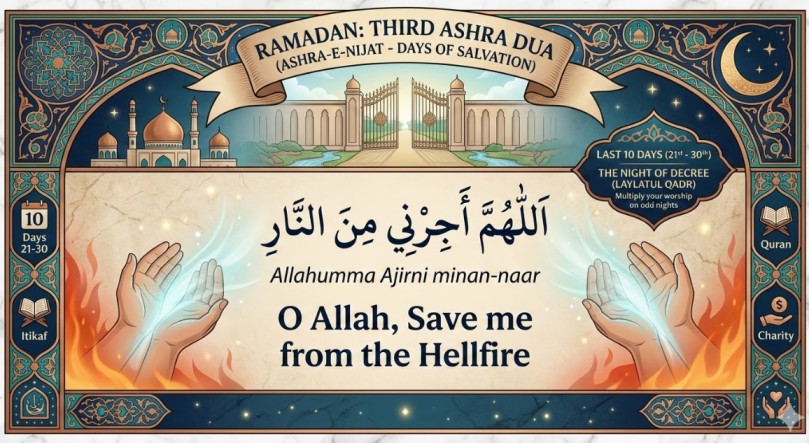
Finally, we arrive at the third Ashra. This stage begins on the 21st of Ramadan and lasts until the moon for Eid-ul-Fitr is sighted. The theme of these final days is Nijat, which translates to salvation or safety from the Hellfire. Therefore, our prayers become more intense, our late nights become longer, and our hearts become more focused.
The Powerful Third Ashra Dua
Muslims around the world recite a very short, yet incredibly powerful, supplication during these last ten days. Because it is short, you can easily memorize it and recite it throughout the day—while cooking, driving, walking, or resting.
Arabic Text:
اَللَّهُمَّ أَجِرْنِي مِنَ النَّارِ
Transliteration:
Allahumma Ajirni Minan Naar
English Translation:
“O Allah, protect me from the Hellfire.”
Furthermore, many scholars recommend reciting this dua frequently after your obligatory prayers, especially after Fajr and Maghrib. The beauty of this prayer lies in its absolute simplicity. You are directly asking the Creator of the universe to grant you safety from the ultimate punishment.
Deep Dive: Why Seek Refuge from the Hellfire?
You might wonder why the entire final stretch of Ramadan focuses on this one specific concept. To understand this, we must look at what the Quran says about the afterlife. Islam teaches us that this worldly life is a temporary testing ground. Ultimately, our actions here determine our eternal destination.
Allah clearly states in the Holy Quran:
“Every soul will taste death, and you will only be given your [full] compensation on the Day of Resurrection. So he who is drawn away from the Fire and admitted to Paradise has attained [his desire]. And what is the life of this world except the enjoyment of delusion.” (Surah Al-Imran, 3:185)
This verse serves as a massive wake-up call. It reminds us that true success is not about the wealth we accumulate or the status we achieve. Instead, true success is simply staying away from the Hellfire and entering Paradise. Therefore, dedicating the last ten days of Ramadan to asking for this specific protection is the smartest spiritual move a believer can make.
In addition to this, the Quran teaches us another beautiful dua that perfectly complements the third Ashra prayer:
“Our Lord, give us in this world [that which is] good and in the Hereafter [that which is] good and protect us from the punishment of the Fire.” (Surah Al-Baqarah, 2:201)
By combining these prayers, you actively ask Allah for a beautiful life right now, as well as ultimate safety in the next life.
The Prophet’s Routine in the Last 10 Days
To truly grasp the importance of the third Ashra, we must look at how Prophet Muhammad (SAW) behaved during this time. Did he relax because the month was almost over? On the contrary, he increased his efforts significantly.
Aisha (May Allah be pleased with her), the beloved wife of the Prophet, reported:
“With the start of the last ten days of Ramadan, the Messenger of Allah (peace be upon him) would tighten his waist belt (meaning he worked hard), spend the night in prayer, and awaken his family.” (Sahih Al-Bukhari)
This authentic Hadith shows us exactly what our attitude should be. Even if you feel physically tired after twenty days of fasting, the third Ashra is the time to sprint toward the finish line. It is the time to wake up your family members, encourage your friends, and push through the fatigue.
Laylatul Qadr: The Night of Power
We cannot talk about the third Ashra without discussing the crown jewel of Ramadan: Laylatul Qadr, or the Night of Decree. This is the main reason why the last ten days hold such immense power.
Allah dedicated an entire Surah in the Quran to this magnificent night:
“Indeed, We sent the Qur’an down during the Night of Decree. And what can make you know what is the Night of Decree? The Night of Decree is better than a thousand months. The angels and the Spirit descend therein by permission of their Lord for every matter. Peace it is until the emergence of dawn.” (Surah Al-Qadr, 97:1-5)
Imagine this: worshiping Allah on this single night brings you more reward than worshiping Him continuously for over 83 years! Because Allah concealed the exact date of Laylatul Qadr, He encourages us to seek it actively in the odd nights of the last ten days (the 21st, 23rd, 25th, 27th, and 29th nights).
The Specific Dua for Laylatul Qadr
While you should repeatedly recite Allahumma Ajirni Minan Naar throughout the third Ashra, there is a very special dua you must recite when searching for Laylatul Qadr.
Aisha (RA) once asked the Prophet (SAW): “O Messenger of Allah, if I know which night is Laylatul Qadr, what should I say during it?” The Prophet (SAW) replied, “Say: “
اَللَّهُمَّ إِنَّكَ عَفْوٌ تُحِبُّ الْعَفْوَ فَاعْفُ عَنِّي
(Allahumma innaka ‘afuwwun tuhibbul ‘afwa fa’fu ‘anni)
“O Allah, You are forgiving and You love forgiveness, so forgive me.” (Sunan Ibn Majah – Sahih)
Notice how this dua beautifully ties back into the theme of the third Ashra. By asking Allah for His complete forgiveness (Afuw), you naturally secure your safety from the Hellfire.
Actionable Tips: How to Maximize the Third Ashra
Knowing the dua is only the first step. To truly transform your spiritual life during these final days, you need a solid strategy. We highly recommend mapping out your schedule so you do not waste a single hour. For a complete, step-by-step guide on structuring your nights, you must read our comprehensive worship plan for the last 10 nights of Ramadan.
Meanwhile, here are some practical, actionable tips you can start applying right now:
1. Perform I’tikaf (Spiritual Retreat)
If you have the time and capability, performing I’tikaf is an incredibly rewarding Sunnah. I’tikaf involves staying in the mosque (or a designated quiet place at home for women, according to some scholars) for the final ten days. During this time, you disconnect completely from worldly distractions, social media, and useless chatter. Instead, you focus 100% on reciting the Quran, making dua, and performing prayers. It acts as a deep spiritual detox.
2. Give Charity Every Night
Because rewards multiply massively during the third Ashra, many Muslims use a clever strategy: they give a small amount of charity every single night. If your donation happens to fall on Laylatul Qadr, it is as if you gave charity every day for 83 years! You can automate this through various Islamic charity websites to ensure you never miss a night.
3. Increase Your Quran Recitation
If you have fallen behind on your goal to finish reading the Quran this month, do not panic. The third Ashra provides the perfect opportunity to catch up. Dedicate specific blocks of time—like the hour before Iftar or the peaceful time right after Suhoor—to read. Even reading a few pages with translation and deeply understanding the meaning is better than rushing through it without thought.
4. Avoid the “Eid Prep” Trap
This is a very common mistake. As Eid approaches, many people spend the precious odd nights roaming through shopping malls, buying clothes, or preparing grand feasts. While celebrating Eid is important, you should ideally finish your shopping before Ramadan begins or during the daytime in the early Ashras. Do not sacrifice the most blessed nights of the year for temporary worldly items.
5. Make a Comprehensive Dua List
When you raise your hands in the dead of night, your mind might suddenly go blank. To prevent this, write down a detailed dua list beforehand. Include your personal struggles, your career goals, your health, your family, and the struggles of the global Muslim Ummah. Most importantly, keep repeating the third Ashra dua: Allahumma Ajirni Minan Naar.
The Power of True Sincerity
Ultimately, reciting the third Ashra dua is not just about moving your lips. It requires true sincerity. When you say, “O Allah, protect me from the Hellfire,” you must mean it from the very bottom of your heart.
Moreover, true sincerity means your actions must align with your words. You cannot ask Allah for protection from the fire while simultaneously committing actions that lead you toward it. Therefore, use these last ten days to make firm resolutions. Promise Allah that you will leave behind your bad habits. Promise Him that you will strive to maintain your daily prayers even after Ramadan ends.
Ramadan is a gift that offers us a clean slate. The first Ashra washed us with mercy, the second Ashra cleansed us through forgiveness, and now, the third Ashra offers us the ultimate prize: guaranteed safety and salvation.
Conclusion: Finishing Strong
As we bid farewell to this beautiful month, let us not feel sad that it is ending, but rather, let us feel motivated to finish strong. The final ten days are a golden opportunity that we may not live to see next year.
Make the third Ashra dua your constant companion. Recite Allahumma Ajirni Minan Naar with conviction. Seek out Laylatul Qadr with a pure heart, give generously to those in need, and remember to include your brothers and sisters across the globe in your prayers.
May Allah accept our fasting, our standing in the night, our charity, and our supplications. May He grant us all Nijat from the Hellfire, and may He reunite us all in the highest levels of Jannat-ul-Firdous. Ameen!